
Bakuchiol 0.5%,
does it really help with Improvement of facial photoaging wrinkles and hyperpigmentation with topical 0.5% use?
research showsTopical 0.5% bakuchiol is rated C because it may modestly improve facial photoaging wrinkles and hyperpigmentation. In a 44-participant randomized double-blind trial published in 2019, both bakuchiol and retinol reduced wrinkle surface area and pigmentation from baseline over 12 weeks, but there was no vehicle group or prespecified noninferiority margin, so retinol equivalence was not established. In June 2026, just before the verification date, a 73-participant vehicle-controlled trial reported better wrinkles and hyperpigmentation at 84 days, strengthening the efficacy signal. The newer trial was nevertheless a single-center study funded by the manufacturer of the branded Sytenol A ingredient, with authors directly affiliated with Sytheon. A 2024 systematic review found that 12 of the 15 human trials available at that time were unblinded and uncontrolled and 10 tested combination products. Positive human evidence is accepted, but product and manufacturer concentration plus small cosmetic outcomes invoke the rule ②-b ceiling of C, with 52 points.
ads claimMarketing can expand this into natural retinol, wrinkle removal equal to retinol, or an irritation-free and pregnancy-safe alternative. The evidence concerns specific 0.5% branded formulations tested for about 12 weeks and does not establish equivalent performance of any product sharing the ingredient name or safety during pregnancy.
Useful facts when choosing a product
- Bakuchiol is used in ordinary cosmetics rather than as a prescription retinoid, so concentration, purity, stabilization, packaging, vehicle, and co-ingredients vary substantially; results from a tested 0.5% formulation cannot be generalized to every product labeled bakuchiol.
- The principal trials used 0.5% twice daily for about 12 weeks, but this is a schedule for the tested formulations and does not show that higher concentrations or different blends are more effective or safer.
- Mild stinging, dryness, erythema, or itching can occur, and allergic contact dermatitis has rarely been reported. Persistent irritation, swelling, or blistering warrants discontinuation and assessment.
- Lower irritation than retinol in one small trial cannot be converted into evidence of safety during pregnancy or lactation. Use during pregnancy or lactation and combination with other lightening or exfoliating products deserves professional advice.
Chamgap Semantic Classification Code
Candidate index · review held
M.bakuchiol.UNK.facial-photoaging-wrinkles-and-hyperpigmentation-with-topical-0-5-percent-use.improve.activeMedicinal interventions > Bakuchiol > Unknown > facial photoaging wrinkles and hyperpigmentation with topical 0.5% use > Improvement claim > Active comparator
An automated migration candidate, not an issued permanent code; exact claim scope remains under review. This machine-generated migration candidate helps retrieval but is not a permanent assignment. The original verdict ID and URL remain authoritative.
What the research actually shows
Dhaliwal and colleagues in 2019 randomized 44 participants to bakuchiol 0.5% twice daily or retinol 0.5% once daily. At 12 weeks, both groups improved wrinkle surface area and hyperpigmentation from baseline, but there was no vehicle group, seven participants discontinued, and a nonsignificant difference does not establish formal noninferiority. Khan and colleagues in 2026 randomized 73 Chinese adults to 0.5% bakuchiol in a matched vehicle or vehicle alone and reported better wrinkles, hyperpigmentation, radiance, and pores at 84 days. This was a single-center study funded by Sytheon, which supplied the Sytenol A formulation. Fanning and colleagues in 2024 reviewed 15 human trials and found that 12 were unblinded and uncontrolled and 10 tested combination products. The new trial partially fills the vehicle-control gap but not the need for independent replication.
Why this is classified as C (52)
A 44-participant active-control trial in 2019 and a 73-participant vehicle-control trial in 2026 point in the same positive direction for wrinkles and hyperpigmentation with 0.5% bakuchiol, making C more appropriate than D. The first lacked vehicle control and a prespecified noninferiority margin, so it did not establish retinol equivalence. The newer study was a single-center 84-day trial with direct author and funding links to Sytheon and Sytenol A, while the remainder of the corpus reviewed in 2024 was dominated by uncontrolled combination studies. In fairness with the C-rated glycolic-acid photoaging evidence, but recognizing the new direct vehicle signal, the result is C with 52 points. Irritation, contact dermatitis, and missing pregnancy data remain separate safety issues.
Counterpoint. Sun protection remains the foundation of photoaging care. Bakuchiol is a cosmetic ingredient that may modestly improve appearance, not a treatment that removes wrinkles; absent change or persistent irritation after 12 weeks should prompt reassessment rather than heavier application.
Rejudgment record. Cross-check reflected — Applied the rule ②-b ceiling of C with 52 points because the 44-participant active-control trial lacked vehicle control and prespecified noninferiority and therefore did not establish retinol equivalence, while the 73-participant vehicle-control trial was a single-center short cosmetic study with direct author and funding links to Sytheon and Sytenol A
Sub-claim grades by effect
This ingredient is marketed for several effects. A single overall grade blends strong and weak claims together, so each effect is graded separately here. The overall grade reflects the strongest disconfirming or core claim.
| Effect (sub-claim) | Grade | Basis |
|---|---|---|
| Improvement of facial photoaging wrinkles with 0.5% bakuchiol | C | A 44-participant active-control trial and a 73-participant vehicle-control trial point in the same positive direction but are small, short, and limited to branded formulations. |
| Improvement of facial photoaging hyperpigmentation with 0.5% bakuchiol | C | Two randomized trials provide a pigmentation signal, but independent multicenter replication and durable long-term effects are absent. |
| Short-term overall improvement in the appearance of facial photoaging with 0.5% bakuchiol | C | Cosmetic grading and photographic analysis improved over about 12 weeks, but this does not establish equivalence to prescription retinoids or persistence after stopping. |
Cross-check — AI research and Codex final gate
Evidence Table
| Study | Design | Sample | Funding | Endpoint | Result | Weight |
|---|---|---|---|---|---|---|
| Dhaliwal S et al. 2019 | Twelve-week randomized double-blind active-control trial | 44 adults with facial photoaging; 21 bakuchiol and 23 retinol | Funded by the University of California, Davis Department of Dermatology; Sytheon supplied matched-vehicle formulations | Wrinkle surface area from high-resolution photography, dermatologist-rated pigmentation, and self-reported irritation | Both bakuchiol and retinol reduced wrinkle surface area and hyperpigmentation from baseline with no significant between-group difference, but there was no vehicle control or noninferiority margin. | Direct 0.5% human signal with design limitations |
| Khan ZEH et al. 2026 | Eighty-four-day single-center randomized double-blind vehicle-controlled trial | 73 Chinese adults; 37 bakuchiol and 36 vehicle | Funded by Sytheon, which supplied the Sytenol A formulation; company-affiliated coauthors | Clinical grading and facial photography for wrinkles, hyperpigmentation, radiance, and pores | Bakuchiol 0.5% significantly improved overall wrinkles and hyperpigmentation versus vehicle at 84 days. | New direct positive vehicle-controlled evidence concentrated in a branded ingredient |
| Fanning JE et al. 2024 | Systematic review of human trials of topical bakuchiol formulations | Fifteen human clinical trials | Authors reported no conflicts of interest | Facial outcomes for aging, acne, postinflammatory hyperpigmentation, and other conditions | Twelve trials were unblinded and uncontrolled, 10 used combination products, and heterogeneity and high risk of bias precluded meta-analysis. | Assessment of methodological limitations across the corpus |
Receipt — 4 References
All 4 cited sources were verified for existence at the original page (as of 2026-07-21).
Final verification and publication gate: Codex · Evidence date: 2026-07-21 · Corrections: none
Cite this verdict
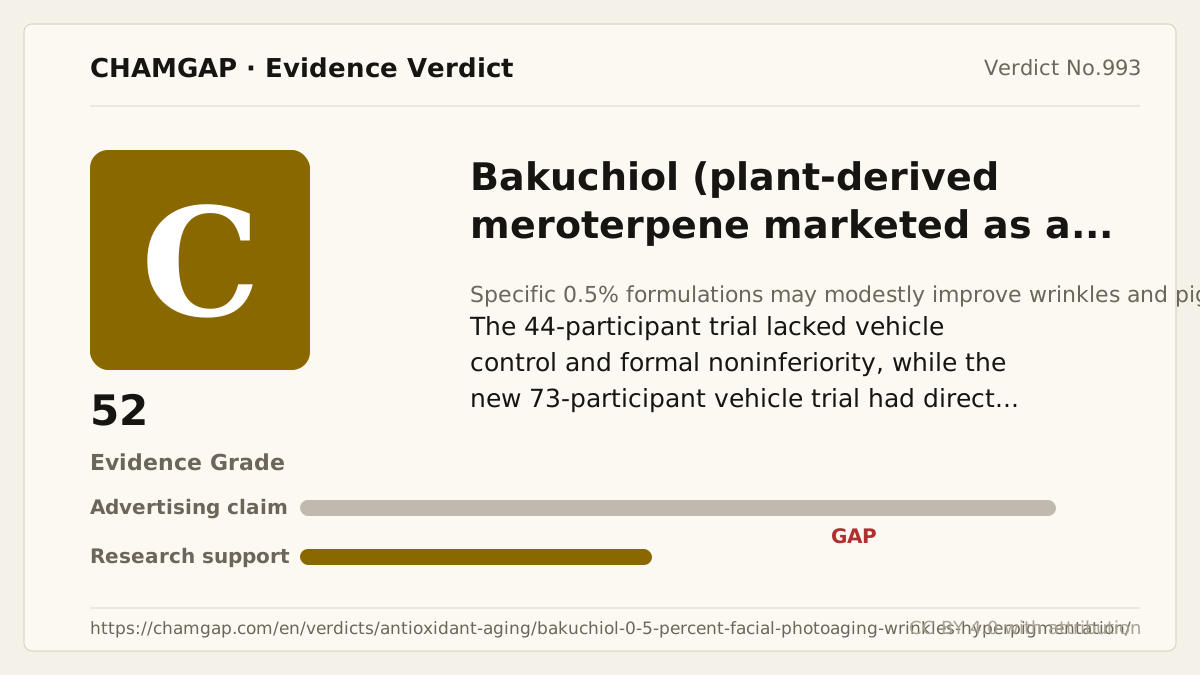
[Chamgap] Bakuchiol 0.5% x improvement of facial photoaging wrinkles and hyperpigmentation — Evidence Grade C·52. 4 cited sources checked. Source: https://chamgap.com/en/verdicts/antioxidant-aging/bakuchiol-0-5-percent-facial-photoaging-wrinkles-hyperpigmentation/ · CC BY 4.0CC BY 4.0 — free to use with attribution; do not distort grades, numbers, or verdict meaning.
What this document does and does not do
Chamgap is an information source. It reports what research has and has not confirmed; it does not tell readers what to take or buy. That decision belongs to readers and, when needed, medical or legal professionals. This verdict reflects literature available up to the search date and may change as new research appears. Nothing here is medical advice.