
Apigenin alone,
does it really help with Slower aging rate and extended healthspan and lifespan in healthy adults?
research showsNo human efficacy literature was identified showing that apigenin alone slows aging or extends healthspan or lifespan in healthy adults, so the rating is ?. Preclinical studies report longer lifespan in yeast, flies, and worms and propose mechanisms involving cellular senescence, CD38, NAD+, and mitohormesis. No trial was found that administered apigenin alone to humans and assessed a validated aging biomarker, disability-free survival, healthspan, or overall lifespan. Absorption and metabolism studies in healthy men are pharmacokinetic studies, not anti-aging efficacy trials. This matches the evidence-gap pattern of berberine for aging in verdict 910 and differs from the sleep axis for apigenin in verdicts 241 and 406.
ads claimMarketing turns senomorphic labeling, CD38 inhibition, NAD+ preservation, and animal lifespan into claims of lower biological age and human longevity. Pathway modulation and preclinical lifespan are not clinical evidence of extended human healthspan or lifespan.
Useful facts when choosing a product
- Apigenin occurs mainly as glycosides in parsley, celery, chamomile, and other foods, but food or tea exposure is not equivalent to a high-dose purified capsule.
- Human studies have examined absorption and metabolism of apigenin and its glycosides, with exposure varying by chemical form and food matrix.
- Long-term high-dose safety, reproductive and hepatic effects, and drug interactions of purified apigenin alone are not adequately characterized, so tolerance of ordinary foods cannot be extrapolated to high-dose products.
- People using anticoagulants, anticancer treatment, or narrow-therapeutic-index medicines, and those who are pregnant or breastfeeding, should avoid unsupervised high-dose use when evidence is sparse.
Chamgap Semantic Classification Code
Candidate index · review held
S.apigenin-alone.UNK.slower-aging-rate-and-extended-healthspan-and-lifespan.reduce.UNKSupplements and nutraceuticals > Apigenin alone > Unknown > Slower aging rate and extended healthspan and lifespan > Reduction claim > Unknown
An automated migration candidate, not an issued permanent code; exact claim scope remains under review. This machine-generated migration candidate helps retrieval but is not a permanent assignment. The original verdict ID and URL remain authoritative.
What the research actually shows
Sun and colleagues in 2025 reported that apigenin extended replicative and chronological lifespan in yeast and lifespan in male and female flies while modulating PTEN-AKT signaling. Cheng and colleagues in 2023 found that apigenin lengthened worm lifespan through transient mitochondrial inhibition and reactive-oxygen-species mitohormesis requiring AAK-2, DAF-16, and SKN-1. The 2024 narrative review by Kramer and Johnson summarized aging evidence largely from cells, worms, flies, and disease-model mice and noted the need for human studies using established aging biomarkers. The healthy-male study by Borges and colleagues in 2022 measured absorption and metabolites, not an aging efficacy outcome.
Why this is classified as ?
Apigenin has extended lifespan in yeast, flies, and worms, but no efficacy literature was found that administered apigenin alone to healthy humans and assessed aging rate, healthspan, disability-free survival, or overall lifespan. Human absorption and metabolism studies are not efficacy evidence. Because this is absence of claim-matched human evidence rather than null preclinical evidence, the grade is ? and the score is null; the long-term high-dose safety gap remains separate.
Counterpoint. An aging trial should prespecify validated biomarkers and include controls, masking, and long follow-up. A short-term change in a commercial biological-age test cannot establish extended healthspan or lifespan.
Rejudgment record. New verdict — Applied ? because lifespan extension has been reported in yeast, flies, and worms, but no human efficacy literature was found that administered apigenin alone to healthy adults and assessed aging rate, healthspan, disability-free survival, or overall lifespan, while human absorption and metabolism studies are not efficacy trials
Sub-claim grades by effect
This ingredient is marketed for several effects. A single overall grade blends strong and weak claims together, so each effect is graded separately here. The overall grade reflects the strongest disconfirming or core claim.
| Effect (sub-claim) | Grade | Basis |
|---|---|---|
| Slower biological aging in healthy adults | ? | No human efficacy literature was found administering apigenin alone and assessing aging rate or an established aging biomarker. |
| Extended healthspan in healthy adults | ? | No human efficacy literature for apigenin alone has followed disability-free survival or healthspan. |
| Extended overall lifespan in healthy adults | ? | Only yeast, fly, and worm lifespan data were found, with no efficacy trial assessing human mortality or overall lifespan. |
Cross-check — AI research and Codex final gate
Evidence Table
| Study | Design | Sample | Funding | Endpoint | Result | Weight |
|---|---|---|---|---|---|---|
| Kramer DJ and Johnson AA. 2024 | Narrative review of apigenin, sleep, and aging | Cell, animal, and limited human literature | Funding was not reported in the PubMed abstract; both authors were affiliated with Tally Health | Scope of lifespan, aging-mechanism, and sleep evidence | Aging evidence was predominantly preclinical, and human studies with established aging biomarkers were identified as needed. | Evidence-gap assessment for human efficacy |
| Cheng Y et al. 2023 | Preclinical C. elegans lifespan and mechanism experiment | Experimental worm cohorts | Non-United-States government research support from China | Worm lifespan and mitohormesis pathways | Apigenin extended worm lifespan through pathways requiring AAK-2, DAF-16, and SKN-1. | Direct preclinical lifespan signal |
| Sun Z et al. 2025 | Preclinical yeast and Drosophila lifespan experiments | Experimental yeast and male and female fly cohorts | Funding was not reported in the PubMed abstract | Yeast replicative and chronological lifespan and fly lifespan | Apigenin extended lifespan in yeast and both male and female flies while modulating PTEN-AKT signaling. | Direct preclinical lifespan signal |
| Borges G et al. 2022 | Absorption, distribution, metabolism, and excretion study in healthy men | Participant count was not stated in the PubMed abstract | One author was affiliated with Mars Inc.; see the article's funding and conflict disclosures | Plasma and urinary apigenin metabolites | Human absorption and metabolism were characterized, but aging rate, healthspan, and lifespan efficacy were not assessed. | Human exposure evidence, not efficacy evidence |
Receipt — 4 References
All 4 cited sources were verified for existence at the original page (as of 2026-07-21).
Final verification and publication gate: Codex · Evidence date: 2026-07-21 · Corrections: none
Cite this verdict
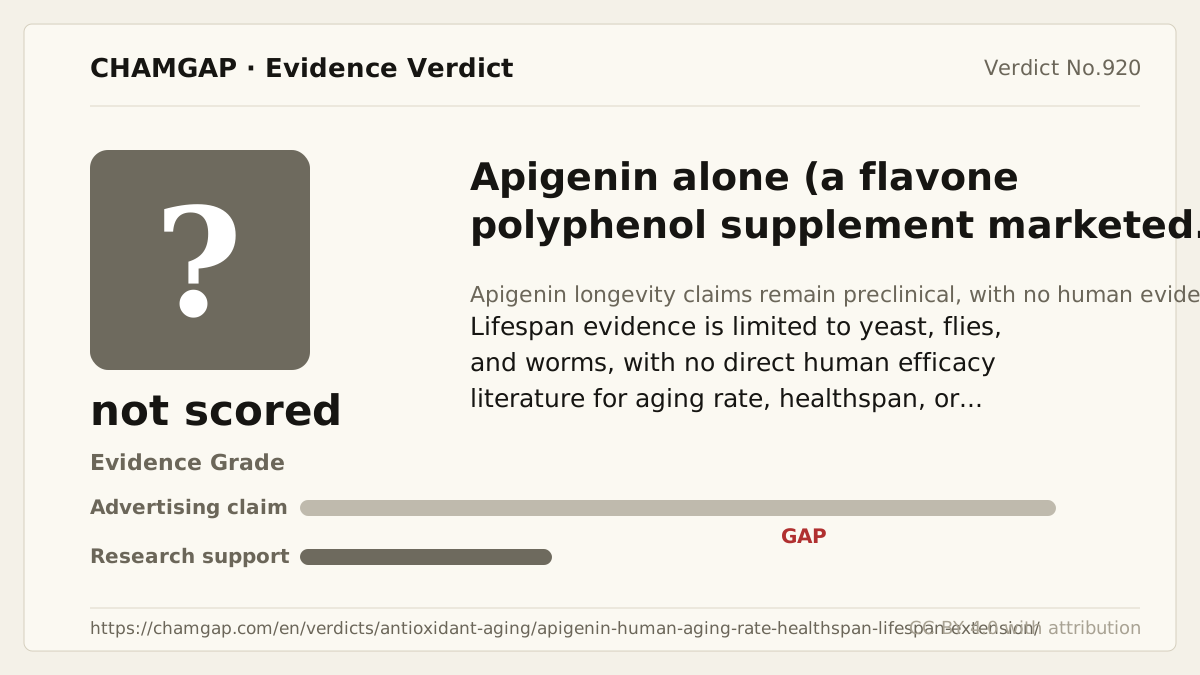
[Chamgap] Apigenin alone x slower human aging and extended healthspan and lifespan — Evidence Grade ?. 4 cited sources checked. Source: https://chamgap.com/en/verdicts/antioxidant-aging/apigenin-human-aging-rate-healthspan-lifespan-extension/ · CC BY 4.0CC BY 4.0 — free to use with attribution; do not distort grades, numbers, or verdict meaning.
What this document does and does not do
Chamgap is an information source. It reports what research has and has not confirmed; it does not tell readers what to take or buy. That decision belongs to readers and, when needed, medical or legal professionals. This verdict reflects literature available up to the search date and may change as new research appears. Nothing here is medical advice.