
Adapalene 0.3%,
does it really help with Topical improvement of periorbital and forehead wrinkles, pigmentation, and texture in photoaged skin?
research showsAdapalene 0.3% is rated C because positive human evidence supports improvement of periorbital and forehead wrinkles, pigmentation, and overall texture in photoaged skin. In a 128-participant, 24-week randomized comparison, adapalene was noninferior to tretinoin 0.05%, and global photoaging scores improved by 20.4% versus 20.8%. Improvement was reported in 59.6% for periorbital wrinkles, 64.9% for pigmentation, and 50.8% for forehead wrinkles, but this was an active-comparator noninferiority trial without a vehicle group and was sponsored by Galderma. A positive 40-person single-arm study had the same sponsor. The small evidence base, comparative design, and sponsor concentration therefore yield C with 50 points. Irritation, erythema, dryness, and avoidance during pregnancy are recorded separately under safety.
ads claimPromotion may extend this prescription-retinoid comparison into claims that every adapalene concentration reliably erases wrinkles, spots, and pores or is fully interchangeable with tretinoin. The evidence concerns 0.3% gel used for 24 weeks in mild-to-moderate photoaging, and approval for acne is not proof of efficacy for photoaging.
Useful facts when choosing a product
- Adapalene is a third-generation synthetic topical retinoid that acts at retinoic acid receptors. The 0.3% single-agent gel is distributed as a prescription acne product, and local labeling and prescribing guidance should be checked for photoaging use.
- Photoaging studies applied a thin layer to the whole face once each evening and used moisturizer and sunscreen. It should not be applied to eyelids, lips, mucosa, wounds, or eczematous skin.
- Stinging, burning, erythema, scaling, and dryness are common during the first weeks and may require reduced frequency or a temporary pause. Other irritating exfoliants or retinoids can intensify these reactions.
- Concentrations of 0.1% and 0.3%, gel and cream vehicles, and adapalene alone versus adapalene-benzoyl peroxide combinations are not interchangeable products. Evidence from a different concentration or formulation should not be relabeled as evidence for 0.3% single-agent gel in photoaging.
Chamgap Semantic Classification Code
Candidate index · review held
M.adapalene-0-3-percent.topical-skin.topical-improvement-of-periorbital-and-forehead-wrinkles-pigmentation-and-texture-in-photoaged-skin.improve.MULTIMedicinal interventions > Adapalene 0.3% > Topical skin > Topical improvement of periorbital and forehead wrinkles, pigmentation, and texture in photoaged skin > Improvement claim > Multiple: primary unresolved
An automated migration candidate, not an issued permanent code; exact claim scope remains under review. This machine-generated migration candidate helps retrieval but is not a permanent assignment. The original verdict ID and URL remain authoritative.
What the research actually shows
Bagatin and colleagues randomized 128 adults aged 35 to 55 years with mild-to-moderate photoaging at four Brazilian sites to adapalene 0.3% gel or tretinoin 0.05% cream once nightly for 24 weeks. Global photoaging improved by 20.4% versus 20.8%, establishing noninferiority. At week 24, improvement was reported in 59.6% versus 66.6% for periorbital wrinkles, 64.9% versus 71.9% for ephelides or melanosis, and 50.8% in both groups for forehead wrinkles. Morphometric and histologic measures involving the stratum corneum, melanin, and type I collagen improved from baseline without a between-group difference. The open 40-woman Herane study reported mean severity reductions of 40% for forehead, 52% for periorbital, and 29% for perioral wrinkles after 24 weeks, but it lacked a control group. A 2022 systematic review identified seven randomized trials involving topical tretinoin and included the active-comparator adapalene study; this does not constitute several independent confirmatory trials of adapalene 0.3% itself.
Why this is classified as C (50)
Adapalene 0.3% was noninferior to tretinoin 0.05% in a 128-participant, 24-week randomized active-comparator trial, with baseline improvement in periorbital and forehead wrinkles, pigmentation, and global photoaging. A 40-person single-arm study was directionally consistent, but the pivotal trial lacked a vehicle group, the supporting study was uncontrolled, and both were sponsored by Galderma. Credible positive human evidence exists, while large independent replication and a direct vehicle comparison do not, yielding C with 50 points. Irritation and pregnancy precautions remain independent safety issues.
Counterpoint. Daily broad-spectrum sunscreen, moisturization, and minimizing irritation remain the foundation of photoaging care. If adapalene 0.3% is considered, skin condition and pregnancy potential should be reviewed and application frequency adjusted with the prescriber.
Rejudgment record. New verdict — Accepted positive findings from the 128-participant, 24-week randomized active-comparator noninferiority trial and the 40-person open single-arm study of adapalene 0.3%, while applying the rule ②-b ceiling of C because of no vehicle control, few studies, and concentration of evidence in Galderma-sponsored research
Sub-claim grades by effect
This ingredient is marketed for several effects. A single overall grade blends strong and weak claims together, so each effect is graded separately here. The overall grade reflects the strongest disconfirming or core claim.
| Effect (sub-claim) | Grade | Basis |
|---|---|---|
| Improved periorbital and forehead wrinkles | C | The 24-week comparison and 40-person single-arm study were positive, but vehicle-controlled and independent replication is lacking. |
| Improved photoaging-related pigmentation | C | Ephelides or melanosis and melanin measures improved, but evidence is concentrated in a few manufacturer-sponsored studies. |
| Improved skin texture and overall photoaging | C | Global photoaging scores and histology improved, but a distinct vehicle-controlled texture endpoint has not been confirmed. |
Cross-check — AI research and Codex final gate
Evidence Table
| Study | Design | Sample | Funding | Endpoint | Result | Weight |
|---|---|---|---|---|---|---|
| Bagatin E et al. 2018 | Four-center randomized investigator-blinded active-comparator noninferiority trial | 128 adults with mild-to-moderate photoaging; 65 assigned adapalene and 63 tretinoin | Sponsored by Galderma with assistance from sponsor clinical-research personnel | Global photoaging, periorbital and forehead wrinkles, ephelides or melanosis, histology, and morphometry at 24 weeks | Global photoaging improved by 20.4% versus 20.8%, establishing adapalene noninferiority, with no significant between-group differences in periorbital or forehead wrinkles or pigmentation. | Pivotal positive direct human trial without a vehicle group |
| Herane MI et al. 2012 | Twenty-four-week open single-arm clinical study | 40 Latin American women with facial photoaging | Sponsored by Galderma | Periorbital, forehead, and perioral wrinkles, melanin, skin tone, hydration, barrier, and ultrasound measures | Forehead, periorbital, and perioral wrinkle severity fell by 40%, 52%, and 29%, respectively, but there was no control group and three participants stopped because of early irritation. | Positive supporting evidence limited by no control, small size, and sponsor concentration |
| Sitohang IBS et al. 2022 | Systematic review of randomized trials of topical tretinoin for photoaging | Seven randomized trials among 180 screened records, including one adapalene 0.3% comparison | Academic systematic review with no commercial sponsorship reported | Photoaging wrinkles, clinical signs, and topical-retinoid adverse events | Tretinoin had several randomized trials, whereas direct comparative evidence for adapalene 0.3% relied on the single Bagatin trial. | Confirms the limited volume of adapalene-specific evidence |
Receipt — 3 References
All 3 cited sources were verified for existence at the original page (as of 2026-07-22).
Final verification and publication gate: Codex · Evidence date: 2026-07-22 · Corrections: none
Cite this verdict
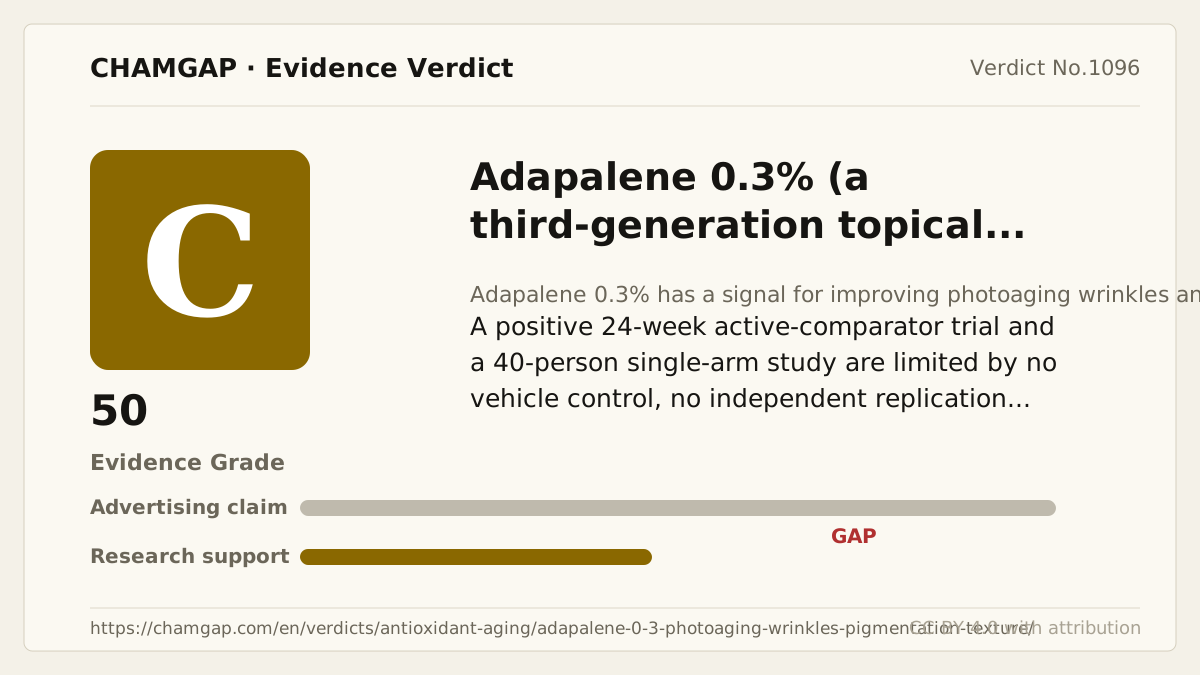
[Chamgap] Adapalene 0.3% x improvement of wrinkles, pigmentation, and texture in photoaged skin — Evidence Grade C·50. 3 cited sources checked. Source: https://chamgap.com/en/verdicts/antioxidant-aging/adapalene-0-3-photoaging-wrinkles-pigmentation-texture/ · CC BY 4.0CC BY 4.0 — free to use with attribution; do not distort grades, numbers, or verdict meaning.
What this document does and does not do
Chamgap is an information source. It reports what research has and has not confirmed; it does not tell readers what to take or buy. That decision belongs to readers and, when needed, medical or legal professionals. This verdict reflects literature available up to the search date and may change as new research appears. Nothing here is medical advice.