
Maca,
does it really help with Female desire and sexual function, including antidepressant-associated sexual dysfunction?
research showsEvidence for maca in women is small and inconsistent across scales and subgroups, supporting C. In an analysis of 42 women with antidepressant-associated sexual dysfunction, changes in total ASEX and MGH-SFQ scores did not differ significantly from placebo. A crossover trial in 14 postmenopausal women showed signals only on selected psychological and sexual-function measures.
ads claimMarketing claims hormonal balance, immediate libido enhancement, or reversal of antidepressant side effects. Some marketed products combine maca with red clover, pomegranate, zinc, or vitamins, so their effects cannot be attributed to maca alone.
Useful facts when choosing a product
- Maca powders, capsules, and combination products are sold in Korea as foods or imported products, with differences in origin, color phenotype, gelatinization, and extract ratio.
- The female antidepressant-associated trial used 3.0 g/day of maca root for 12 weeks, and the postmenopausal crossover trial used 3.5 g/day.
- Products combining red clover, pomegranate, zinc, or vitamins are not equivalent to single-ingredient maca trials.
- Short-term use may cause gastrointestinal discomfort or headache, while safety evidence is insufficient in pregnancy, lactation, and hormone-sensitive conditions. Antidepressants should not be reduced or stopped without medical guidance.
Chamgap Semantic Classification Code
Candidate index · review held
S.maca.UNK.female-desire-and-sexual-function-including-antidepressant-associated-sexual-dysfunction.assess.placeboSupplements and nutraceuticals > Maca > Unknown > Female desire and sexual function, including antidepressant-associated sexual dysfunction > Association or change assessment > Placebo
An automated migration candidate, not an issued permanent code; exact claim scope remains under review. This machine-generated migration candidate helps retrieval but is not a permanent assignment. The original verdict ID and URL remain authoritative.
What the research actually shows
The 2015 Dording trial randomized 45 women with remitted depression and SSRI- or SNRI-associated sexual dysfunction and analyzed 42 in a modified intention-to-treat population. After 12 weeks of maca at 3 g/day, changes in total ASEX and MGH-SFQ scores were not significantly different from placebo overall or within premenopausal and postmenopausal subgroups, although selected remission thresholds and item-level signals appeared. The 2008 Brooks crossover trial in 14 postmenopausal women reported that 3.5 g/day improved selected psychological and sexual-function measures on the Greene scale. A 2010 systematic review concluded that evidence for sexual function was limited; its predominantly male evidence was not transferred to this female claim.
Why this is classified as C (40)
Direct female trials prevent a D or ? rating, but the most relevant antidepressant-associated trial was null on between-group total scores and the postmenopausal trial enrolled only 14 participants. Only subgroup and item-level signals remain, supporting C with 40 points.
Counterpoint. A responsive subgroup among postmenopausal women or users of particular antidepressants cannot be excluded. Male libido, erectile, and sperm studies were not used for this verdict.
Rejudgment record. New verdict — Direct trials in women exist, but key total-score comparisons were null, the postmenopausal trial was extremely small, and scale-level findings conflicted, capping the rating at C
Sub-claim grades by effect
This ingredient is marketed for several effects. A single overall grade blends strong and weak claims together, so each effect is graded separately here. The overall grade reflects the strongest disconfirming or core claim.
| Effect (sub-claim) | Grade | Basis |
|---|---|---|
| Antidepressant-associated sexual dysfunction in women | C | Among 42 analyzed women, changes in total ASEX and MGH-SFQ scores did not differ significantly from placebo, while only selected remission and item-level signals appeared. |
| Desire and sexual function in postmenopausal women | C | Selected signals appeared in a 14-person crossover trial and a very small subgroup of the antidepressant trial, but sample size and replication are inadequate. |
Cross-check — AI research and Codex final gate
Evidence Table
| Study | Design | Sample | Funding | Endpoint | Result | Weight |
|---|---|---|---|---|---|---|
| Dording CM et al. 2015 | Double-blind randomized placebo-controlled trial | 42 | NIH/NCCAM support and an ingredient-supply collaborator | ASEX and MGH-SFQ total scores and remission thresholds | Total-score changes were not significantly different between groups overall or by menopausal subgroup, while selected remission, arousal, and orgasm signals appeared. | Key |
| Brooks NA et al. 2008 | Randomized double-blind placebo-controlled crossover trial | 14 | Unknown | Greene climacteric scale, sexual function, and hormones | Selected psychological and sexual-function measures improved, hormones did not change, and the sample included only 14 women. | Supportive |
| Shin BC et al. 2010 | Systematic review | 4 | Unknown | Sexual desire and function | The review concluded that evidence for improved sexual function was limited, and most included trials involved men. | Contextual |
Receipt — 3 References
All 3 cited sources were verified for existence at the original page (as of 2026-07-18).
Final verification and publication gate: Codex · Evidence date: 2026-07-18 · Corrections: none
Cite this verdict
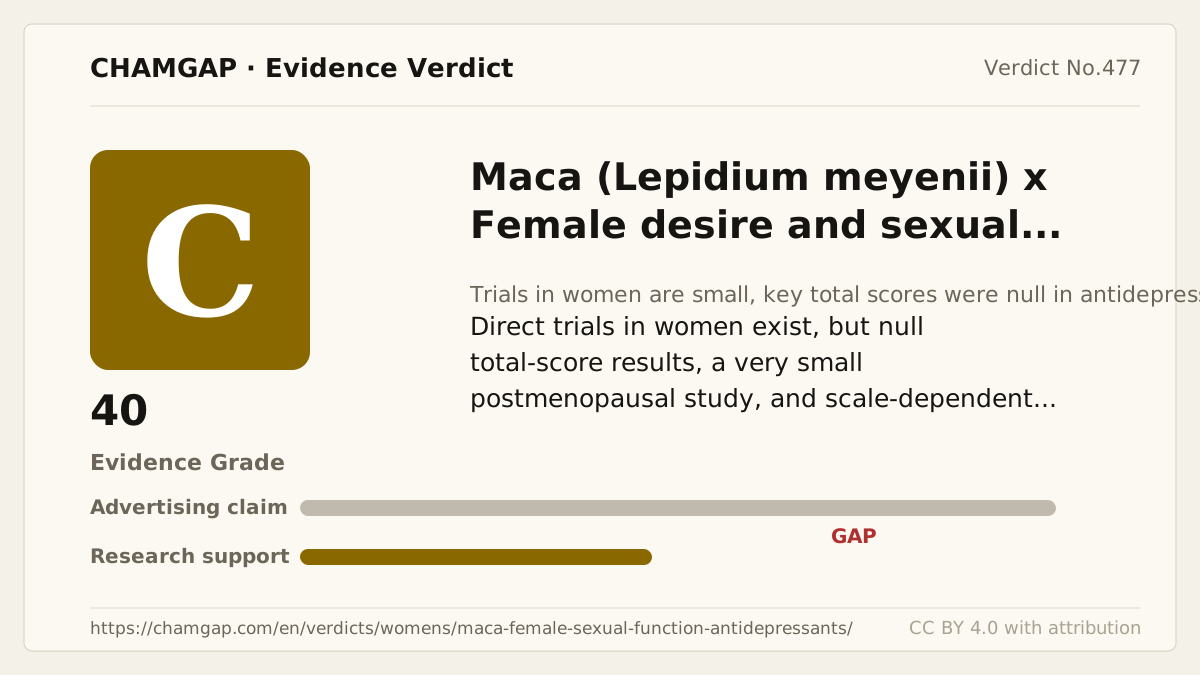
[Chamgap] Maca (Lepidium meyenii) x female desire, sexual function, and antidepressant-associated sexual dysfunction — Evidence Grade C·40. 3 cited sources checked. Source: https://chamgap.com/en/verdicts/womens/maca-female-sexual-function-antidepressants/ · CC BY 4.0CC BY 4.0 — free to use with attribution; do not distort grades, numbers, or verdict meaning.
What this document does and does not do
Chamgap is an information source. It reports what research has and has not confirmed; it does not tell readers what to take or buy. That decision belongs to readers and, when needed, medical or legal professionals. This verdict reflects literature available up to the search date and may change as new research appears. Nothing here is medical advice.