
Fennel seed extract,
does it really help with Reduced pain and analgesic use in primary dysmenorrhea?
research showsFennel seed extract is rated C because it may reduce pain from primary dysmenorrhea over the short term. A 2020 meta-analysis of 12 randomized trials found less pain than placebo and a similar average effect to conventional drugs, but placebo heterogeneity was I² 98%, all trials had moderate risk of bias, and publication bias from small favorable studies was suspected. Most studies were short and regionally concentrated, pain was subjective, and neither NSAID equivalence nor reduced rescue-analgesic use is established. This is a dysmenorrhea-axis verdict distinct from the menopause claim for fennel in verdict 285.
ads claimMarketing expands a short-term pain-score signal into equivalence to NSAIDs, freedom from analgesics, and normalized cycles. A nonsignificant difference is not proof of equivalence, and rescue use and cycle regularity are separate claims.
Useful facts when choosing a product
- Trials used differing capsules, drops, oils, and standardized extracts, so their doses cannot be mapped directly to retail fennel tea or an unspecified supplement.
- Fennel can cause skin or respiratory allergy and should be avoided by people allergic to fennel or related Apiaceae plants.
- EMA does not recommend medicinal fennel during pregnancy or lactation because safety data are inadequate and advises keeping estragole exposure as low as practical.
- Suddenly severe pain, heavy bleeding, fever, possible pregnancy, or persistent disabling pain requires evaluation for secondary causes such as endometriosis.
Chamgap Semantic Classification Code
Candidate index · review held
S.fennel-seed-extract.UNK.pain-and-analgesic-use-in-primary-dysmenorrhea.reduce.placeboSupplements and nutraceuticals > Fennel seed extract > Unknown > pain and analgesic use in primary dysmenorrhea > Reduction claim > Placebo
An automated migration candidate, not an issued permanent code; exact claim scope remains under review. This machine-generated migration candidate helps retrieval but is not a permanent assignment. The original verdict ID and URL remain authoritative.
What the research actually shows
Lee et al. 2020 reviewed 12 fennel trials. Seven placebo comparisons involving 468 participants favored fennel but had I² of 98%, while seven conventional-drug comparisons involving 502 participants found no average difference. The reviewers rated overall risk of bias moderate and identified potential publication bias from small favorable studies. Shahrahmani et al. 2021 also pooled 12 studies and found lower pain than placebo with no statistical difference from mefenamic acid. A 2016 Cochrane review rated supplement evidence for dysmenorrhea low or very low because of tiny samples, poor methods reporting, and inconsistency. No consistent evidence was found for a prespecified reduction in rescue analgesic use or improved cycle regularity.
Why this is classified as C (48)
Pain reduction versus placebo repeats across several small trials and meta-analyses, establishing an efficacy signal. Subjective pain scales, short follow-up, regional concentration, I² of 98%, and masking and publication-bias concerns cap the grade at C with 48 points. No significant difference from mefenamic acid does not establish equivalence. Estragole and pregnancy precautions remain separate safety issues.
Counterpoint. An adult who cannot or prefers not to use standard NSAIDs may briefly try a clearly specified product. Recording pain and rescue medication and stopping if ineffective is reasonable.
Rejudgment record. New verdict — Accepted the placebo-controlled pain signal but applied the rule ① ceiling of C for subjective outcomes, small short regionally concentrated trials, masking and publication-bias concerns, and high heterogeneity
Sub-claim grades by effect
This ingredient is marketed for several effects. A single overall grade blends strong and weak claims together, so each effect is graded separately here. The overall grade reflects the strongest disconfirming or core claim.
| Effect (sub-claim) | Grade | Basis |
|---|---|---|
| Reduced pain in primary dysmenorrhea | C | The placebo-controlled signal repeats, but studies are small, short, regionally concentrated, subjective, and bias-prone. |
| Reduced NSAID use or equivalence to NSAIDs | ? | Rescue-use reduction was not consistently assessed, and no significant difference does not establish noninferiority or equivalence. |
| Menstrual-cycle regularity | ? | No suitable human efficacy trial establishing improved cycle regularity was found. |
Cross-check — AI research and Codex final gate
Evidence Table
| Study | Design | Sample | Funding | Endpoint | Result | Weight |
|---|---|---|---|---|---|---|
| Lee HW et al. 2020 | Systematic review and meta-analysis of randomized trials | 12 studies; 502 in drug comparisons and 468 in placebo comparisons | Public research support from the Korea Institute of Oriental Medicine | Subjective dysmenorrhea pain scales and adverse events | Pain versus placebo had SMD -3.27 with I² 98%; versus conventional drugs SMD was 0.07 without a significant difference. | Key synthesis with bias concerns |
| Shahrahmani H et al. 2021 | Systematic review and meta-analysis | 12 studies | Iranian academic institutions; limited reporting | Dysmenorrhea pain intensity | SMD was -0.632 versus placebo and -0.214 versus mefenamic acid without a significant difference. | Repeated pain signal with regional concentration |
| Pattanittum P et al. 2016 Cochrane | Systematic review of dietary supplements for dysmenorrhea | 27 randomized trials including 12 herbal medicines | Cochrane systematic review | Pain, response, and adverse events | Evidence was rated low or very low because of tiny samples, poor methods reporting, and inconsistency. | Certainty limitation |
Receipt — 4 References
All 4 cited sources were verified for existence at the original page (as of 2026-07-19).
Final verification and publication gate: Codex · Evidence date: 2026-07-19 · Corrections: none
Cite this verdict
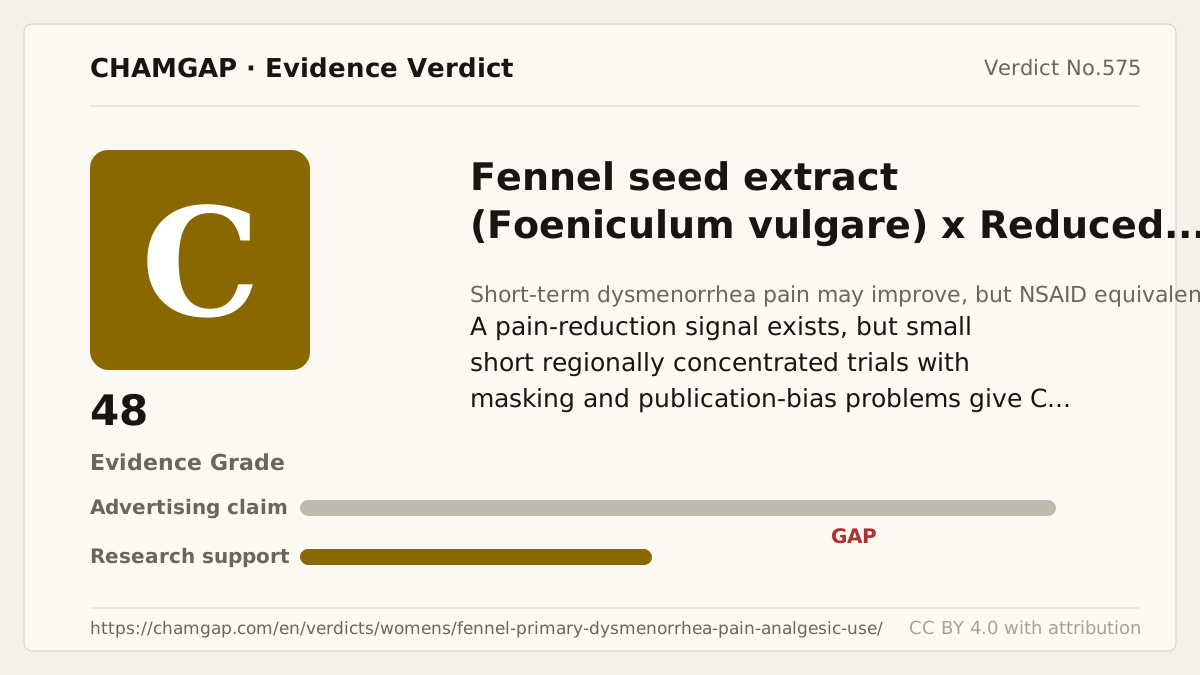
[Chamgap] Fennel seed extract x reduced pain and analgesic use in primary dysmenorrhea — Evidence Grade C·48. 4 cited sources checked. Source: https://chamgap.com/en/verdicts/womens/fennel-primary-dysmenorrhea-pain-analgesic-use/ · CC BY 4.0CC BY 4.0 — free to use with attribution; do not distort grades, numbers, or verdict meaning.
What this document does and does not do
Chamgap is an information source. It reports what research has and has not confirmed; it does not tell readers what to take or buy. That decision belongs to readers and, when needed, medical or legal professionals. This verdict reflects literature available up to the search date and may change as new research appears. Nothing here is medical advice.