
Extended-release naltrexone/bupropion,
does it really help with One-year weight loss in adults with obesity when combined with diet and exercise?
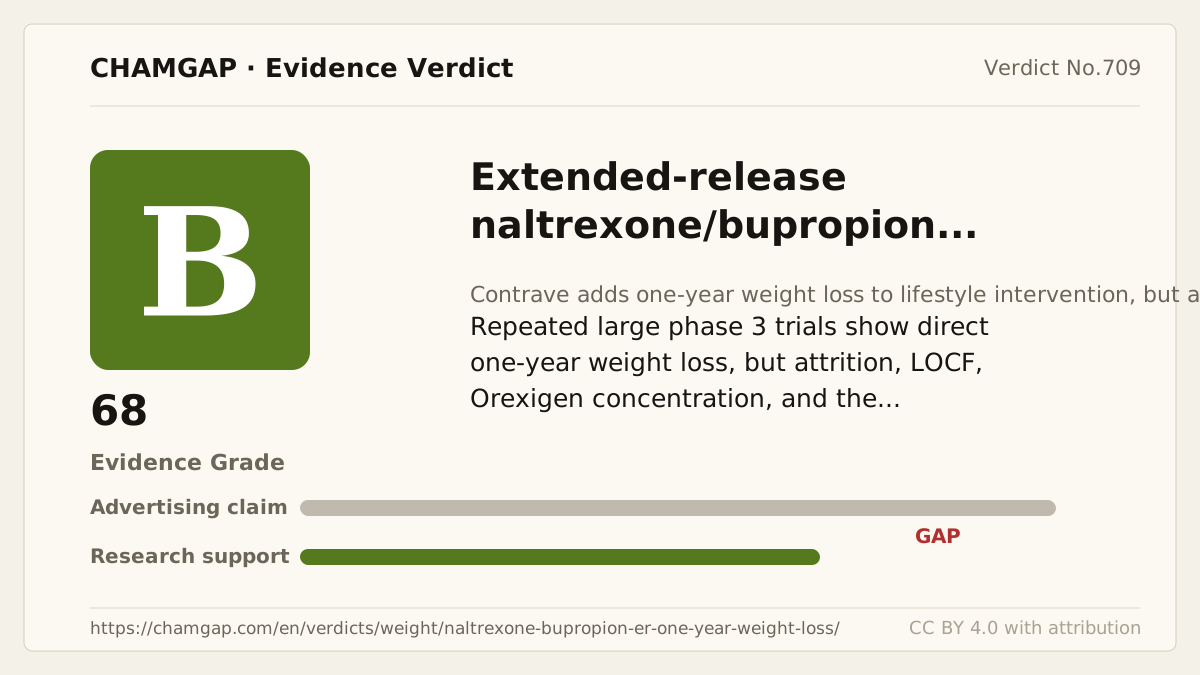
research showsExtended-release naltrexone/bupropion is rated B because it increases one-year weight loss versus placebo with diet and exercise. COR-I with 1,742 participants, COR-II with 1,496, and COR-BMOD with 793 repeatedly improved direct weight outcomes. All belong to the Orexigen development program, however, attrition was high, COR-I completion was about 50%, and LOCF or modified-intention-to-treat methods influence estimates. LIGHT ended early, leaving long-term cardiovascular benefit and safety unestablished. The evidence is not extended to GLP-1-class weight loss and gives low-range B with 68 points.
ads claimMarketing may imply double-digit average loss over one year, established cardiovascular safety, or an effect comparable to newer GLP-1 medicines. The randomized-allocation average effect is moderate, responder selection and attrition matter, and cardiovascular benefit has not been established.
Useful facts when choosing a product
- The standard United States maintenance dose provides naltrexone 32 mg and bupropion 360 mg per day in two divided doses after a four-week escalation; national labeling and the prescription take priority.
- Labeling directs reassessment when at least 5% of starting weight has not been lost after 12 weeks on the maintenance dose because clinically meaningful later loss is unlikely.
- Major contraindications include uncontrolled hypertension, seizure disorder, anorexia nervosa or bulimia, use of another bupropion product, chronic opioid use, and acute opioid withdrawal.
- Bupropion carries warnings about suicidal thoughts and behavior, lowers the seizure threshold, and can increase blood pressure and heart rate; weight loss during pregnancy can harm the fetus. Naltrexone blockade must be considered whenever opioid analgesia is needed.
Chamgap Semantic Classification Code
Candidate index · review held
M.extended-release-naltrexone-bupropion.UNK.weight-loss-with-obesity-when-combined-with-diet-and-exercise.assess.placeboMedicinal interventions > Extended-release naltrexone/bupropion > Unknown > weight loss with obesity when combined with diet and exercise > Association or change assessment > Placebo
An automated migration candidate, not an issued permanent code; exact claim scope remains under review. This machine-generated migration candidate helps retrieval but is not a permanent assignment. The original verdict ID and URL remain authoritative.
What the research actually shows
Greenway 2010 COR-I randomized 1,742 participants to NB32, NB16, or placebo with a mildly hypocaloric diet and exercise. NB32 improved mean loss and the proportion losing at least 5% at week 56, but only 870 participants completed 56 weeks. Apovian 2013 COR-II randomized 1,496 participants 2:1 to NB32 or placebo and reported week-56 weight change of -6.4% versus -1.2% and at least 5% loss in 50.5% versus 17.1%. Wadden 2011 COR-BMOD found added loss when the medicine was combined with intensive behavior modification, although modified-intention-to-treat analysis and attrition matter. Nissen 2016 LIGHT sought major cardiovascular outcomes in 8,910 participants but was terminated after release of interim data and could not provide a definitive final noninferiority or superiority conclusion.
Why this is classified as B (68)
COR-I, COR-II, and COR-BMOD repeatedly improved direct one-year weight outcomes in 1,742, 1,496, and 793 participants, supporting prescription-drug B. Orexigen concentration, about 50% completion in COR-I, high attrition, LOCF and modified-intention-to-treat effects, and the prematurely terminated LIGHT cardiovascular trial lower the verdict to 68 points. Long-term cardiovascular benefit and safety remain unestablished.
Counterpoint. Individual response and tolerability vary, so the 12-week response threshold, blood pressure, pulse, mood, and opioid use require follow-up. When greater average loss or cardiovascular benefit is a priority, other obesity-treatment options should be compared directly.
Rejudgment record. New verdict — Accepted repeated improvements in direct weight loss and at least 5% loss across large 56-week phase 3 randomized trials, but used B rather than A because of sponsor concentration, high discontinuation, modified-intention-to-treat and responder-selection effects, and the prematurely terminated cardiovascular-outcomes trial
Sub-claim grades by effect
This ingredient is marketed for several effects. A single overall grade blends strong and weak claims together, so each effect is graded separately here. The overall grade reflects the strongest disconfirming or core claim.
| Effect (sub-claim) | Grade | Basis |
|---|---|---|
| One-year weight loss in adults with obesity alongside diet and exercise | B | Several large 56-week trials repeatedly improved direct weight change and at least 5% loss, but attrition and sponsor concentration are substantial. |
| Long-term cardiovascular benefit and safety | ? | The 8,910-participant LIGHT trial terminated early, leaving definitive long-term cardiovascular outcomes unestablished. |
| Extension to the weight-loss magnitude of GLP-1-class medicines | ? | Average loss in the pivotal placebo-controlled trials does not support that extension, and no direct equivalence trial exists. |
Cross-check — AI research and Codex final gate
Evidence Table
| Study | Design | Sample | Funding | Endpoint | Result | Weight |
|---|---|---|---|---|---|---|
| Greenway FL et al. COR-I, 2010 | Multicenter randomized double-blind placebo-controlled phase 3 trial | 1,742 adults with overweight or obesity; 56 weeks | Sponsored by Orexigen Therapeutics with involvement in study design | Percent weight change and proportion losing at least 5% | At week 56, NB32 produced -6.1% versus -1.3% with placebo, and 48% versus 16% lost at least 5%, but only 870 participants completed the trial. | Key large direct-efficacy trial with high attrition |
| Apovian CM et al. COR-II, 2013 | Randomized double-blind placebo-controlled phase 3 trial | 1,496 adults with overweight or obesity; 56 weeks | Sponsored by Orexigen Therapeutics with company employees as coauthors | Percent weight change and at least 5% loss at weeks 28 and 56 | At week 56, weight change was -6.4% versus -1.2%, and 50.5% versus 17.1% lost at least 5%, favoring active treatment. | Replicated large direct-efficacy randomized trial |
| Wadden TA et al. COR-BMOD, 2011 | Randomized double-blind placebo-controlled trial alongside intensive behavior modification | 793 adults with obesity; 56 weeks | Sponsored by Orexigen Therapeutics | Modified-intention-to-treat weight change and at least 5% loss | Adding the medicine produced more 56-week loss than behavior modification alone, but modified-intention-to-treat analysis and attrition affect interpretation. | Confirms added effect beyond lifestyle intervention |
| Nissen SE et al. LIGHT, 2016 | Randomized double-blind placebo-controlled cardiovascular-outcomes trial | 8,910 adults with overweight or obesity and elevated cardiovascular risk | Sponsored by Orexigen Therapeutics | Composite major adverse cardiovascular events | The trial ended earlier than planned after disclosure of interim data and could not establish cardiovascular benefit or definitive long-term safety. | Confirms the long-term cardiovascular-outcome gap |
Receipt — 4 References
All 4 cited sources were verified for existence at the original page (as of 2026-07-19).
Final verification and publication gate: Codex · Evidence date: 2026-07-19 · Corrections: none
Cite this verdict
[Chamgap] Extended-release naltrexone/bupropion x one-year weight loss in adults with obesity — Evidence Grade B·68. 4 cited sources checked. Source: https://chamgap.com/en/verdicts/weight/naltrexone-bupropion-er-one-year-weight-loss/ · CC BY 4.0CC BY 4.0 — free to use with attribution; do not distort grades, numbers, or verdict meaning.
What this document does and does not do
Chamgap is an information source. It reports what research has and has not confirmed; it does not tell readers what to take or buy. That decision belongs to readers and, when needed, medical or legal professionals. This verdict reflects literature available up to the search date and may change as new research appears. Nothing here is medical advice.