
Meratrim,
does it really help with Reduction in body weight, BMI, and waist circumference?
research showsA few short placebo-controlled trials of Meratrim at 800 mg/day combined with a diet and walking program reported large reductions in body weight, BMI, and waist circumference. All studies, however, tested the same branded blend, funding and conflicts were concentrated around the ingredient developers and suppliers, and there is no independent replication. A 2020 systematic review acknowledged the large signal but found insufficient evidence to recommend it because of the small number of studies and limitations in methods and ingredient reporting, supporting C.
ads claimMarketing can describe the product as clinically proven to reduce fat or waist size without exercise. The trials actually combined Meratrim 800 mg/day with a 2,000-kcal diet and regular walking and did not establish long-term weight maintenance or efficacy across unrelated finished products.
Useful facts when choosing a product
- Korean consumers can encounter 400-mg Meratrim capsules through Korean-language cross-border retailers, which is not equivalent to an authorized Korean functional claim.
- The pivotal trial dose was 400 mg twice daily, totaling 800 mg/day, together with diet and walking programs.
- Meratrim is a specific branded ratio of Sphaeranthus indicus flower and Garcinia mangostana fruit-rind extracts. Results do not transfer to Garcinia cambogia alone or arbitrary finished-product blends.
- No major adverse-event signal appeared in the eight- to sixteen-week trials, but long-term safety and evidence in pregnancy, lactation, liver disease, and drug interactions are insufficient.
Chamgap Semantic Classification Code
Candidate index · review held
S.meratrim.UNK.body-weight-bmi-and-waist-circumference.reduce.placeboSupplements and nutraceuticals > Meratrim > Unknown > body weight, BMI, and waist circumference > Reduction claim > Placebo
An automated migration candidate, not an issued permanent code; exact claim scope remains under review. This machine-generated migration candidate helps retrieval but is not a permanent assignment. The original verdict ID and URL remain authoritative.
What the research actually shows
Stern 2013 pooled two similarly designed eight-week trials involving 100 people with a BMI of 30 to 40 and compared Meratrim 400 mg twice daily with placebo. All participants followed a 2,000-kcal/day diet and walked five days per week, and the study reported greater reductions in weight, BMI, waist, and hip circumference with Meratrim. Kudiganti 2016 followed 60 adults with overweight for sixteen weeks and reported reductions of 5.09 versus 1.10 kg in weight and about 9.97 versus 3.71 cm in waist circumference. Both studies tested the same branded ingredient within the developer-supplier network. The 2020 Maunder systematic review advised caution because of the small number of studies, generally poor methodological quality, and poor reporting of herbal interventions, and concluded that evidence was insufficient to recommend any included herbal medicine for weight loss.
Why this is classified as C (46)
Randomized placebo-controlled trials including body weight were positive, so this is not an absence-of-human-evidence or null verdict. All positive trials nevertheless came from the same branded-ingredient and developer network, were small and short, and lacked independent replication and long-term maintenance data, resulting in C with 46 points under the branded-ingredient cap.
Counterpoint. Independent long-term replication of the exact standardized ingredient at 800 mg/day could justify reassessment. This verdict is attributable only to branded Meratrim and not to Garcinia alone or arbitrary combination products.
Rejudgment record. New verdict — Accepted positive randomized evidence for weight, BMI, and waist circumference but applied the branded-ingredient cap because of developer concentration and absent independent replication
Sub-claim grades by effect
This ingredient is marketed for several effects. A single overall grade blends strong and weak claims together, so each effect is graded separately here. The overall grade reflects the strongest disconfirming or core claim.
| Effect (sub-claim) | Grade | Basis |
|---|---|---|
| Reduction in body weight | C | Eight- and sixteen-week placebo-controlled trials reported large reductions, but branded-ingredient and developer concentration with no independent replication limits the grade to C. |
| Reduction in BMI | C | This short-term marker accompanied weight change and is positive only in trials of the same branded ingredient. |
| Reduction in waist circumference | C | Short randomized trials were positive, but independent confirmation, measurement replication, and long-term maintenance data are absent. |
Cross-check — AI research and Codex final gate
Evidence Table
| Study | Design | Sample | Funding | Endpoint | Result | Weight |
|---|---|---|---|---|---|---|
| Stern JS et al. 2013 | Pooled analysis of two similarly designed randomized double-blind placebo-controlled trials | 95 | Supported within the branded-ingredient developer and supplier network | Primary body weight; secondary BMI, waist, and hip circumference | Reported net reductions versus placebo of about 5.2 kg in weight, 2.2 kg/m² in BMI, and 11.9 cm in waist circumference with 400 mg twice daily. | Positive key evidence, concentrated |
| Kudiganti V et al. 2016 | Randomized double-blind placebo-controlled trial | 57 | Funded by Laila Nutraceuticals within the branded-ingredient development network | Primary body weight; BMI, waist circumference, lipids, and safety | Reported reductions of 5.09 versus 1.10 kg in weight and about 9.97 versus 3.71 cm in waist circumference. | Positive replication, not independent |
| Maunder A et al. 2020 | Systematic review and meta-analysis of randomized trials of herbal weight-loss products | 3 | Academic research with author conflicts disclosed | Weight loss, safety, and study quality | Acknowledged a clinically large signal for the combination but advised caution because of few studies, generally poor quality, and poor intervention reporting, concluding that evidence was insufficient for recommendation. | Independent synthesis |
Receipt — 3 References
All 3 cited sources were verified for existence at the original page (as of 2026-07-18).
Final verification and publication gate: Codex · Evidence date: 2026-07-18 · Corrections: none
Cite this verdict
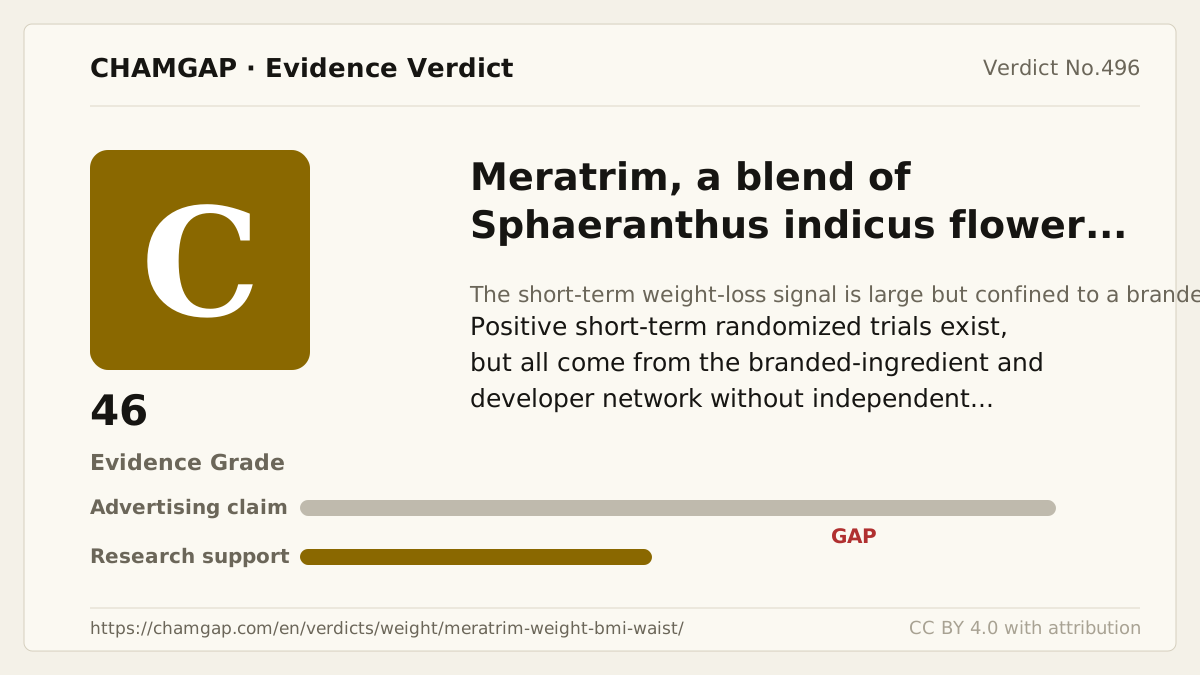
[Chamgap] Meratrim x reduction in body weight, BMI, and waist circumference — Evidence Grade C·46. 3 cited sources checked. Source: https://chamgap.com/en/verdicts/weight/meratrim-weight-bmi-waist/ · CC BY 4.0CC BY 4.0 — free to use with attribution; do not distort grades, numbers, or verdict meaning.
What this document does and does not do
Chamgap is an information source. It reports what research has and has not confirmed; it does not tell readers what to take or buy. That decision belongs to readers and, when needed, medical or legal professionals. This verdict reflects literature available up to the search date and may change as new research appears. Nothing here is medical advice.