
Melatonin,
does it really help with Reduced body weight, body mass index, and waist circumference in adults with overweight or obesity?
research showsThe weight-loss claim for melatonin is rated at the low end of C. A 2021 meta-analysis of 23 trials reported a small positive body-weight estimate, SMD -0.48, but the 95% confidence interval of -0.94 to -0.02 was borderline and heterogeneity was I-squared 92%; body mass index and waist circumference were null. A 2024 meta-analysis of 28 trials with 1,543 participants found no significant effect on weight, body mass index, or waist circumference. A 2026 meta-analysis of 14 trials in women with overweight or obesity reported a body-mass-index reduction of 1.03 kg/m2, but weight, -0.34 kg, and waist circumference, -0.66 cm, were null. Credible positive human signals keep the grade above D, but outcome- and population-dependent results with extreme heterogeneity are difficult to generalize to weight management.
ads claimMarketing converts sleep-hormone, brown-fat, and circadian mechanisms directly into fat burning and a smaller waist. Clinical studies do not show consistent simultaneous reductions in weight, body mass index, and waist, and they vary widely in dose, duration, and underlying condition.
Useful facts when choosing a product
- Melatonin is regulated as a prescription medicine, nonprescription medicine, or supplement depending on the country, and formulation and actual content can vary among products with the same labeled dose.
- Weight trials used varied doses and durations and mixed populations receiving sleep care or living with metabolic disease, menopause, or psychiatric medication exposure.
- Melatonin is not established as a weight-loss treatment that replaces nutrition, activity, behavioral care, or approved obesity medicines.
- Dose timing matters for circadian effects, and there is no evidence that simply increasing the dose improves weight efficacy or safety.
Chamgap Semantic Classification Code
Candidate index · review held
UNK.melatonin.UNK.body-weight-body-mass-index-and-waist-circumference-with-overweight-or-obesity.reduce.UNKUnknown > Melatonin > Unknown > body weight, body mass index, and waist circumference with overweight or obesity > Reduction claim > Unknown
An automated migration candidate, not an issued permanent code; exact claim scope remains under review. This machine-generated migration candidate helps retrieval but is not a permanent assignment. The original verdict ID and URL remain authoritative.
What the research actually shows
An early meta-analysis by Mostafavi and colleagues found a null weight SMD of 0.09, 95% CI -0.17 to 0.34, across seven clinical trials and 244 participants. Delpino and Figueiredo reported that 11 of 23 trials were significant for at least one of weight, body mass index, or waist circumference; weight was SMD -0.48 with I-squared 92%, while body mass index and waist were null. Vajdi and colleagues found no significant weight, body-mass-index, or waist effect across 28 trials and 1,543 participants, with body-mass-index heterogeneity of 96.9%. The latest women-only analysis by Li and colleagues lowered body mass index but not weight or waist circumference. Populations ranged across metabolic disease, psychiatric medication use, and postmenopausal status, reducing directness for routine obesity treatment.
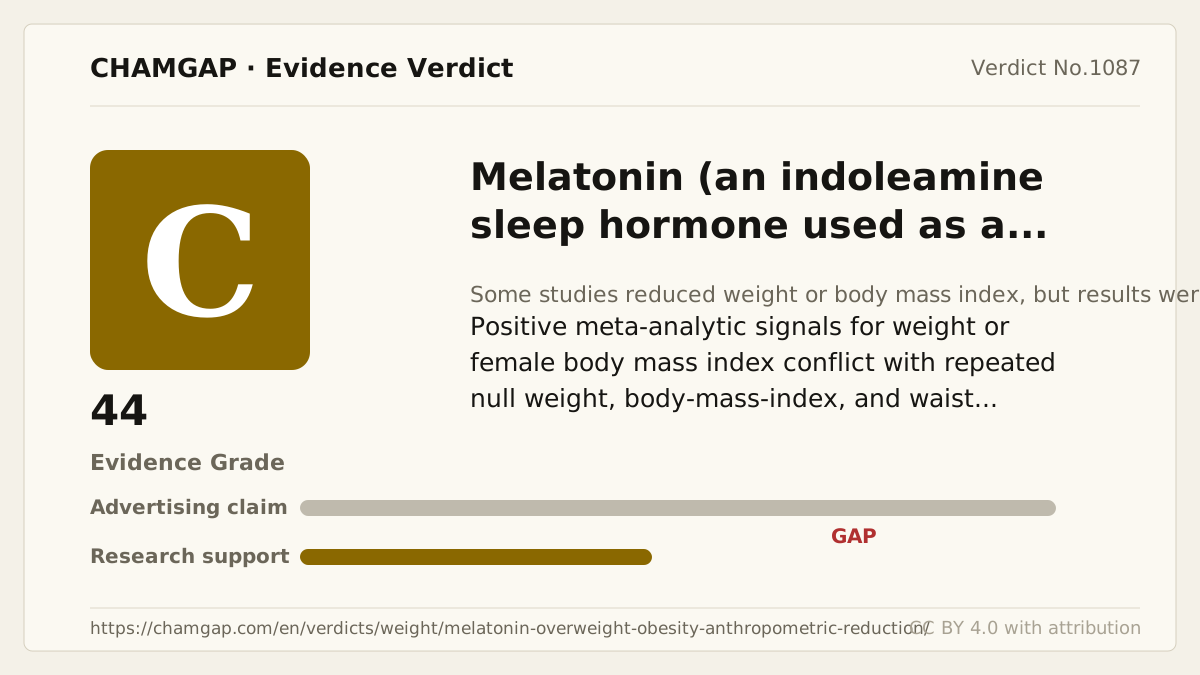
Why this is classified as C (44)
Positive meta-analytic signals for weight and female body mass index support C, but the comprehensive 2024 analysis found no weight, body-mass-index, or waist effect and heterogeneity reached 96.9%. Outcome inconsistency and indirectness give 44 points. Daytime sleepiness, headache, and uncertain long-term metabolic safety are separate from efficacy.
Counterpoint. When weight loss is the goal, energy intake, activity, sleep apnea, and weight-promoting medicines should be evaluated first. Even when melatonin is used for sleep or circadian timing, weight change is not an assured benefit.
Rejudgment record. New verdict — Accepted positive meta-analytic signals for weight in 2021 and female body mass index in 2026, but applied low C because the comprehensive 2024 meta-analysis found no effect on weight, body mass index, or waist, waist findings were repeatedly null, heterogeneity ranged from 83.7% to 96.9%, and study populations were indirect
Sub-claim grades by effect
This ingredient is marketed for several effects. A single overall grade blends strong and weak claims together, so each effect is graded separately here. The overall grade reflects the strongest disconfirming or core claim.
| Effect (sub-claim) | Grade | Basis |
|---|---|---|
| Reduced body weight in adults with overweight or obesity | C | A positive 2021 meta-analysis conflicts with null 2017, 2024, and women-specific 2026 results and had high heterogeneity. |
| Reduced body mass index in adults with overweight or obesity | C | The comprehensive adult analysis was null, but a positive 2026 women-specific meta-analysis supports a low C signal. |
| Reduced waist circumference in adults with overweight or obesity | D | The outcome was consistently nonsignificant in the 2021, 2024, and 2026 syntheses. |
Cross-check — AI research and Codex final gate
Evidence Table
| Study | Design | Sample | Funding | Endpoint | Result | Weight |
|---|---|---|---|---|---|---|
| Mostafavi SA et al. 2017 | Systematic review and meta-analysis of clinical trials | Seven parallel-group trials and 244 participants | Academic study; no industry funding stated in the PubMed record | Body weight | The pooled SMD was 0.09, 95% CI -0.17 to 0.34, with I-squared 0% and P=0.66, and was not significant. | Early null synthesis |
| Delpino FM and Figueiredo LM. 2021 | Systematic review and meta-analysis of randomized clinical trials | 23 trials | Academic study; no industry funding stated in the PubMed record | Body weight, body mass index, and waist circumference | Body weight was positive at SMD -0.48, 95% CI -0.94 to -0.02, with I-squared 92%, while body mass index and waist circumference were null. | Key positive but highly heterogeneous synthesis |
| Vajdi M et al. 2024 | Systematic review and dose-response meta-analysis of randomized controlled trials | 28 trials and 1,543 participants | Tabriz University of Medical Sciences support; no competing interests reported | Weight, body mass index, waist and hip circumference, and blood pressure | Weight, body mass index, and waist circumference were all nonsignificant; heterogeneity was 96.9%, 83.7%, and 87.4%, respectively. | Most comprehensive recent null adult synthesis |
| Li J et al. 2026 | Systematic review and meta-analysis of randomized trials in women | 14 trials in women with overweight or obesity | Academic study; no competing interests reported | Weight, body mass index, waist circumference, and glycemic markers | Body mass index was significant at WMD -1.03 kg/m2, but weight at -0.34 kg and waist circumference at -0.66 cm were nonsignificant. | Latest women-specific conflicting evidence |
Receipt — 4 References
All 4 cited sources were verified for existence at the original page (as of 2026-07-22).
Final verification and publication gate: Codex · Evidence date: 2026-07-22 · Corrections: none
Cite this verdict
[Chamgap] Melatonin x reduced weight, body mass index, and waist circumference in adults with overweight or obesity — Evidence Grade C·44. 4 cited sources checked. Source: https://chamgap.com/en/verdicts/weight/melatonin-overweight-obesity-anthropometric-reduction/ · CC BY 4.0CC BY 4.0 — free to use with attribution; do not distort grades, numbers, or verdict meaning.
What this document does and does not do
Chamgap is an information source. It reports what research has and has not confirmed; it does not tell readers what to take or buy. That decision belongs to readers and, when needed, medical or legal professionals. This verdict reflects literature available up to the search date and may change as new research appears. Nothing here is medical advice.