
Coleus forskohlii extract,
does it really help with Reduction of body fat and body weight?
research showsThree small 12-week RCTs of Coleus forskohlii extract were identified. A 30-man trial reported reductions in body-fat percentage and fat mass but did not establish weight loss, while a trial in women and a trial combined with a hypocaloric diet found no significant placebo-adjusted effect on weight or body fat. With small samples and product-company support, the weight subclaim is D, the body-fat subclaim is C, and the overall grade is D.
ads claimAdvertising uses terms such as 'fat burning,' 'body-fat breakdown,' 'lean-mass increase,' and 'diet booster.' Human evidence consists of small 12-week studies; placebo-adjusted weight loss was not demonstrated and body-fat signals were inconsistent.
Useful facts when choosing a product
- The main RCTs generally used 250 mg of extract standardized to 10% forskolin twice daily.
- Results cannot be directly applied to products with different forskolin content and extraction specifications.
- In a trial combined with a hypocaloric diet, the diet effect must be distinguished from the ingredient effect.
- Possible blood-pressure reduction, heart-rate change, gastrointestinal symptoms, and co-use with anticoagulant or antiplatelet medicines require safety distinction.
Chamgap Semantic Classification Code
Candidate index · review held
S.coleus-forskohlii-extract.UNK.body-fat-and-body-weight.reduce.placeboSupplements and nutraceuticals > Coleus forskohlii extract > Unknown > body fat and body weight > Reduction claim > Placebo
An automated migration candidate, not an issued permanent code; exact claim scope remains under review. This machine-generated migration candidate helps retrieval but is not a permanent assignment. The original verdict ID and URL remain authoritative.
What the research actually shows
Godard 2005 gave 30 overweight or obese men 250 mg of extract standardized to 10% forskolin twice daily and reported reductions in DXA body-fat percentage and fat mass. Henderson 2005 tested a similar preparation in overweight women, but placebo-adjusted differences after 12 weeks were nonsignificant for weight (-0.7 versus +1.0 kg, p=0.10), fat mass, and body-fat percentage. In the Loftus 2015 RCT combined with a hypocaloric diet, both groups reduced weight and circumferences, and no extract-specific weight or body-fat benefit was identified.
Why this is classified as D (31)
The weight subclaim is D because multiple small RCTs found no significant placebo-adjusted effect. The body-fat subclaim is C because one small positive male RCT conflicts with negative trials and product-company support is present. Considering the marketed weight and body-fat claim together, the overall grade is D with 31 points.
Counterpoint. A specific extract standardized to 10% forskolin may affect DXA body fat in men, but independent replication of adequate size is absent.
Rejudgment record. New judgment — Small RCTs found no significant placebo-adjusted weight reduction; the positive body-fat finding is limited to one small male trial and was not reproduced in other trials
Sub-claim grades by effect
This ingredient is marketed for several effects. A single overall grade blends strong and weak claims together, so each effect is graded separately here. The overall grade reflects the strongest disconfirming or core claim.
| Effect (sub-claim) | Grade | Basis |
|---|---|---|
| Weight loss | D | Small RCTs did not reproduce significant placebo-adjusted weight loss |
| Body-fat reduction | C | One small male RCT was positive, but female and diet-combination trials did not reproduce the finding |
Cross-check — AI research and Codex final gate
Evidence Table
| Study | Design | Sample | Funding | Endpoint | Result | Weight |
|---|---|---|---|---|---|---|
| Godard et al. 2005 | 12-week randomized, double-blind, placebo-controlled RCT | 30 overweight or obese men | No clear external funding information in the abstract or index | DXA body-fat percentage, fat mass, lean mass, and body weight | Lower body-fat percentage and fat mass and higher lean mass; significant weight loss was not demonstrated. | Positive for body fat; negative for weight |
| Henderson et al. 2005 | 12-week randomized, double-blind, placebo-controlled RCT | 23 randomized; 7 forskolin and 12 placebo participants analyzed | Partly supported by Sabinsa and ImagiNutrition; product supplied by Sabinsa | Body weight, fat mass, body-fat percentage, and dietary intake | Negative versus placebo for weight (p=0.10), fat mass (p=0.16), and body-fat percentage (p=0.40). | Key negative |
| Loftus et al. 2015 | 12-week randomized, double-blind, placebo-controlled RCT with a hypocaloric diet | 30 completers | Paper declared no conflict; funding beyond product supply unclear | Weight, BMI, waist, hip, body fat, and insulin markers | Weight and circumferences fell in both groups; no forskolin-specific weight or body-fat advantage. | Key negative |
Receipt — 3 References
All 3 cited sources were verified for existence at the original page (as of 2026-07-11).
Final verification and publication gate: Codex · Evidence date: 2026-07-11 · Corrections: none
Cite this verdict
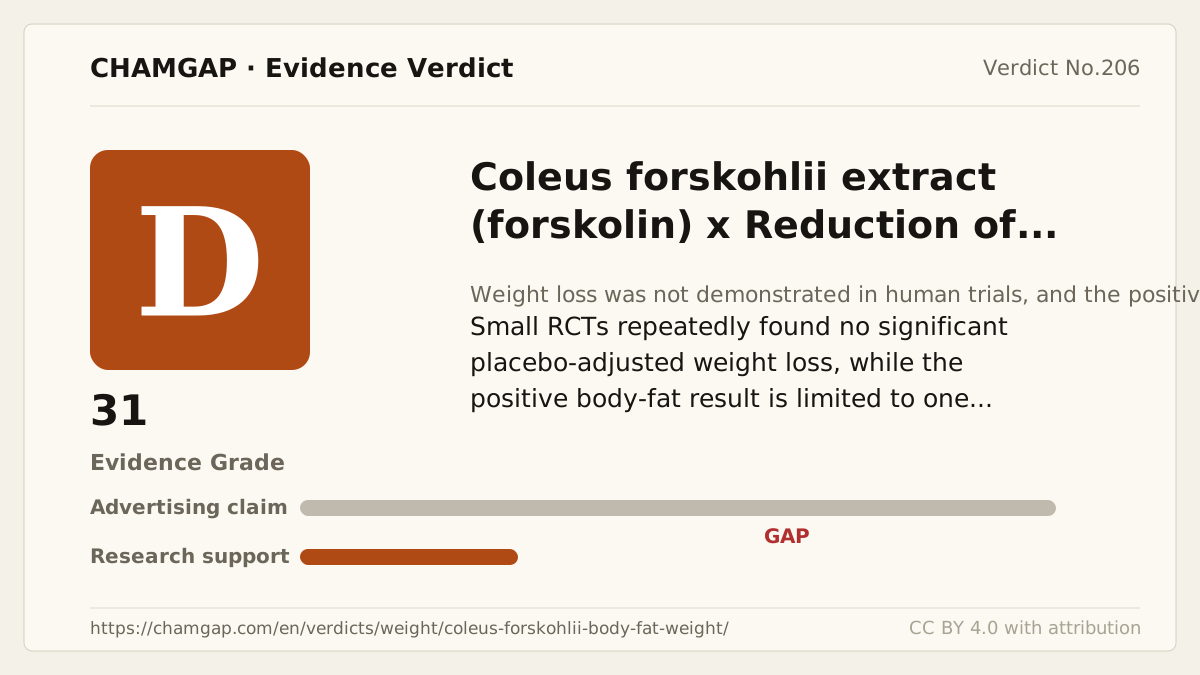
[Chamgap] Coleus forskohlii extract (forskolin) x reduction of body fat and body weight — Evidence Grade D·31. 3 cited sources checked. Source: https://chamgap.com/en/verdicts/weight/coleus-forskohlii-body-fat-weight/ · CC BY 4.0CC BY 4.0 — free to use with attribution; do not distort grades, numbers, or verdict meaning.
What this document does and does not do
Chamgap is an information source. It reports what research has and has not confirmed; it does not tell readers what to take or buy. That decision belongs to readers and, when needed, medical or legal professionals. This verdict reflects literature available up to the search date and may change as new research appears. Nothing here is medical advice.