
Glycine,
does it really help with Improved sleep quality and daytime alertness when taken before bed?
research showsSmall crossover trials of 3 g glycine before bed reported improvements in subjective sleep satisfaction, next-day fatigue or sleepiness, and selected polysomnography measures. The rating is C because only 7 to 19 participants were analyzed per trial, the investigators and ingredient-industry links overlap, and independent replication is absent.
ads claimAdvertisements can present glycine as a proven deep-sleep or refreshed-morning ingredient. The actual evidence almost entirely concerns short-term 3 g dosing in very small groups of healthy adults.
Useful facts when choosing a product
- Products sold to Korean consumers include powders and capsules that may suggest roughly 2 to 3 g per serving, but content and excipients vary.
- The most repeated research condition is 3 g glycine about 30 to 60 minutes before bed.
- Magnesium glycinate is not the same as a glycine-only product.
- It has not been established as treatment for sleep apnea or insomnia disorder or as a substitute for prescription sleep medication.
Chamgap Semantic Classification Code
Candidate index · review held
S.glycine.UNK.sleep-quality-and-daytime-alertness-when-taken-before-bed.improve.placeboSupplements and nutraceuticals > Glycine > Unknown > sleep quality and daytime alertness when taken before bed > Improvement claim > Placebo
An automated migration candidate, not an issued permanent code; exact claim scope remains under review. This machine-generated migration candidate helps retrieval but is not a permanent assignment. The original verdict ID and URL remain authoritative.
What the research actually shows
Inagawa 2006 studied 19 women in a four-day crossover trial and reported better subjective sleep satisfaction and next-day condition with 3 g one hour before bed. Yamadera 2007 studied 11 people over two crossover nights and reported changes in subjective measures and selected polysomnography variables. Bannai 2012 analyzed 7 of 10 enrolled sleep-restricted participants and reported signals for next-day fatigue, sleepiness, and psychomotor performance. A 2024 systematic review judged this evidence to be small and at high risk of bias.
Why this is classified as C (50)
Several randomized crossover trials prevent a rating of unknown or D, but samples contain only 7 to 19 participants, outcomes are short-term and largely subjective, and positive evidence is concentrated in an Ajinomoto-linked network, yielding C with 50 points.
Counterpoint. The short-term signal for sleep satisfaction and next-day fatigue after 3 g before bed can justify independent follow-up trials.
Rejudgment record. Reassessment (cross-check reflected) — Tiny short-term RCTs, subjective outcomes, concentration in Ajinomoto-linked research, and no independent replication
Sub-claim grades by effect
This ingredient is marketed for several effects. A single overall grade blends strong and weak claims together, so each effect is graded separately here. The overall grade reflects the strongest disconfirming or core claim.
| Effect (sub-claim) | Grade | Basis |
|---|---|---|
| Sleep quality | C | Tiny short-term crossover trials of 3 g before bed found subjective and selected polysomnography signals |
| Daytime alertness and fatigue | C | Only seven participants were analyzed in the sleep-restriction trial, requiring independent replication |
Cross-check — AI research and Codex final gate
Evidence Table
| Study | Design | Sample | Funding | Endpoint | Result | Weight |
|---|---|---|---|---|---|---|
| Inagawa K et al. 2006 | Randomized placebo-controlled crossover trial | 19 | Included Ajinomoto investigators | Subjective sleep satisfaction and next-day condition | Selected subjective measures improved with 3 g one hour before bed. | Key but limited |
| Yamadera W et al. 2007 | Randomized placebo-controlled crossover trial | 11 | Included Ajinomoto investigators | Subjective sleep and polysomnography | Signals of improvement in subjective sleep and selected objective sleep measures. | Key but limited |
| Bannai M et al. 2012 | Randomized placebo-controlled crossover sleep-restriction trial | 7 | Included Ajinomoto investigators | Next-day fatigue, sleepiness, and psychomotor performance | Signals of reduced fatigue and sleepiness and selected performance improvement with 3 g. | Supportive; tiny sample |
| Soh J et al. 2024 | Systematic review | 3 | Mixed | Sleep, fatigue, and alertness | Judged the signal possible but the samples small and risk of bias high. | Key synthesis |
Receipt — 4 References
All 4 cited sources were verified for existence at the original page (as of 2026-07-16).
Final verification and publication gate: Codex · Evidence date: 2026-07-16 · Corrections: none
Cite this verdict
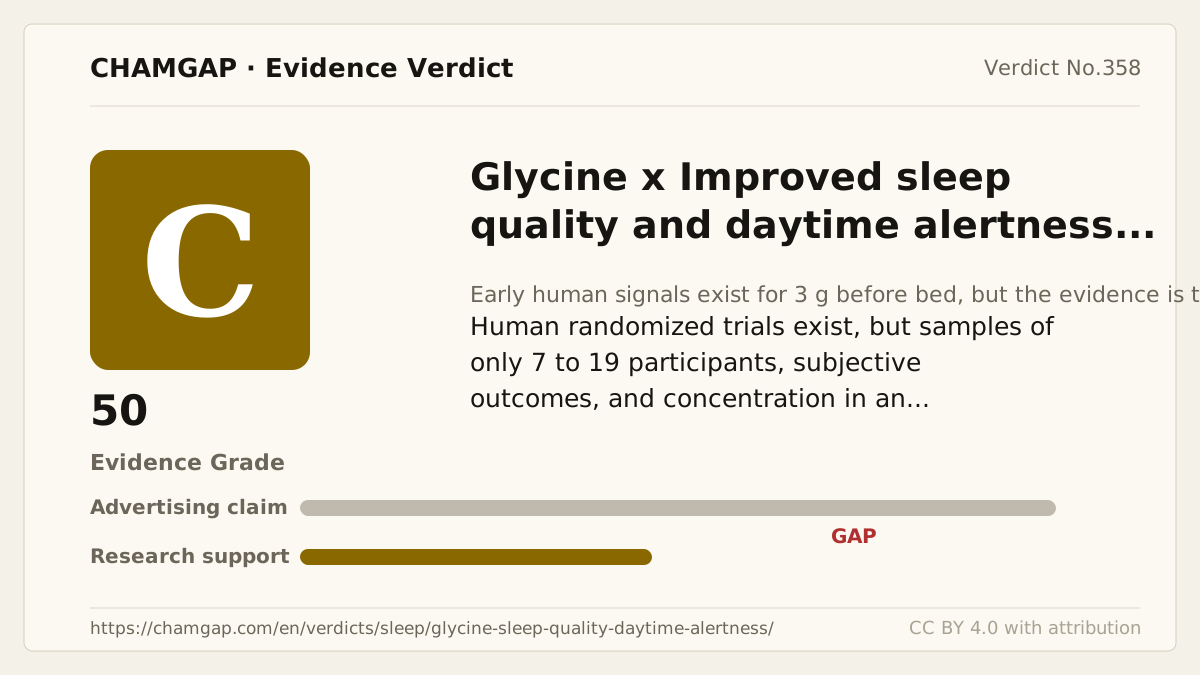
[Chamgap] Glycine x sleep quality and daytime alertness — Evidence Grade C·50. 4 cited sources checked. Source: https://chamgap.com/en/verdicts/sleep/glycine-sleep-quality-daytime-alertness/ · CC BY 4.0CC BY 4.0 — free to use with attribution; do not distort grades, numbers, or verdict meaning.
What this document does and does not do
Chamgap is an information source. It reports what research has and has not confirmed; it does not tell readers what to take or buy. That decision belongs to readers and, when needed, medical or legal professionals. This verdict reflects literature available up to the search date and may change as new research appears. Nothing here is medical advice.