
Zuranolone,
does it really help with Rapid reduction of depressive symptoms in postpartum depression?
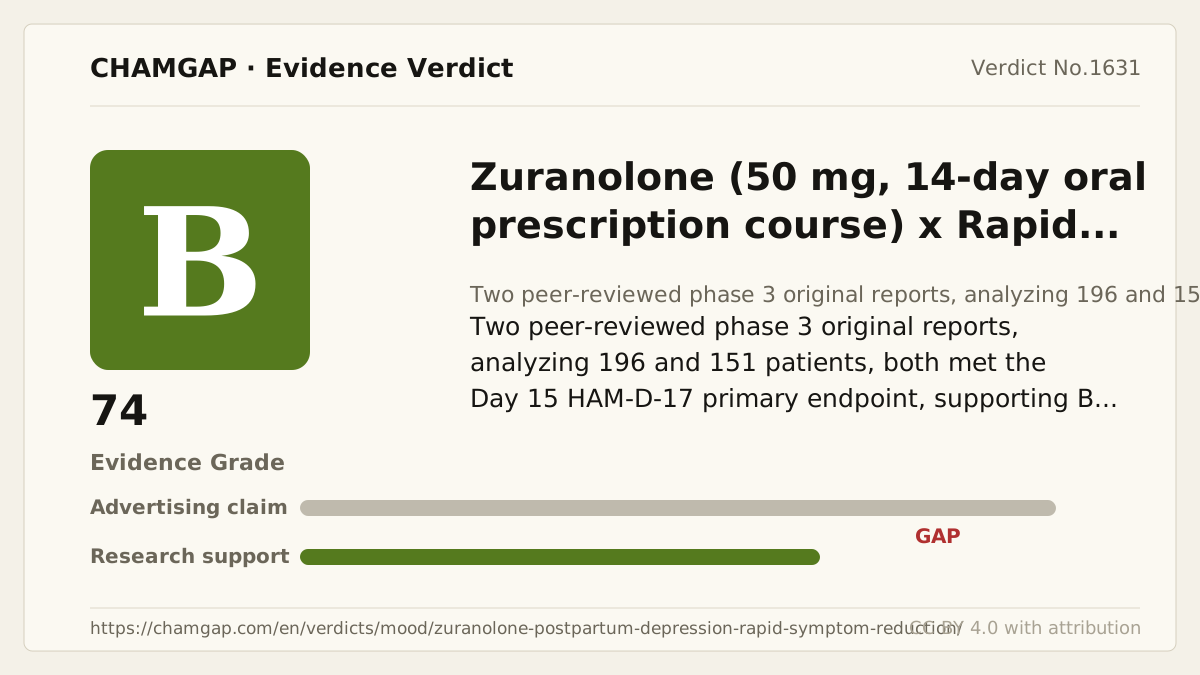
research showsB. Two peer-reviewed phase 3 original reports, analyzing 196 and 151 patients, both met the Day 15 HAM-D-17 primary endpoint, supporting B with 74 points. The publication form is two peer-reviewed phase 3 original reports. In SKYLARK, the actual full-analysis set of 196 met the Day 15 HAM-D-17 change primary endpoint, and the earlier randomized trial also met the same primary endpoint in its actual 151-patient analysis. Depression severity is a patient symptom and treatment target, not a surrogate. Differences were observed through Day 45, but long-term relapse prevention after the 14-day course is unestablished. Both trials came from the Sage program, so limited independence and duration support B with 74 points rather than A.
ads claimMarketing may expand a 14-day course into a rapid, durable cure or relapse prevention. The demonstrated scope is symptom reduction at Day 15; long-term relapse prevention is unproven.
Useful facts when choosing a product
- Zuranolone is a prescription drug taken as 50 mg each evening with fat-containing food for 14 days in adults with postpartum depression.
- Central nervous system depression can cause somnolence, dizziness, and sedation; patients should not drive or operate hazardous machinery for at least 12 hours after each dose.
- Worsening suicidal thoughts or behavior requires monitoring, and other central nervous system depressants can increase sedation.
- Clinical information on exposed breastfed infants is limited, so the benefits of breastfeeding and the need for treatment require individualized discussion with a clinician.
Chamgap Semantic Classification Code
Candidate index · review held
M.zuranolone.oral.rapid-reduction-of-depressive-symptoms-in-postpartum-depression.reduce.placeboMedicinal interventions > Zuranolone > Oral > Rapid reduction of depressive symptoms in postpartum depression > Reduction claim > Placebo
An automated migration candidate, not an issued permanent code; exact claim scope remains under review. This machine-generated migration candidate helps retrieval but is not a permanent assignment. The original verdict ID and URL remain authoritative.
What the research actually shows
The publication form is two peer-reviewed phase 3 original reports. In SKYLARK, the actual full-analysis set of 196 met the Day 15 HAM-D-17 change primary endpoint, and the earlier randomized trial also met the same primary endpoint in its actual 151-patient analysis. Depression severity is a patient symptom and treatment target, not a surrogate. Differences were observed through Day 45, but long-term relapse prevention after the 14-day course is unestablished. Both trials came from the Sage program, so limited independence and duration support B with 74 points rather than A.
Why this is classified as B (74)
The publication form is two peer-reviewed phase 3 original reports. In SKYLARK, the actual full-analysis set of 196 met the Day 15 HAM-D-17 change primary endpoint, and the earlier randomized trial also met the same primary endpoint in its actual 151-patient analysis. Depression severity is a patient symptom and treatment target, not a surrogate. Differences were observed through Day 45, but long-term relapse prevention after the 14-day course is unestablished. Both trials came from the Sage program, so limited independence and duration support B with 74 points rather than A. Rule ①: (a) improvement only in surrogate biomarkers such as HbA1c, LDL, blood pressure, intraocular pressure, bone density, laboratory values, or imaging has a ceiling of C; (b) a failed primary endpoint with only positive subjective secondary endpoints has a ceiling of C; and (c) small, single-manufacturer, short-term, or conflicting evidence has a ceiling of C. Patient-reported symptoms that are themselves treatment targets, including pain, sleep, bowel function, IRLS, IIEF/SEP, and depression or anxiety scales, are not surrogates. Consistent achievement of clinical-importance thresholds such as MCID in multiple independent randomized trials can support B, and large, consistent, independent evidence can exceptionally support A. If effects do not meet clinical-importance thresholds, the grade remains C regardless of trial count.
Counterpoint. Efficacy was judged separately from safety and regulatory status. Diagnosis and standard treatment choices require clinical discussion.
Rejudgment record. New verdict — The publication form is two peer-reviewed phase 3 original reports. In SKYLARK, the actual full-analysis set of 196 met the Day 15 HAM-D-17 change primary endpoint, and the earlier randomized trial also met the same primary endpoint in its actual 151-patient analysis. Depression severity is a patient symptom and treatment target, not a surrogate. Differences were observed through Day 45, but long-term relapse prevention after the 14-day course is unestablished. Both trials came from the Sage program, so limited independence and duration support B with 74 points rather than A. Rule ①: (a) improvement only in surrogate biomarkers such as HbA1c, LDL, blood pressure, intraocular pressure, bone density, laboratory values, or imaging has a ceiling of C; (b) a failed primary endpoint with only positive subjective secondary endpoints has a ceiling of C; and (c) small, single-manufacturer, short-term, or conflicting evidence has a ceiling of C. Patient-reported symptoms that are themselves treatment targets, including pain, sleep, bowel function, IRLS, IIEF/SEP, and depression or anxiety scales, are not surrogates. Consistent achievement of clinical-importance thresholds such as MCID in multiple independent randomized trials can support B, and large, consistent, independent evidence can exceptionally support A. If effects do not meet clinical-importance thresholds, the grade remains C regardless of trial count.
Sub-claim grades by effect
This ingredient is marketed for several effects. A single overall grade blends strong and weak claims together, so each effect is graded separately here. The overall grade reflects the strongest disconfirming or core claim.
| Effect (sub-claim) | Grade | Basis |
|---|---|---|
| Rapid Day 15 reduction of depressive symptoms in postpartum depression | B | The HAM-D-17 primary endpoint was replicated in two phase 3 trials. |
| Maintenance of depressive-symptom improvement through Day 45 | B | Follow-up in both trials retained a signal, but longer durability without retreatment is unknown. |
| Long-term relapse prevention | ? | No long-term randomized relapse-prevention trial was identified. |
Cross-check — AI research and Codex final gate
Evidence Table
| Study | Design | Sample | Funding | Endpoint | Result | Weight |
|---|---|---|---|---|---|---|
| Deligiannidis KM et al. 2023 (SKYLARK) | Phase 3 randomized double-blind placebo-controlled trial; peer-reviewed original article | FAS 196 (50 mg 98; placebo 98) | Sage Therapeutics and Biogen | Change from baseline in HAM-D-17 at Day 15 | Primary endpoint met: between-group difference -4.0 points (95% CI -6.3 to -1.7; P<.001). | Key efficacy evidence |
| Deligiannidis KM et al. 2021 | Phase 3 randomized double-blind placebo-controlled trial; peer-reviewed original article | Actual analysis 151 (zuranolone 76; placebo 75) | Sage Therapeutics | Change from baseline in HAM-D-17 at Day 15 | Primary endpoint met: between-group difference -4.2 points (95% CI -6.9 to -1.5; P=.003). | Key efficacy evidence |
Receipt — 2 References
All 2 cited sources were verified for existence at the original page (as of 2026-07-24).
Final verification and publication gate: Codex · Evidence date: 2026-07-24 · Corrections: none
Cite this verdict
[Chamgap] Zuranolone x Rapid reduction of depressive symptoms in postpartum depression — Evidence Grade B·74. 2 cited sources checked. Source: https://chamgap.com/en/verdicts/mood/zuranolone-postpartum-depression-rapid-symptom-reduction/ · CC BY 4.0CC BY 4.0 — free to use with attribution; do not distort grades, numbers, or verdict meaning.
What this document does and does not do
Chamgap is an information source. It reports what research has and has not confirmed; it does not tell readers what to take or buy. That decision belongs to readers and, when needed, medical or legal professionals. This verdict reflects literature available up to the search date and may change as new research appears. Nothing here is medical advice.