
Zembrin Sceletium tortuosum extract,
does it really help with Relief of everyday stress and anxiety?
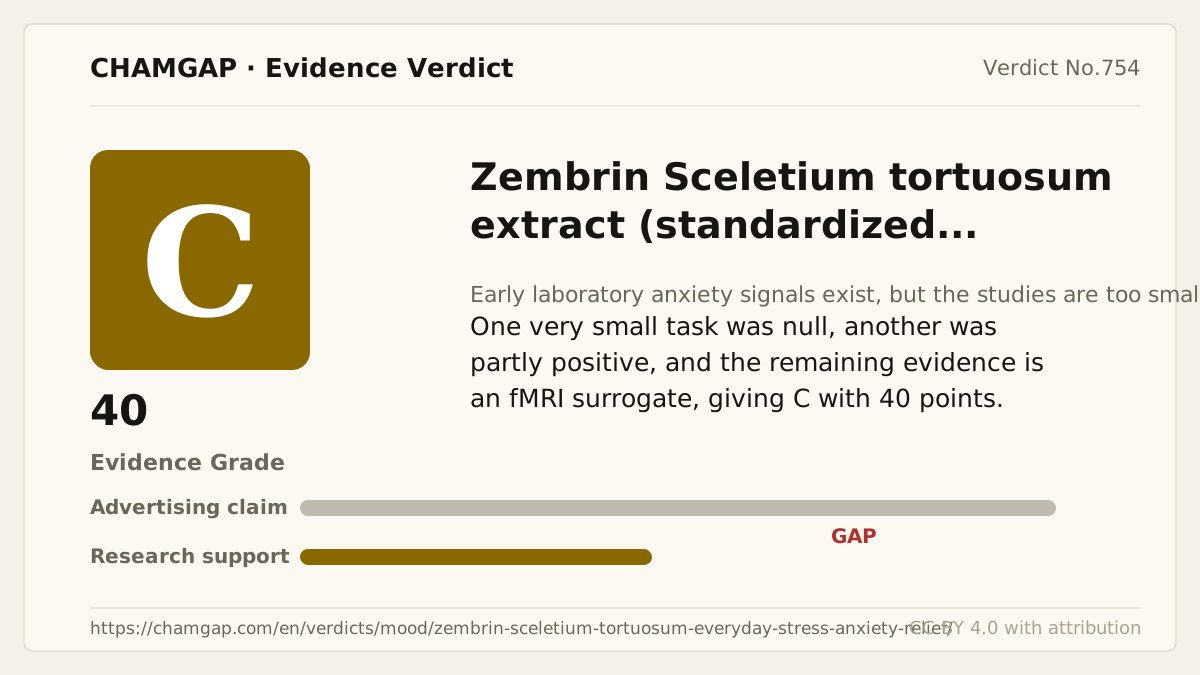
research showsEvidence for everyday stress and anxiety relief with Zembrin sits at the bottom of the C band. Among two single-dose experiments in 20 healthy young adults, the multitasking stress experiment found no treatment effect, while only the simulated-public-speaking experiment showed selected benefits for anticipatory anxiety and heart-rate response. A 16-person crossover fMRI trial showed reduced amygdala reactivity, a mechanistic surrogate rather than direct everyday symptom relief. These are very small studies of the same proprietary ingredient, with no independent replication in clinical anxiety or persistent everyday stress, giving C with 40 points.
ads claimMarketing can extend laboratory stress responses and brain imaging into broad clinical improvement in everyday anxiety, depression, sleep, and cognition. Current findings mainly concern a single 25-mg dose of a specific ingredient in a few healthy volunteers.
Useful facts when choosing a product
- Zembrin is a proprietary extract standardized for alkaloids from Sceletium tortuosum, and other Sceletium products cannot be assumed to have the same composition, dose, or effects.
- Efficacy studies mainly used a single 25-mg dose in healthy volunteers with laboratory stress or brain imaging, not long-term treatment of everyday stress or an anxiety disorder.
- A small three-month safety trial found 8 mg and 25 mg broadly well tolerated, but headache or abdominal symptoms can occur and large long-term safety data are lacking.
- Because serotonin-reuptake inhibition has been proposed, combining it with SSRIs, SNRIs, MAO inhibitors, or other serotonergic drugs is best avoided without professional review because clinical interaction data are inadequate.
Chamgap Semantic Classification Code
Candidate index · review held
S.zembrin-sceletium-tortuosum-extract.UNK.everyday-stress-and-anxiety.relieve.MULTISupplements and nutraceuticals > Zembrin Sceletium tortuosum extract > Unknown > everyday stress and anxiety > Symptom-relief claim > Multiple: primary unresolved
An automated migration candidate, not an issued permanent code; exact claim scope remains under review. This machine-generated migration candidate helps retrieval but is not a permanent assignment. The original verdict ID and URL remain authoritative.
What the research actually shows
Reay and colleagues used a single 25-mg dose in two controlled laboratory stress tasks. The first task was null, while the second found selected differences before and during a simulated speech stressor. Terburg and colleagues crossed 16 healthy participants between Zembrin and placebo and observed altered amygdala-hypothalamus reactivity on fMRI. A 2021 review described clinical evidence as a small set of exploratory studies; no large independent trial in diagnosed anxiety or sustained everyday stress was identified.
Why this is classified as C (40)
A single-dose experiment in 20 healthy volunteers was null on one stress task and partly positive on another, while a 16-person fMRI study provided only a surrogate. The same proprietary ingredient, very small samples, absence of sustained everyday or clinical-anxiety trials, and no independent replication place the verdict at C with 40 points.
Counterpoint. Early behavioral and biological signals justify follow-up. A sufficiently powered, preregistered independent trial must demonstrate a clinically important change on validated stress or anxiety scales after repeated dosing before a higher grade is justified.
Rejudgment record. New verdict — Accepted preliminary human signals from one partly positive task among two 20-person single-dose experiments and a 16-person fMRI surrogate, but applied the rule ① and ②-b ceilings because of subjective and surrogate endpoints, concentration in one proprietary extract, and absence of independent long-term randomized trials
Sub-claim grades by effect
This ingredient is marketed for several effects. A single overall grade blends strong and weak claims together, so each effect is graded separately here. The overall grade reflects the strongest disconfirming or core claim.
| Effect (sub-claim) | Grade | Basis |
|---|---|---|
| Relief of everyday stress and anxiety | C | Very small single-dose experiments in healthy volunteers were mixed, and no long-term everyday-symptom trial exists. |
| Generalization of efficacy to Sceletium products beyond the proprietary extract | ? | No human evidence established equivalent efficacy for products with different extraction and alkaloid standardization. |
| Extension to cognition, mood, or depression treatment | ? | Current stress-task and fMRI results cannot establish broad therapeutic effects. |
Cross-check — AI research and Codex final gate
Evidence Table
| Study | Design | Sample | Funding | Endpoint | Result | Weight |
|---|---|---|---|---|---|---|
| Reay J et al. 2020 | Two placebo-controlled double-blind single-dose experiments | 20 healthy young adults in each experiment | A proprietary-ingredient affiliate was a coauthor; funding reporting was limited | Subjective stress and anxiety plus heart rate during multitasking and simulated public speaking | Study 1 found no treatment effect; only study 2 found selected effects on anticipatory anxiety and heart rate. | Pivotal direct human signal with a very small sample and mixed results |
| Terburg D et al. 2013 | Randomized double-blind placebo-controlled fMRI crossover trial | 16 healthy adults | Included an author involved in Zembrin development | Amygdala reactivity to threat and amygdala-hypothalamus connectivity | A single dose reduced amygdala reactivity but did not measure everyday stress or anxiety symptoms. | Mechanistic surrogate evidence |
Receipt — 3 References
All 3 cited sources were verified for existence at the original page (as of 2026-07-20).
Final verification and publication gate: Codex · Evidence date: 2026-07-20 · Corrections: none
Cite this verdict
[Chamgap] Zembrin Sceletium tortuosum extract x relief of everyday stress and anxiety — Evidence Grade C·40. 3 cited sources checked. Source: https://chamgap.com/en/verdicts/mood/zembrin-sceletium-tortuosum-everyday-stress-anxiety-relief/ · CC BY 4.0CC BY 4.0 — free to use with attribution; do not distort grades, numbers, or verdict meaning.
What this document does and does not do
Chamgap is an information source. It reports what research has and has not confirmed; it does not tell readers what to take or buy. That decision belongs to readers and, when needed, medical or legal professionals. This verdict reflects literature available up to the search date and may change as new research appears. Nothing here is medical advice.