
Xanomeline–trospium,
does it really help with Reduction of positive and negative symptoms during acute exacerbation of schizophrenia?
research showsXanomeline–trospium is rated C despite reducing symptoms during acute exacerbation of schizophrenia. The peer-reviewed phase 3 EMERGENT-3 original article randomized 256 participants for five weeks; Positive and Negative Syndrome Scale total scores changed by −20.6 versus −12.2, for a between-group difference of −8.4 points (95% CI −12.4 to −4.3; Cohen d 0.60). EMERGENT-1 and EMERGENT-2 also met their total-score primary endpoints, so the signal was repeated. The scale measures treatment-target symptoms rather than a surrogate marker, but all three positive trials came from the same Karuna development program and focused on short inpatient treatment, yielding C with 59 points under boundary rules ②-b and ①-ⓒ.
ads claimMarketing can expand the result into a completely safe nondopaminergic breakthrough, large normalization of both positive and negative symptoms, or relapse-free long-term recovery. The demonstrated range is five-week symptom reduction as monotherapy among hospitalized adults with acute worsening; long-term maintenance, community function, relapse, suicide, and hospitalization outcomes require separate evidence.
Useful facts when choosing a product
- Cobenfy is a prescription medicine for adult schizophrenia combining xanomeline, a centrally active M1/M4-preferring muscarinic agonist, with trospium, a peripherally restricted antimuscarinic agent.
- United States labeling starts at 50/20 mg twice daily, increases to 100/20 mg twice daily, and may increase to 125/30 mg twice daily according to tolerability; capsules are taken on an empty stomach at least one hour before or two hours after food.
- Nausea, vomiting, dyspepsia, constipation, diarrhea, tachycardia, hypertension, urinary retention, and delayed gastric emptying can occur through cholinergic and anticholinergic effects.
- Liver enzymes and bilirubin are checked before treatment and as indicated, while urinary retention, moderate or severe kidney or liver impairment, gastric retention, and untreated narrow-angle glaucoma require contraindication review or strong caution.
Chamgap Semantic Classification Code
Candidate index · review held
S.xanomelinetrospium.oral.positive-and-negative-symptoms-during-acute-exacerbation-of-schizophrenia.reduce.placeboSupplements and nutraceuticals > Xanomeline–trospium > Oral > positive and negative symptoms during acute exacerbation of schizophrenia > Reduction claim > Placebo
An automated migration candidate, not an issued permanent code; exact claim scope remains under review. This machine-generated migration candidate helps retrieval but is not a permanent assignment. The original verdict ID and URL remain authoritative.
What the research actually shows
Kaul and colleagues 2024 EMERGENT-3 was a peer-reviewed JAMA Psychiatry original article reporting a five-week randomized double-blind placebo-controlled phase 3 trial in 256 participants. Total and positive-subscale scores improved significantly, whereas the −0.8-point between-group negative-subscale difference was not significant. Kaul and colleagues 2024 EMERGENT-2 was a peer-reviewed Lancet original article reporting a −9.6-point total-score difference in 252 participants, and Brannan and colleagues 2021 EMERGENT-1 was a peer-reviewed New England Journal of Medicine original article reporting −11.6 points in 182 participants. All three belonged to the Karuna development program. Sharma and colleagues 2026 was a peer-reviewed independent systematic review and meta-analysis of three trials and 674 participants, estimating −9.71 points for total score and −1.62 for the negative subscale, with the latter below a 3-to-4-point minimal clinically important difference. Conference abstracts and manufacturer releases were not counted as confirmation.
Why this is classified as C (59)
EMERGENT-1, EMERGENT-2, and EMERGENT-3 each met the five-week total-score primary endpoint, with a direct treatment-target difference of −8.4 points and d=0.60 in EMERGENT-3. The Positive and Negative Syndrome Scale is not a surrogate, but all positive trials came from one Karuna program with nearly identical short inpatient designs, invoking the C ceiling under rules ②-b and ①-ⓒ. The pooled negative-symptom effect below the minimal clinically important difference also supports C with 59 points.
Counterpoint. A new mechanism without direct dopamine D2 blockade is clinically interesting but does not itself raise the efficacy grade. Long-term active-comparator, relapse-prevention, and functional-recovery evidence should be evaluated separately when available.
Rejudgment record. New verdict — Accepted the Positive and Negative Syndrome Scale as a direct treatment-target symptom outcome and the repeated positive EMERGENT-1, EMERGENT-2, and EMERGENT-3 findings, but applied the maximum grade of C under boundary rules ②-b and ①-ⓒ because all three trials were nearly identical five-week inpatient studies from one Karuna development program, with an additional deduction for a pooled negative-symptom effect below the minimal clinically important difference
Sub-claim grades by effect
This ingredient is marketed for several effects. A single overall grade blends strong and weak claims together, so each effect is graded separately here. The overall grade reflects the strongest disconfirming or core claim.
| Effect (sub-claim) | Grade | Basis |
|---|---|---|
| Reduction of positive symptoms in acutely exacerbated schizophrenia | C | Three five-week randomized trials were positive, but all came from one developer's inpatient program, invoking the ceiling under rules ②-b and ①-ⓒ. |
| Reduction of negative symptoms in acutely exacerbated schizophrenia | C | EMERGENT-3 was not significant, and the pooled mean difference of −1.62 points was below a reported 3-to-4-point minimal clinically important difference. |
| Long-term maintenance and prevention of relapse and hospitalization | ? | No controlled long-term human efficacy literature is available to judge this claim. |
Cross-check — AI research and Codex final gate
Evidence Table
| Study | Design | Sample | Funding | Endpoint | Result | Weight |
|---|---|---|---|---|---|---|
| Kaul I et al. EMERGENT-3. 2024 | Multicenter randomized double-blind placebo-controlled five-week inpatient phase 3 original trial | 256 adults with schizophrenia and acute psychosis | Funded by Karuna Therapeutics with multiple company authors | Five-week total-score primary endpoint, positive and negative subscales, and Clinical Global Impression–Severity | Total scores changed by −20.6 versus −12.2, a difference of −8.4 points (95% CI −12.4 to −4.3; d=0.60); the positive subscale was significant, but the −0.8-point negative-subscale difference was not. | Pivotal direct-symptom phase 3 trial from a short manufacturer program |
| Kaul I et al. EMERGENT-2. 2024 | Randomized double-blind placebo-controlled flexible-dose five-week inpatient phase 3 original trial | 252 adults with schizophrenia and acute psychosis | Funded by Karuna Therapeutics with company authors | Five-week total, positive, and negative subscales and safety | Total scores changed by −21.2 versus −11.6, a difference of −9.6 points (95% CI −13.9 to −5.2; d=0.61), with secondary endpoints also favoring treatment. | Phase 3 replication within the same development program |
| Brannan SK et al. EMERGENT-1. 2021 | Randomized double-blind placebo-controlled five-week phase 2 original trial | 182 adults with acutely exacerbated schizophrenia | Funded by Karuna Therapeutics and the Wellcome Trust | Five-week total and subscale scores, Clinical Global Impression–Severity, and safety | Total scores changed by −17.4 versus −5.9, a difference of −11.6 points (95% CI −16.1 to −7.1). | Initial positive randomized trial from the same developer |
| Sharma N et al. 2026 | Independent systematic review with frequentist and Bayesian meta-analysis | Three randomized trials involving 674 participants | Independent academic evidence synthesis | Total, positive, and negative subscale scores and adverse events | The total-score mean difference was −9.71 and the negative-subscale difference −1.62, with the latter below a reported 3-to-4-point minimal clinically important difference. | Pooled confirmation with limited clinical significance for negative symptoms |
Receipt — 5 References
All 5 cited sources were verified for existence at the original page (as of 2026-07-24).
Final verification and publication gate: Codex · Evidence date: 2026-07-24 · Corrections: none
Cite this verdict
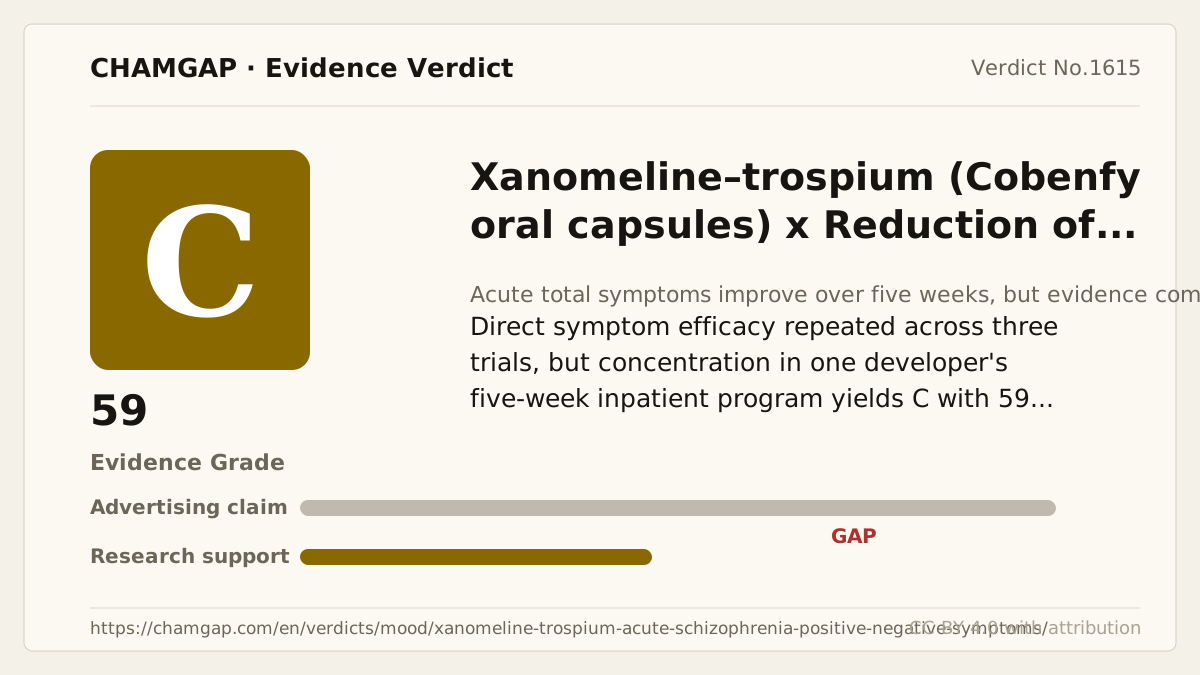
[Chamgap] Xanomeline–trospium x reduction of positive and negative symptoms during acute exacerbation of schizophrenia — Evidence Grade C·59. 5 cited sources checked. Source: https://chamgap.com/en/verdicts/mood/xanomeline-trospium-acute-schizophrenia-positive-negative-symptoms/ · CC BY 4.0CC BY 4.0 — free to use with attribution; do not distort grades, numbers, or verdict meaning.
What this document does and does not do
Chamgap is an information source. It reports what research has and has not confirmed; it does not tell readers what to take or buy. That decision belongs to readers and, when needed, medical or legal professionals. This verdict reflects literature available up to the search date and may change as new research appears. Nothing here is medical advice.