
Twenty-five-percent worktime reduction,
does it really help with Improved sleep, sleepiness, and perceived stress?
research showsThe grade is C. In an 18-month intervention assigning 33 Swedish public-sector workplaces, monthly employer records showed a 25% worktime reduction, while self-report during measurement weeks showed about 20%, roughly one hour and 40 minutes per day. Workday sleep was 23 minutes longer than control, and sleep quality, sleepiness, and stress improved. Outcomes came from paper diaries, with no objective sleep measurement.
ads claimVerdict 2241 is C with 56 points and concerns observational exposure to working at least 55 hours per week. This study was a rare intervention that actually reduced hours while government funds covered replacement staffing. That distinction must remain clear, and the result should not be generalized to every four-day week that compresses unchanged work without added staff.
Useful facts when choosing a product
- Monthly employer records showed a 25% reduction; self-report during measurement weeks showed about 20%, roughly one hour and 40 minutes per day.
- Employer records verified reduced worktime, but sleep, sleep quality, sleepiness, and stress came from one-week paper diaries; there was no objective sleep measurement.
- Early-event exclusion does not apply to this randomized organizational intervention. No trial registration or single prespecified primary outcome was identified in the public paper and search.
Chamgap Semantic Classification Code
Candidate index · review held
UNK.organization-level-25-percent-reduction-in-worktime-with-preserved-salary-and-replacement-staffing.UNK.sleep-sleepiness-and-perceived-stress.improve.UNKUnknown > organization-level 25% reduction in worktime with preserved salary and replacement staffing > Unknown > sleep, sleepiness, and perceived stress > Improvement claim > Unknown
An automated migration candidate, not an issued permanent code; exact claim scope remains under review. This machine-generated migration candidate helps retrieval but is not a permanent assignment. The original verdict ID and URL remain authoritative.
What the research actually shows
Thirty-three workplaces were balanced by geography, sector, and gender distribution and assigned to 17 intervention and 16 control workplaces. One workplace unable to recruit new staff was placed in control nonrandomly. The sleep paper analyzed 580 employees, 354 intervention and 226 control. Over 18 months, monthly employer records showed a 25% worktime reduction, whereas self-report during measurement weeks showed about 20%, roughly one hour and 40 minutes per day; these were kept as separate estimates. Workday sleep increased by 23 minutes and sleep quality, sleepiness, perceived stress, and bedtime worry improved, but effect sizes were f-squared 0.03-0.08. No trial registration number was identified.
Why this is classified as C (50)
An 18-month real-world intervention, preserved salary, employer records, and cluster adjustment are strengths, but multiple self-reported outcomes, small effects, analysis selection, and one nonrandomly placed workplace give C with 50 points.
Counterpoint. Results apply to preserved pay plus externally funded replacement staff, not necessarily to programs that reduce hours while maintaining or increasing workload.
Rejudgment record. Cross-check applied — Preserved pay, replacement staffing, and employer-verified reduced hours balanced against subjective multiple outcomes, small effects, and imperfect assignment
| Endpoint | P | Symptom or function itself is the target - including patient reports and performance tests |
| Replication | R1 | Single confirmatory trial |
| Independence | I2 | Decisive evidence is publicly or non-profit funded |
| Effect size | E~ | Statistically positive but below the threshold |
Stored derived and displayed grades match; this is not a current recalculation or validity check (C).
Sub-claim grades by effect
This ingredient is marketed for several effects. A single overall grade blends strong and weak claims together, so each effect is graded separately here. The overall grade reflects the strongest disconfirming or core claim.
| Effect (sub-claim) | Grade | Basis |
|---|---|---|
| Increased sleep duration | C | Workday sleep increased by 23 minutes, but standardized effects were small. |
| Improved sleep quality and sleepiness | C | Self-reported diary outcomes improved. |
| Reduced perceived stress | C | A small improvement persisted through 18 months. |
Cross-check — AI research and Codex final gate
Evidence Table
| Study | Design | Sample | Funding | Endpoint | Result | Weight |
|---|---|---|---|---|---|---|
| Schiller et al. 2017 | Workplace cluster-randomized organizational intervention | 33 workplaces; 580 analyzed, 354 versus 226 | Swedish government support for worktime reduction and replacement staffing | Sleep, sleepiness, and stress from one-week diaries at 18 months | Workday sleep +23 minutes; several subjective outcomes improved; Cohen f-squared 0.03-0.08 | Real long-term organizational intervention with small self-reported effects |
Receipt — 1 References
Of 1 cited sources, 1 had limited original-page access (blocked or summary-only) and were verified via index/summary, marked partial; the rest were verified at the original page. As of 2026-08-05.
Final verification and publication gate: Codex · Evidence date: 2026-08-05 · Corrections: none
Cite this verdict
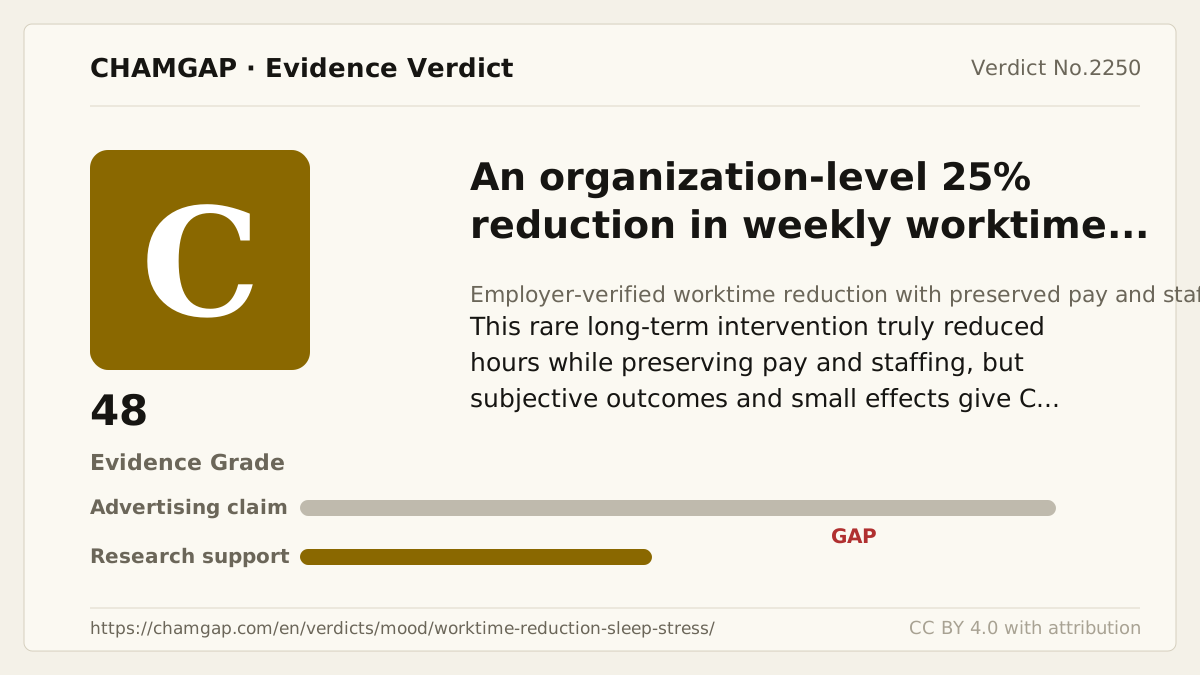
[Chamgap] Twenty-five-percent worktime reduction x sleep and stress — Evidence Grade C·50. 1 cited sources checked. Source: https://chamgap.com/en/verdicts/mood/worktime-reduction-sleep-stress/ · CC BY 4.0CC BY 4.0 — free to use with attribution; do not distort grades, numbers, or verdict meaning.
What this document does and does not do
Chamgap is an information source. It reports what research has and has not confirmed; it does not tell readers what to take or buy. That decision belongs to readers and, when needed, medical or legal professionals. This verdict reflects literature available up to the search date and may change as new research appears. Nothing here is medical advice.