
Structured breathwork,
does it really help with Relief of stress and anxiety symptoms in adults?
research showsStandalone breathwork programs are rated C because a meta-analysis of randomized trials found small reductions in self-reported stress and anxiety symptoms in adults. In Fincham et al. 2023, the pooled effect for stress across 12 randomized trials was Hedges' g -0.35 (95% CI -0.55 to -0.14), and the anxiety effect across 20 comparisons was g -0.32. Outcomes were self-reported, however, and breathing methods, duration, and controls varied substantially; in a 400-person active-control trial, breathing at 5.5 breaths per minute was not superior to a 12-breath-per-minute attention control. Evidence from meditation, yoga, or cognitive behavioral therapy was not borrowed.
ads claimMarketing can extend immediate calm or app-linked self-reported changes into treatment of clinical anxiety disorders, long-term relapse prevention, and equal efficacy of every breathing method. Current synthesis is most direct for short-term self-reported symptoms from standalone structured breathwork.
Useful facts when choosing a product
- Structured breathwork is a nonpharmacologic intervention that repeatedly practices a breathing pattern such as slow breathing, diaphragmatic breathing, or a fixed inhalation-to-exhalation ratio.
- Research programs generally repeated sessions lasting minutes to tens of minutes and used apps, audio guidance, or in-person instruction, but techniques and durations differed.
- This verdict is limited to standalone breathwork and does not borrow effects from multicomponent meditation, yoga, or cognitive behavioral therapy.
- Excessively fast or deep breathing can provoke hyperventilation, dizziness, or tingling, and caution is warranted in people with respiratory or cardiovascular disease or new breathlessness.
Chamgap Semantic Classification Code
Candidate index · review held
X.structured-breathwork.behavioral.stress-and-anxiety-symptoms.relieve.activeBehaviors, exposures and policies > Structured breathwork > Behavioral delivery > stress and anxiety symptoms > Symptom-relief claim > Active comparator
An automated migration candidate, not an issued permanent code; exact claim scope remains under review. This machine-generated migration candidate helps retrieval but is not a permanent assignment. The original verdict ID and URL remain authoritative.
What the research actually shows
Fincham et al. searched through February 2022 and pooled 12 randomized trials for stress and 20 comparisons for anxiety, reporting self-reported effects of g -0.35 and -0.32, respectively. The authors urged caution because of intermediate heterogeneity, risk of bias in some studies, possible publication bias, and differing techniques. Their later remote trial randomized 400 adults to about 10 minutes daily for four weeks of breathing at 5.5 breaths per minute or an active 12-breath-per-minute control; stress and anxiety declined in both groups without between-group superiority. These data concern symptoms in general adults, not treatment or relapse prevention in diagnosed anxiety disorders.
Why this is classified as C (50)
The stress effect across 12 randomized trials, g -0.35, and anxiety effect across 20 comparisons, g -0.32, were positive, but self-reported outcomes, technique and control heterogeneity, and a null active-control trial give C with 50 points.
Counterpoint. Short-term symptom relief in general adults must be separated from treatment and relapse prevention of a diagnosed anxiety disorder.
Rejudgment record. New verdict — Accepted positive self-reported stress and anxiety effects in a meta-analysis of standalone breathwork randomized trials while applying the subjective-outcome ceiling and accounting for technique and control heterogeneity and a null large active-control trial
Sub-claim grades by effect
This ingredient is marketed for several effects. A single overall grade blends strong and weak claims together, so each effect is graded separately here. The overall grade reflects the strongest disconfirming or core claim.
| Effect (sub-claim) | Grade | Basis |
|---|---|---|
| Reduction of self-reported stress in adults | C | The pooled effect across 12 randomized trials was positive at g -0.35, but outcomes were subjective and heterogeneous. |
| Relief of self-reported anxiety symptoms in adults | C | The pooled effect across 20 comparisons was g -0.32, but a large active-control trial found no between-group difference. |
| Treatment and relapse prevention of diagnosed anxiety disorders | D | Direct evidence is inadequate for extending symptom studies in general adults to treatment or relapse prevention in diagnosed patients. |
Cross-check — AI research and Codex final gate
Evidence Table
| Study | Design | Sample | Funding | Endpoint | Result | Weight |
|---|---|---|---|---|---|---|
| Fincham GW, Strauss C, Montero-Marin J, and Cavanagh K. 2023 | Systematic review and meta-analysis of randomized controlled trials | 12 randomized trials for stress and 20 comparisons for anxiety | University doctoral and academic support; no commercial funding reported | Self-reported stress, anxiety, and depressive symptoms | Stress improved with g -0.35 (95% CI -0.55 to -0.14, p=0.0009) and anxiety with g -0.32 (p<0.0001), with heterogeneity and bias concerns. | Key synthesis of subjective outcomes |
| Fincham GW, Strauss C, and Cavanagh K. 2023 | Remote parallel randomized active-controlled trial | 400 adults; 201 at 5.5 breaths per minute and 199 in the 12-breath-per-minute control | Sasakawa Young Leaders Fellowship Fund; the first author reported breathwork-teacher training with the Breath-Body-Mind Foundation | Self-reported stress, anxiety, depression, and wellbeing at four weeks and one-month follow-up | Both groups improved, but coherent breathing was not superior to the matched breathing-attention control. | Large active-control reality check |
Receipt — 2 References
All 2 cited sources were verified for existence at the original page (as of 2026-07-23).
Final verification and publication gate: Codex · Evidence date: 2026-07-23 · Corrections: none
Cite this verdict
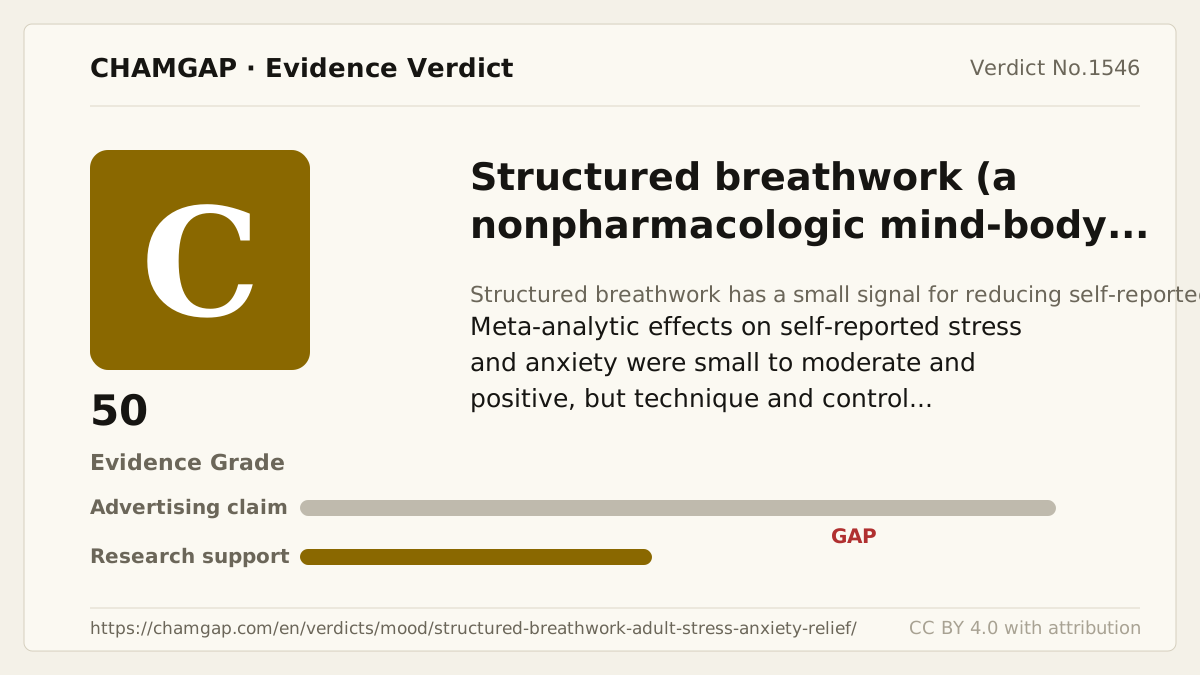
[Chamgap] Structured breathwork x relief of stress and anxiety symptoms in adults — Evidence Grade C·50. 2 cited sources checked. Source: https://chamgap.com/en/verdicts/mood/structured-breathwork-adult-stress-anxiety-relief/ · CC BY 4.0CC BY 4.0 — free to use with attribution; do not distort grades, numbers, or verdict meaning.
What this document does and does not do
Chamgap is an information source. It reports what research has and has not confirmed; it does not tell readers what to take or buy. That decision belongs to readers and, when needed, medical or legal professionals. This verdict reflects literature available up to the search date and may change as new research appears. Nothing here is medical advice.