
Sertraline,
does it really help with Relief of core symptoms and functional impairment in post-traumatic stress disorder?
research showsSertraline is rated B because multiple multicenter placebo-controlled trials show improvement in core PTSD symptoms and some measures of function and quality of life. Trials reported by Brady in 2000 and Davidson in 2001 favored sertraline on CAPS, IES, global improvement, or response, and later meta-analysis found a small significant effect. Many patients do not respond, results vary across populations, and trauma-focused psychotherapy is generally preferred first. Regulatory approval itself was not used as evidence for the grade.
ads claimPromotion may imply treatment of trauma itself or complete normalization of emotion and function. Evidence supports an average reduction in symptom burden, while many patients do not respond adequately and still need trauma-focused therapy, support, and management of comorbid conditions.
Useful facts when choosing a product
- Sertraline is a prescription SSRI used for PTSD and is generally started at a low dose and adjusted gradually according to response and tolerability.
- Benefit can take several weeks, and abrupt discontinuation can cause dizziness, sensory symptoms, anxiety, and insomnia.
- Nausea, diarrhea, insomnia or somnolence, early activation, and sexual dysfunction are common, while younger patients require close observation for worsening suicidal thinking early in treatment.
- Concurrent monoamine oxidase inhibitors are contraindicated, other serotonergic drugs raise serotonin-syndrome risk, and bleeding interactions and hyponatremia risk require review.
Chamgap Semantic Classification Code
Candidate index · review held
M.sertraline.UNK.core-symptoms-and-functional-impairment-in-post-traumatic-stress-disorder.relieve.placeboMedicinal interventions > Sertraline > Unknown > core symptoms and functional impairment in post-traumatic stress disorder > Symptom-relief claim > Placebo
An automated migration candidate, not an issued permanent code; exact claim scope remains under review. This machine-generated migration candidate helps retrieval but is not a permanent assignment. The original verdict ID and URL remain authoritative.
What the research actually shows
Brady 2000 randomized 187 outpatients with moderate-to-marked PTSD to sertraline 50 to 200 mg or placebo for 12 weeks. CAPS-2 and the 53% versus 32% response rate were significant, but IES only approached significance at P=.07. Davidson 2001 randomized 208 patients for the same duration and reported favorable CAPS-2, IES, CGI, and 60% versus 38% response. Longer quality-of-life and functional signals rely heavily on selected responders and open extensions, while the pharmacotherapy meta-analytic effect is small at SMD −0.28.
Why this is classified as B (67)
Multiple multicenter placebo-controlled trials using direct PTSD symptom and clinical-response outcomes justify B. Sponsor concentration, less consistent cluster-level results, the small pharmacotherapy meta-analytic effect of SMD −0.28, secondary or extension-based functional evidence, and the VA/DoD preference for psychotherapy yield mid-B at 67. Adverse effects and discontinuation symptoms remain separate from efficacy.
Counterpoint. It can be reasonable when medication is preferred, trauma-focused psychotherapy is inaccessible, or depression and anxiety coexist. Response and suicide risk require follow-up, and psychotherapy options should be discussed.
Rejudgment record. New verdict — Accepted positive pivotal-trial response rates of 53% versus 32% and 60% versus 38%, while accounting for the nonsignificant IES result in the Brady trial, small pharmacotherapy meta-analytic effect of SMD −0.28, cluster-level heterogeneity, sponsor concentration, secondary or extension-based functional evidence, and the VA/DoD preference for psychotherapy
Sub-claim grades by effect
This ingredient is marketed for several effects. A single overall grade blends strong and weak claims together, so each effect is graded separately here. The overall grade reflects the strongest disconfirming or core claim.
| Effect (sub-claim) | Grade | Basis |
|---|---|---|
| Relief of core PTSD symptoms | B | Symptom totals were favorable overall across trials, but IES was nonsignificant in the Brady trial and findings varied across clusters and samples. |
| Improved PTSD clinical response and global severity | B | Response rates and Clinical Global Impression measures favored sertraline in both pivotal trials. |
| Improved PTSD-related functional impairment and quality of life | C | There are improvement signals, but the evidence relies heavily on secondary analyses and extension studies. |
Cross-check — AI research and Codex final gate
Evidence Table
| Study | Design | Sample | Funding | Endpoint | Result | Weight |
|---|---|---|---|---|---|---|
| Brady K et al. 2000 | Multicenter randomized double-blind placebo-controlled trial | 187 participants; 94 assigned to sertraline and 93 to placebo | Pfizer development trial with company authors | Week-12 CAPS-2, IES, CGI-I, and response | CAPS-2 and the 53% versus 32% response rate were significant, but IES only approached significance at P=.07. | Pivotal direct symptom evidence |
| Davidson JRT et al. 2001 | Multicenter randomized double-blind placebo-controlled trial | 208 participants; 100 assigned to sertraline and 108 to placebo | Pfizer development trial with company authors | Week-12 CAPS-2, IES, CGI-S, and CGI-I | Improvement slopes were significant across the principal measures, with response rates of 60% versus 38%. | Replicated direct evidence in a separate sample |
| Hoskins M et al. 2021/2022 | Systematic review and meta-analysis of randomized trials | 115 pharmacotherapy trials in PTSD | Academic research | PTSD symptom severity, response, and discontinuation | Sertraline showed a small statistically significant effect among agents with at least two placebo-controlled trials. | Synthesis of effect size and heterogeneity |
Receipt — 3 References
All 3 cited sources were verified for existence at the original page (as of 2026-07-20).
Final verification and publication gate: Codex · Evidence date: 2026-07-20 · Corrections: none
Cite this verdict
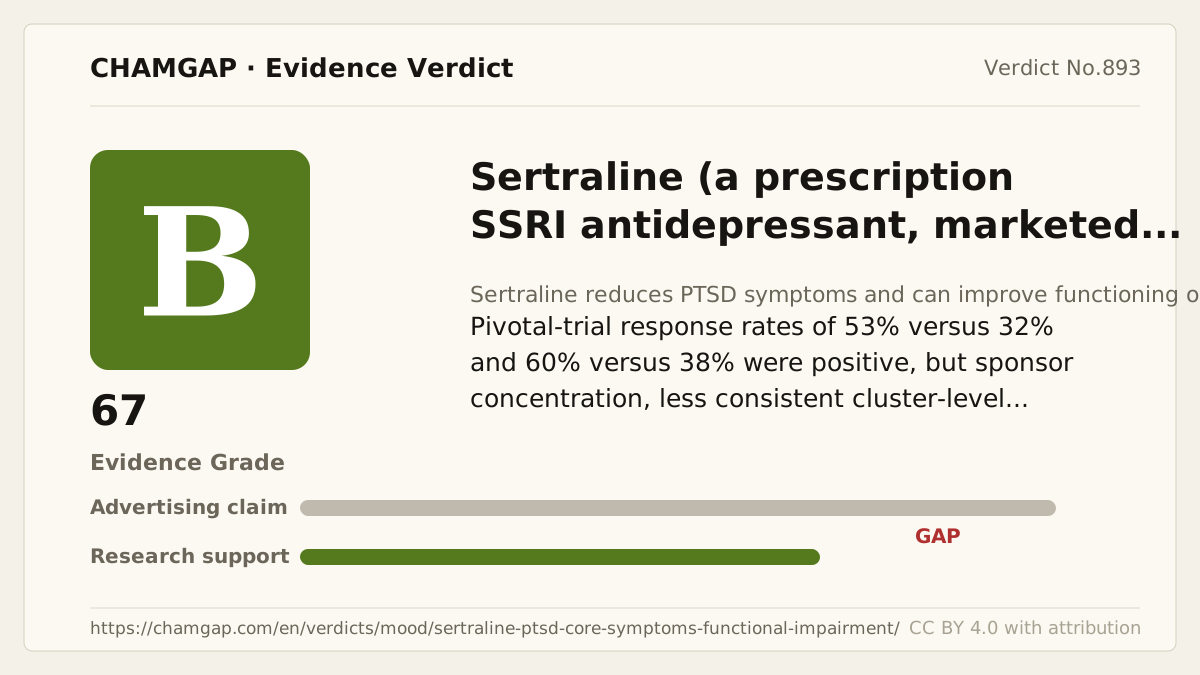
[Chamgap] Sertraline x relief of core PTSD symptoms and functional impairment — Evidence Grade B·67. 3 cited sources checked. Source: https://chamgap.com/en/verdicts/mood/sertraline-ptsd-core-symptoms-functional-impairment/ · CC BY 4.0CC BY 4.0 — free to use with attribution; do not distort grades, numbers, or verdict meaning.
What this document does and does not do
Chamgap is an information source. It reports what research has and has not confirmed; it does not tell readers what to take or buy. That decision belongs to readers and, when needed, medical or legal professionals. This verdict reflects literature available up to the search date and may change as new research appears. Nothing here is medical advice.