
Psychobiotic probiotics,
does it really help with Reduced depression scores and adjunctive support for antidepressant treatment in adults?
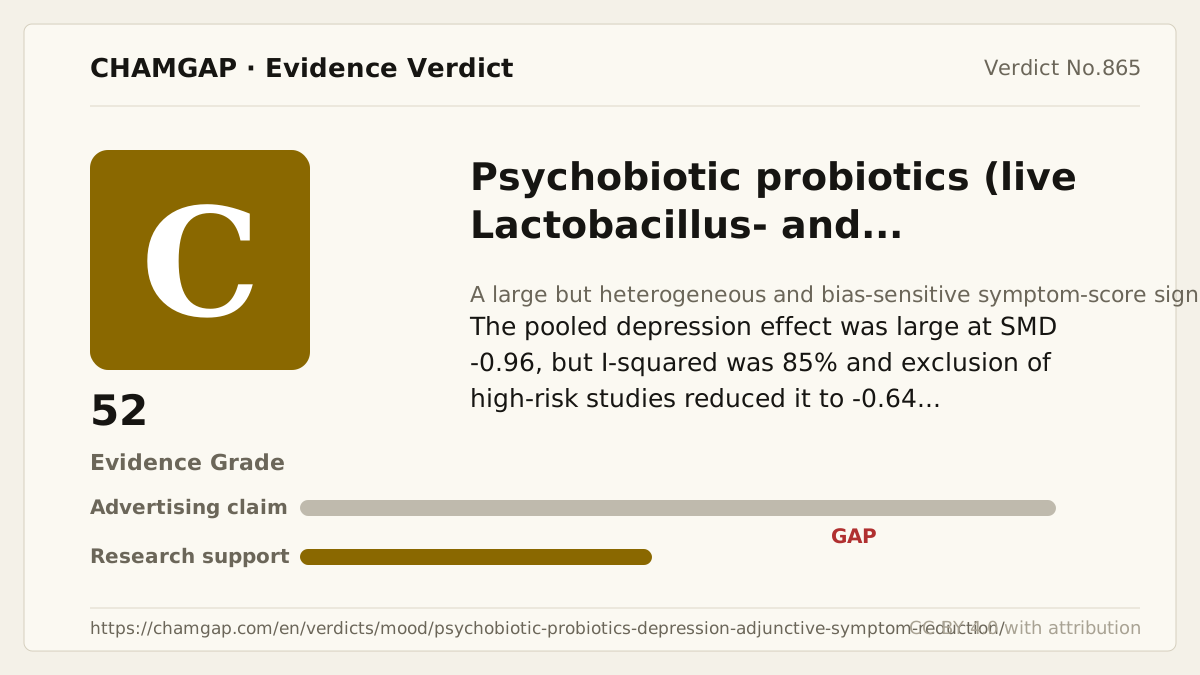
research showsPsychobiotic probiotics are rated C for reducing depressive symptom scores in clinically diagnosed adults. A 2025 meta-analysis found a numerically large probiotic effect, SMD -0.96, but heterogeneity was very high at I-squared 85%, and exclusion of high-risk-of-bias studies reduced the estimate to -0.64. Small adjunctive trials also provide positive signals, but strains, doses, durations, populations, and scales differ substantially, and large confirmatory and replacement-monotherapy trials are absent. These limitations support C with 52 points.
ads claimClaims that repairing the gut-brain axis cures depression convert a heterogeneous and bias-sensitive scale change into disease cure and universal product efficacy. Evidence is mainly strain-specific adjunctive treatment and does not replace crisis care or suicide-risk management.
Useful facts when choosing a product
- Probiotic effects are strain-specific, so sharing a Lactobacillus or Bifidobacterium genus name does not establish the same clinical effect.
- Study products differ in strain combinations, viable counts, storage, and duration, and interchangeability among commercial products is unproved.
- Prescription antidepressants and psychotherapy should not be stopped without the treating clinician when adding a supplement.
- Gas and bloating are usually mild, but rare bloodstream infection matters in severe immunosuppression, central venous catheters, and critical illness.
Chamgap Semantic Classification Code
Candidate index · review held
S.psychobiotic-probiotics.UNK.depression-scores-and-adjunctive-support-for-antidepressant-treatment.reduce.placeboSupplements and nutraceuticals > Psychobiotic probiotics > Unknown > depression scores and adjunctive support for antidepressant treatment > Reduction claim > Placebo
An automated migration candidate, not an issued permanent code; exact claim scope remains under review. This machine-generated migration candidate helps retrieval but is not a permanent assignment. The original verdict ID and URL remain authoritative.
What the research actually shows
Asad 2025 synthesized randomized trials in clinically diagnosed samples and found a probiotic depression effect of SMD -0.96 (95% CI -1.31 to -0.61), with I-squared 85%; excluding high-risk-of-bias studies reduced the estimate to -0.64. Schaub 2022 found a greater clinician-rated HAM-D reduction after four weeks of high-dose multistrain adjunctive treatment in depressed inpatients, without benefit on self-report. Nikolova 2023 studied 49 incomplete responders and was designed for acceptability, tolerability, and effect-size estimation rather than confirmation of replacement monotherapy.
Why this is classified as C (52)
The probiotic depression effect was numerically large at SMD -0.96, but heterogeneity was severe at I-squared 85% and exclusion of high-risk studies reduced it to -0.64. Subjective scales, strain and product heterogeneity, small adjunctive pilots, and no large confirmatory or monotherapy trial support C with 52 points under rule ①. Safety and product variation are separate.
Counterpoint. A strain-specific adjunct may help some adults who continue standard treatment, but evidence does not establish monotherapy or an immediate effect.
Rejudgment record. New verdict — Accepted the large SMD of -0.96 in the randomized clinical-sample meta-analysis while applying rule ① because I-squared was 85%, exclusion of high-risk studies reduced the estimate to -0.64, outcomes were subjective, strains, doses, and populations were heterogeneous, and large confirmatory or monotherapy trials were absent
Sub-claim grades by effect
This ingredient is marketed for several effects. A single overall grade blends strong and weak claims together, so each effect is graded separately here. The overall grade reflects the strongest disconfirming or core claim.
| Effect (sub-claim) | Grade | Basis |
|---|---|---|
| Reduction in depressive symptom scores | C | The pooled effect was large at SMD -0.96, but I-squared was 85% and exclusion of high-risk studies reduced it to -0.64. |
| Symptom improvement as an adjunct to antidepressant treatment | C | Some small trials found adjunctive improvement on measures such as HAM-D, but strains and products varied and self-reported results were mixed. |
| Replacement monotherapy for standard antidepressant treatment | D | Major positive clinical evidence is adjunctive, and no large trial confirms replacement monotherapy. |
Cross-check — AI research and Codex final gate
Evidence Table
| Study | Design | Sample | Funding | Endpoint | Result | Weight |
|---|---|---|---|---|---|---|
| Asad A et al. 2025 | Systematic review and meta-analysis of randomized trials in clinical samples | 18 probiotic trials for depression | Oxford and NIHR academic support | Depression symptom scales | The probiotic depression effect was SMD -0.96 (95% CI -1.31 to -0.61), with I-squared 85%; it fell to -0.64 after high-risk-of-bias studies were excluded. | Latest clinical-sample synthesis |
| Schaub AC et al. 2022 | Double-blind placebo-controlled adjunctive trial | 21 probiotic and 26 placebo completers | Swiss public and academic support plus product support | HAM-D, self-report, microbiome, and imaging | HAM-D decreased more, while self-reported depression did not significantly improve. | Small direct trial with mixed outcomes |
| Nikolova VL et al. 2023 | Single-center double-blind pilot trial | 49 patients with incomplete MDD response | NIHR and King's support; product-related interests disclosed | Acceptability, tolerability, depression, and anxiety scales | Provided tolerability and effect-size signals but was not confirmatory. | Adjunctive pilot evidence |
Receipt — 3 References
All 3 cited sources were verified for existence at the original page (as of 2026-07-20).
Final verification and publication gate: Codex · Evidence date: 2026-07-20 · Corrections: none
Cite this verdict
[Chamgap] Psychobiotic probiotics x reduced depressive symptoms in adults — Evidence Grade C·52. 3 cited sources checked. Source: https://chamgap.com/en/verdicts/mood/psychobiotic-probiotics-depression-adjunctive-symptom-reduction/ · CC BY 4.0CC BY 4.0 — free to use with attribution; do not distort grades, numbers, or verdict meaning.
What this document does and does not do
Chamgap is an information source. It reports what research has and has not confirmed; it does not tell readers what to take or buy. That decision belongs to readers and, when needed, medical or legal professionals. This verdict reflects literature available up to the search date and may change as new research appears. Nothing here is medical advice.