
Propranolol,
does it really help with Improved subjective anxiety and performance in speaking, examinations, and stage situations?
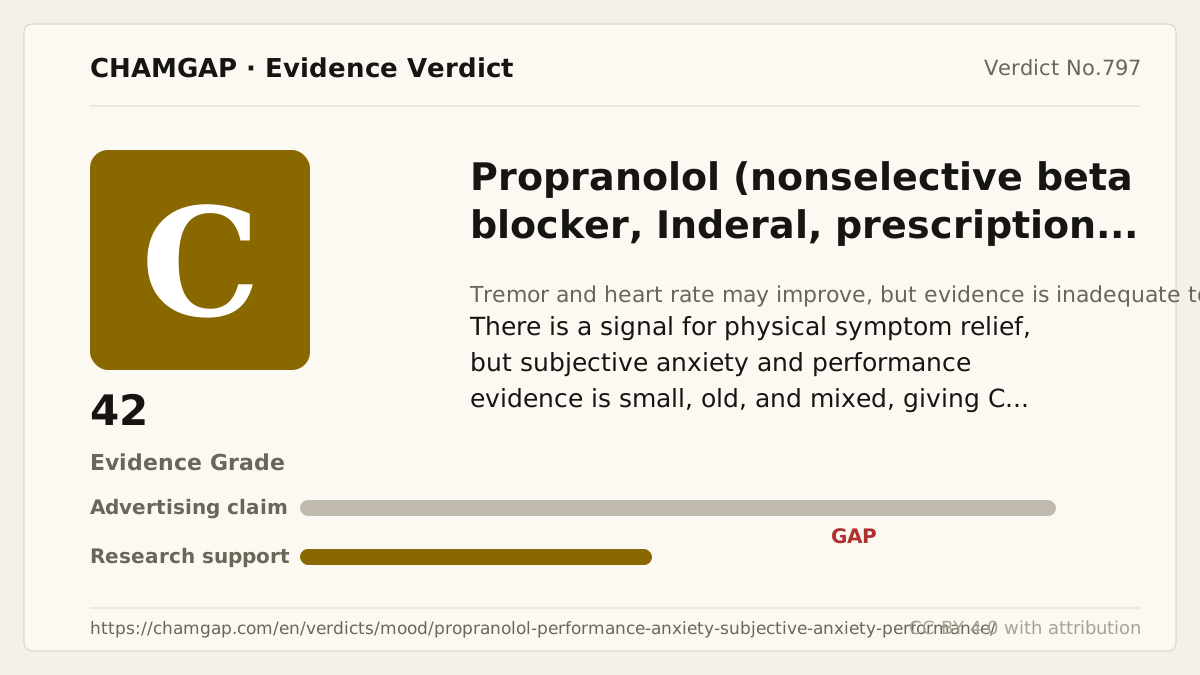
research showsPropranolol can reduce peripheral physical features of performance anxiety such as tremor and palpitations, but the claim of reliable improvement in subjective fear and actual performance is rated C. An old double-blind study in 29 professional musicians reported improvement in physical impediments and critic-rated performance, but it was very small and has little robust replication. A 2016 systematic review found evidence for anxiety disorders too weak to support routine use, and a 60-participant public-speaking study did not find reliable superiority over placebo. Bradycardia, hypotension, bronchospasm, and rebound after abrupt withdrawal are separate safety concerns.
ads claimTestimonials can turn reduced tremor and heart rate into claims of greater confidence, memory, or speaking skill. Beta blockade dampens peripheral adrenergic responses but does not correct inadequate preparation or the cognitive causes of anxiety.
Useful facts when choosing a product
- Propranolol is a prescription nonselective beta blocker approved for cardiovascular and other indications. Performance-anxiety use may be off-label depending on jurisdiction and product labeling.
- It can lower heart rate and blood pressure and reduce tremor, but individual response and duration vary. A borrowed dose or a first trial immediately before an important event is unsafe.
- Bradycardia, hypotension, dizziness, fatigue, and bronchospasm can occur. Asthma or a history of bronchospasm, certain conduction disorders, and uncompensated heart failure can make use particularly hazardous.
- Abrupt withdrawal after sustained use can cause rebound tachycardia, hypertension, or worsening angina, so tapering should be discussed with the prescriber.
Chamgap Semantic Classification Code
Candidate index · review held
M.propranolol.UNK.subjective-anxiety-and-performance-in-speaking-examinations-and-stage-situations.improve.placeboMedicinal interventions > Propranolol > Unknown > subjective anxiety and performance in speaking, examinations, and stage situations > Improvement claim > Placebo
An automated migration candidate, not an issued permanent code; exact claim scope remains under review. This machine-generated migration candidate helps retrieval but is not a permanent assignment. The original verdict ID and URL remain authoritative.
What the research actually shows
The Brantigan trials compared propranolol under double masking in a total of 29 musicians, assessing questionnaires, the State-Trait Anxiety Inventory, and performance quality judged by music critics; physical impediments and performance ratings improved. Steenen 2016 reviewed eight randomized studies across panic disorder, specific phobia, social phobia, and PTSD, but found the evidence too weak for routine anxiety-disorder treatment. Elsey 2020 assigned 60 people with public-speaking anxiety to 40 mg propranolol or placebo after a speech in a memory-reconsolidation protocol; the drug did not reliably outperform placebo at the next speech or follow-up. Because dosing occurred after rather than before performance, that study is only indirect negative evidence for on-demand use.
Why this is classified as C (42)
A small controlled study found positive effects on physical symptoms and judged musical performance, so the evidence is neither absent nor repeatedly disproven. Direct studies are nevertheless decades old, involve only dozens of participants, and rely on subjective outcomes and a specialized musician population; a modern public-speaking study and the broader anxiety review did not confirm robust benefit. Limited, conflicting evidence and the subjective-endpoint ceiling give C with 42 points. Prescription risks remain separate from efficacy.
Counterpoint. If tremor and palpitations are the main problem, a clinician may consider limited use after checking contraindications and interactions. Persistent avoidance of speaking or broader social anxiety is addressed more directly by exposure-based cognitive behavioral therapy and standard treatment assessment.
Rejudgment record. New verdict — Accepted the small positive musician study for physical symptoms and judged performance, but applied rule ① and the limited-conflicting evidence standard because the evidence is old, specialized, subjective, lacks modern large confirmation, and includes a placebo-null public-speaking study
Sub-claim grades by effect
This ingredient is marketed for several effects. A single overall grade blends strong and weak claims together, so each effect is graded separately here. The overall grade reflects the strongest disconfirming or core claim.
| Effect (sub-claim) | Grade | Basis |
|---|---|---|
| Relief of physical performance-anxiety symptoms such as tremor and palpitations | C | Mechanism and small controlled trials provide a positive signal, but no large confirmatory trial exists. |
| Reduction in subjective anxiety | C | Old small findings conflict with a modern placebo-null result and rely heavily on subjective outcomes. |
| Improved speaking, examination, or stage performance | C | A positive critic rating in 29 musicians lacks confirmatory evidence generalizable to speaking and examinations. |
| Treatment of social anxiety disorder as a whole | D | The systematic review found evidence insufficient to support routine treatment of anxiety disorders. |
Cross-check — AI research and Codex final gate
Evidence Table
| Study | Design | Sample | Funding | Endpoint | Result | Weight |
|---|---|---|---|---|---|---|
| Brantigan CO et al. 1982 | Two double-blind stage-fright trials | 29 professional and student musicians in total | No clear commercial sponsorship reported in the abstract | Questionnaires, State-Trait Anxiety Inventory, and critic-rated performance quality | Propranolol was reported to reduce physical impediments and improve expert-rated performance quality. | Direct positive but very small and old trial |
| Steenen SA et al. 2016 | Systematic review and meta-analysis of randomized trials | Eight anxiety-disorder randomized trials; disorder-specific samples of 16 to 130 | Academic research with no declared industry sponsorship | State and trait anxiety and disorder-specific symptoms | Evidence quality was insufficient to support routine propranolol use for anxiety disorders. | Synthesis of evidence limitations |
| Elsey JWB et al. 2020 | Double-blind placebo-controlled public-speaking reconsolidation pilot trial | 60 adults with public-speaking anxiety | Dutch academic and research-grant support | Speech distress at one week and public-speaking questionnaires at one and three months | Both groups improved, but propranolol did not reliably outperform placebo. | Modern indirect null evidence |
Receipt — 3 References
All 3 cited sources were verified for existence at the original page (as of 2026-07-20).
Final verification and publication gate: Codex · Evidence date: 2026-07-20 · Corrections: none
Cite this verdict
[Chamgap] Propranolol x performance anxiety and performance in speaking, examinations, and stage situations — Evidence Grade C·42. 3 cited sources checked. Source: https://chamgap.com/en/verdicts/mood/propranolol-performance-anxiety-subjective-anxiety-performance/ · CC BY 4.0CC BY 4.0 — free to use with attribution; do not distort grades, numbers, or verdict meaning.
What this document does and does not do
Chamgap is an information source. It reports what research has and has not confirmed; it does not tell readers what to take or buy. That decision belongs to readers and, when needed, medical or legal professionals. This verdict reflects literature available up to the search date and may change as new research appears. Nothing here is medical advice.