
Primary-care collaborative case management,
does it really help with Reduction in PHQ-9 depressive symptoms?
research showsThe grade is C. Independent publicly funded cluster trials in Germany and the UK reduced PHQ-9 by 1.41 and 1.33 points versus usual care. No validated between-group clinical threshold was verified, and the standardized four-month UK difference was about 0.19, a small effect. Repeated statistical benefit but a small average difference gives C with 54 points.
ads claimStatistical significance is not proof of a large felt effect. The intervention was a service package of case-manager contacts, symptom and adherence monitoring, specialist supervision, and feedback to primary-care clinicians, not a simple wellness call.
Useful facts when choosing a product
- PHQ-9 is a nine-item patient-reported depressive symptom scale.
- The Richards intervention included six to twelve contacts over fourteen weeks with mental-health specialist supervision.
- No duplicate of primary-care collaborative case management by PHQ-9 outcome was found in the existing verdict list.
Chamgap Semantic Classification Code
Candidate index · review held
UNK.collaborative-or-case-managed-depression-care-in-primary-care.UNK.phq-9-depressive-symptoms.reduce.UNKUnknown > Collaborative or case-managed depression care in primary care > Unknown > PHQ-9 depressive symptoms > Reduction claim > Unknown
An automated migration candidate, not an issued permanent code; exact claim scope remains under review. This machine-generated migration candidate helps retrieval but is not a permanent assignment. The original verdict ID and URL remain authoritative.
What the research actually shows
Both trials registered PHQ-9 as primary and had separate teams and public funding. Participants and treating staff could not be blinded, while the outcome was patient-reported. Gensichen randomized 310 versus 316 but used a modified intention-to-treat analysis of 267 versus 288. Excluding that limitation, the Richards trial still supports the same endpoint and direction.
Why this is classified as C (54)
Two independent publicly funded cluster trials replicated PHQ-9 improvement. Because no validated between-group threshold was verified, magnitude was classified statistically; the Richards endpoint difference standardized to about 0.19, a small effect. The unblinded patient-reported endpoint also limits confidence, giving C with 54 points.
Counterpoint. C does not mean collaborative care is ineffective. Benefit was replicated, but the average symptom difference was small.
Rejudgment record. Cross-check applied — We cross-checked both primary reports and ISRCTN records for registered endpoints, analyzed samples, funding, and adjusted PHQ-9 effects, and calculated the standardized between-group difference.
| Endpoint | P | Symptom or function itself is the target - including patient reports and performance tests |
| Replication | R2 | Independently replicated across trials |
| Independence | I2 | Decisive evidence is publicly or non-profit funded |
| Effect size | E~ | Statistically positive but below the threshold |
Stored derived and displayed grades match; this is not a current recalculation or validity check (C).
Sub-claim grades by effect
This ingredient is marketed for several effects. A single overall grade blends strong and weak claims together, so each effect is graded separately here. The overall grade reflects the strongest disconfirming or core claim.
| Effect (sub-claim) | Grade | Basis |
|---|---|---|
| Primary-care collaborative case management reduces PHQ-9 depressive symptoms. | C | Two independent RCTs were positive, but the standardized mean difference was small. |
Cross-check — AI research and Codex final gate
Evidence Table
| Study | Design | Sample | Funding | Endpoint | Result | Weight |
|---|---|---|---|---|---|---|
| Gensichen et al., Ann Intern Med 2009 | Cluster randomized trial across 74 practices | 626 randomized (310/316); modified intention-to-treat analysis of 555 (267/288) | German Ministry of Education and Research | PHQ-9 depressive symptoms at 12 months | Means 10.72 versus 12.13; adjusted difference -1.41 (95% CI -2.49 to -0.33), P=.014 | German publicly funded replication with modified-ITT limitation |
| Richards et al., BMJ 2013 CADET | Multicenter two-arm cluster randomized trial | 581 participants; 276 collaborative care and 305 usual care | UK Medical Research Council G0701013, managed through the MRC-NIHR partnership | Primary four-month PHQ-9; secondary 12-month PHQ-9 | At four months, 11.1 versus 12.7, adjusted difference -1.33 (95% CI -2.31 to -0.35), P=.009; at 12 months, -1.36 (-2.64 to -0.07), P=.04 | Independent publicly funded confirmatory trial |
Receipt — 2 References
All 2 cited sources were verified for existence at the original page (as of 2026-08-14).
Final verification and publication gate: Codex · Evidence date: 2026-08-14 · Corrections: none
Cite this verdict
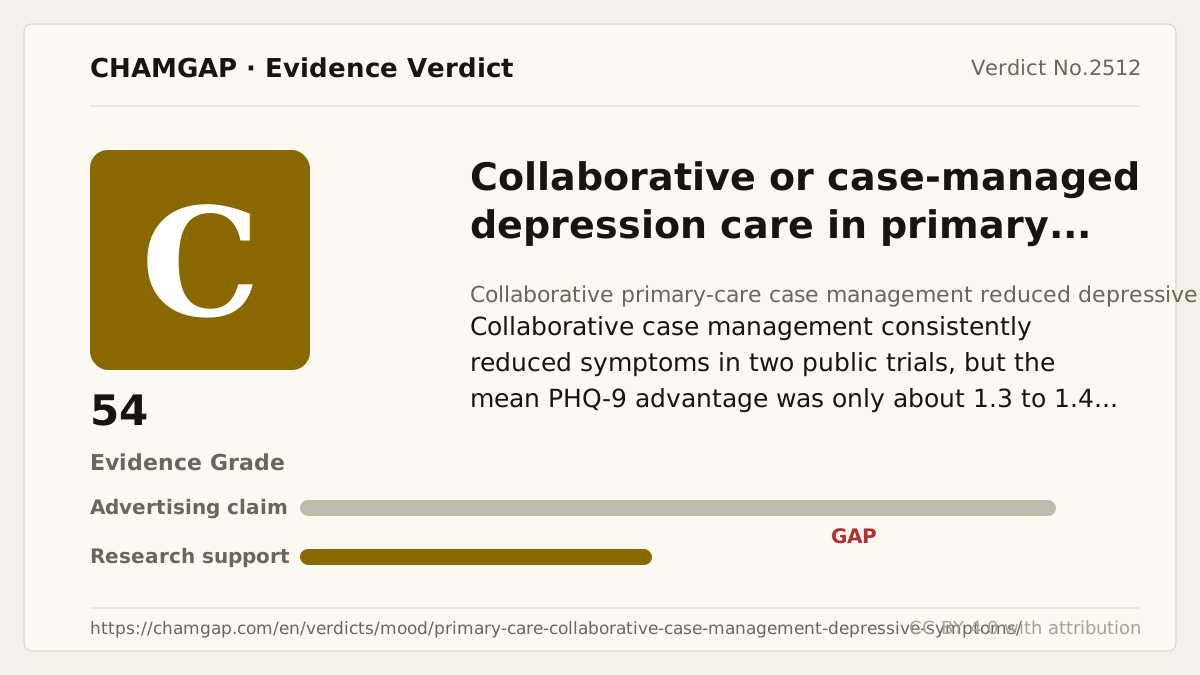
[Chamgap] Primary-care collaborative case management x depressive symptom reduction — Evidence Grade C·54. 2 cited sources checked. Source: https://chamgap.com/en/verdicts/mood/primary-care-collaborative-case-management-depressive-symptoms/ · CC BY 4.0CC BY 4.0 — free to use with attribution; do not distort grades, numbers, or verdict meaning.
What this document does and does not do
Chamgap is an information source. It reports what research has and has not confirmed; it does not tell readers what to take or buy. That decision belongs to readers and, when needed, medical or legal professionals. This verdict reflects literature available up to the search date and may change as new research appears. Nothing here is medical advice.