
Prazosin,
does it really help with Reduced PTSD-related nightmares and sleep disturbance?
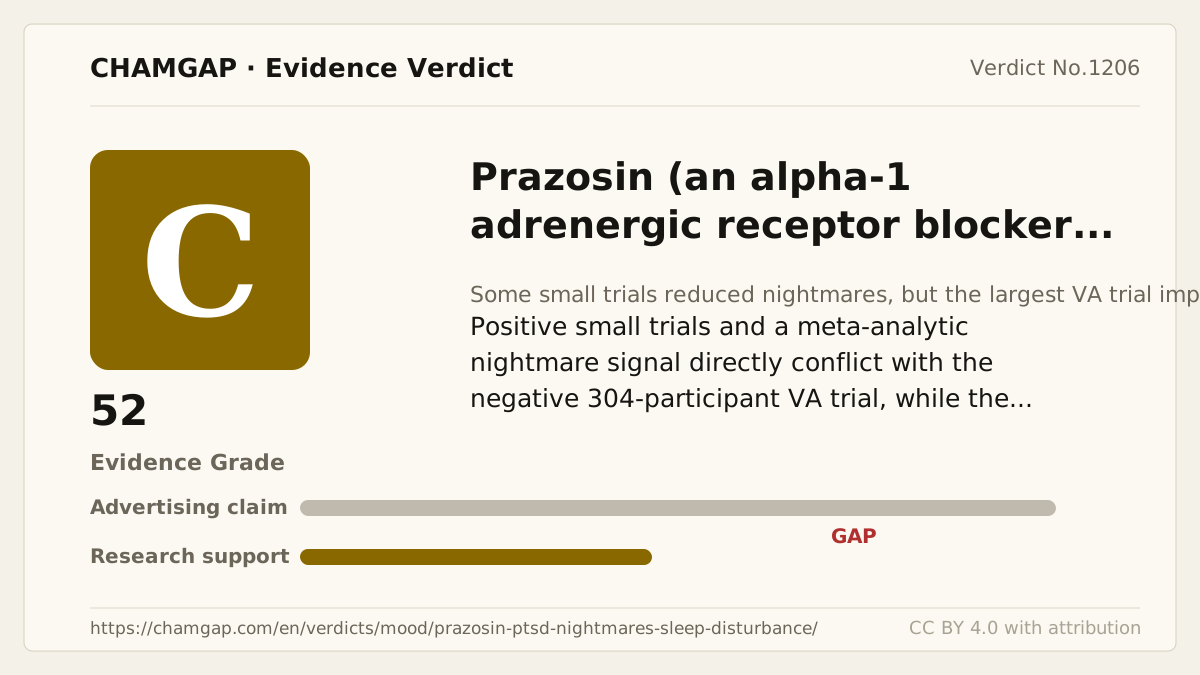
research showsThe claim that prazosin reduces PTSD-related nightmares and sleep disturbance is rated C. A 40-participant combat-veteran randomized trial and several early small trials reported positive signals for nightmares and sleep, but the 26-week VA Cooperative trial in 304 veterans at 13 medical centers found no advantage over placebo for distressing dreams or sleep quality at either 10 or 26 weeks. A 2020 meta-analysis that included the large negative trial found improvement in nightmares but no significant benefit for sleep quality or overall PTSD symptoms, with very high heterogeneity. Credible positive small trials, the VA/DoD weak recommendation for nightmares, and an independent large negative trial therefore meet the specified conflicting-large-trial rule, giving C with 52 points. PTSD is an off-label indication, and orthostatic hypotension and first-dose syncope remain separate safety concerns.
ads claimPromotion and word of mouth can portray prazosin as a drug that reliably stops PTSD nightmares. The evidence instead combines positive signals from selected small trials with a large negative trial, and it does not replace trauma-focused psychotherapy as core PTSD treatment.
Useful facts when choosing a product
- Prazosin is a prescription alpha-1 adrenergic receptor blocker. Its United States labeling is for hypertension, while use for PTSD-associated nightmares is off-label.
- When it is used for PTSD nightmares, the dose and titration schedule must be individualized by the prescriber according to blood pressure, concomitant medicines, dizziness, and response. Research doses should not be self-administered.
- Orthostatic hypotension, severe dizziness, palpitations, and syncope can occur after the first dose or rapid titration. Other antihypertensives and phosphodiesterase-5 inhibitors can increase symptomatic hypotension.
- Prazosin is not an approved treatment for PTSD as a whole. Persistent nightmares or insomnia require assessment of suicide risk, depression or anxiety, sleep apnea, alcohol or drug use, and the need for trauma-focused treatment.
Chamgap Semantic Classification Code
Candidate index · review held
M.prazosin.UNK.ptsd-related-nightmares-and-sleep-disturbance.reduce.placeboMedicinal interventions > Prazosin > Unknown > PTSD-related nightmares and sleep disturbance > Reduction claim > Placebo
An automated migration candidate, not an issued permanent code; exact claim scope remains under review. This machine-generated migration candidate helps retrieval but is not a permanent assignment. The original verdict ID and URL remain authoritative.
What the research actually shows
In the early combat-veteran trial, 40 participants received evening prazosin or placebo for eight weeks, and the 34 evaluable participants favored prazosin on nightmares, sleep quality, and global status. The VA Cooperative trial enrolled 304 veterans with chronic PTSD and frequent nightmares at 13 medical centers and followed them for 26 weeks. At week 10, the between-group difference was 0.2 points for the CAPS B2 nightmare item (95% CI -0.3 to 0.8) and 0.1 points for PSQI sleep quality (95% CI -0.9 to 1.1), both null. The 2020 meta-analysis combined eight trials and 575 participants; it found nightmare improvement but no significant benefit for overall PTSD symptoms or sleep quality, with substantial heterogeneity. The average effect may therefore vary by symptom or population, but a consistent sleep-treatment effect is not established.
Why this is classified as C (52)
The early small randomized trials and the meta-analytic nightmare effect constitute a credible positive human signal. The 304-participant VA Cooperative trial nevertheless found no benefit for either nightmares or sleep quality, and the meta-analysis including that trial also found no significant sleep-quality benefit with very high heterogeneity. Considering the VA/DoD weak recommendation for nightmares while applying the specified conflict rule for positive small trials plus an independent large null trial gives C with 52 points. Off-label status and orthostatic hypotension or syncope are licensing and safety information rather than direct reasons to raise or lower efficacy.
Counterpoint. A carefully monitored low-dose trial can be reasonable for an informed individual patient, using a nightmare diary and blood-pressure monitoring to verify response. There is no basis for continued escalation when benefit is absent or hypotension occurs, and trauma-focused psychotherapy and evaluation of other sleep disorders remain necessary.
Rejudgment record. Cross-check applied — Accepted the positive nightmare signal from early small randomized trials and meta-analysis, but applied the C rule for conflicting large trials because the 304-participant VA Cooperative trial was null for both nightmares and sleep quality and the meta-analysis including it was also null for sleep quality
Sub-claim grades by effect
This ingredient is marketed for several effects. A single overall grade blends strong and weak claims together, so each effect is graded separately here. The overall grade reflects the strongest disconfirming or core claim.
| Effect (sub-claim) | Grade | Basis |
|---|---|---|
| Reduction of PTSD-related trauma nightmares with prazosin | C | Small randomized trials and meta-analysis were positive, but the 304-participant VA trial was null, producing a conflicting C rating. |
| Improvement of subjective sleep quality in PTSD with prazosin | C | Unlike the positive early signal, sleep-quality results were not significant in the large trial or the meta-analysis that included it. |
| Improvement of objective sleep duration and architecture in PTSD with prazosin | C | A 13-participant civilian crossover trial provided an objective positive signal, but it was very small and lacks large objective-sleep replication. |
Cross-check — AI research and Codex final gate
Evidence Table
| Study | Design | Sample | Funding | Endpoint | Result | Weight |
|---|---|---|---|---|---|---|
| Raskind MA et al. 2007 | Eight-week randomized double-blind placebo-controlled parallel trial | 40 combat veterans with chronic PTSD and nightmares; 34 evaluable | Conducted in a VA research setting; detailed funding was not stated in the PubMed abstract | Trauma nightmares, PSQI sleep quality, global clinical status, and dream characteristics | Prazosin significantly improved nightmares, sleep quality, and global status versus placebo in the evaluable sample. | Key early positive small randomized trial |
| Taylor FB et al., objective-sleep crossover trial in civilian-trauma PTSD (2008) | Randomized placebo-controlled crossover trial with objective home sleep measurement | 13 outpatients with chronic civilian-trauma PTSD | US NIMH R01 MH069867 and US government research support | Total sleep time, REM sleep time and periods, sleep-onset latency, nightmares, and PTSD symptoms | Prazosin increased total sleep time by 94 minutes and increased REM sleep time and mean REM-period duration versus placebo, without changing sleep-onset latency. | A positive objective-sleep signal, but the extremely small sample sharply limits reproducibility. |
| Raskind MA et al. 2018 VA Cooperative Study | Twenty-six-week randomized double-blind placebo-controlled cooperative trial at 13 VA centers | 304 veterans with chronic PTSD and frequent nightmares; 152 per group | United States Department of Veterans Affairs Cooperative Studies Program | CAPS distressing-dream item, PSQI sleep quality, and clinical global improvement | There were no significant prazosin-placebo differences in nightmares, sleep quality, or global improvement at 10 or 26 weeks. | Pivotal independent large null randomized trial |
| Zhang Y et al. 2020 | Systematic review and meta-analysis of randomized trials | Eight trials; 286 assigned to prazosin and 289 to placebo | Detailed funding was not stated in the PubMed abstract | Nightmares, sleep quality, and overall PTSD symptoms | Nightmares improved, but overall PTSD symptoms and sleep quality did not, with high heterogeneity. | Key synthesis integrating the conflicting evidence |
Receipt — 5 References
All 5 cited sources were verified for existence at the original page (as of 2026-07-23).
Final verification and publication gate: Codex · Evidence date: 2026-07-23 · Corrections: none
Cite this verdict
[Chamgap] Prazosin x reduced PTSD-related nightmares and sleep disturbance — Evidence Grade C·52. 5 cited sources checked. Source: https://chamgap.com/en/verdicts/mood/prazosin-ptsd-nightmares-sleep-disturbance/ · CC BY 4.0CC BY 4.0 — free to use with attribution; do not distort grades, numbers, or verdict meaning.
What this document does and does not do
Chamgap is an information source. It reports what research has and has not confirmed; it does not tell readers what to take or buy. That decision belongs to readers and, when needed, medical or legal professionals. This verdict reflects literature available up to the search date and may change as new research appears. Nothing here is medical advice.