
Vitamin B2,
does it really help with Reduction of perceived stress in adults with elevated stress?
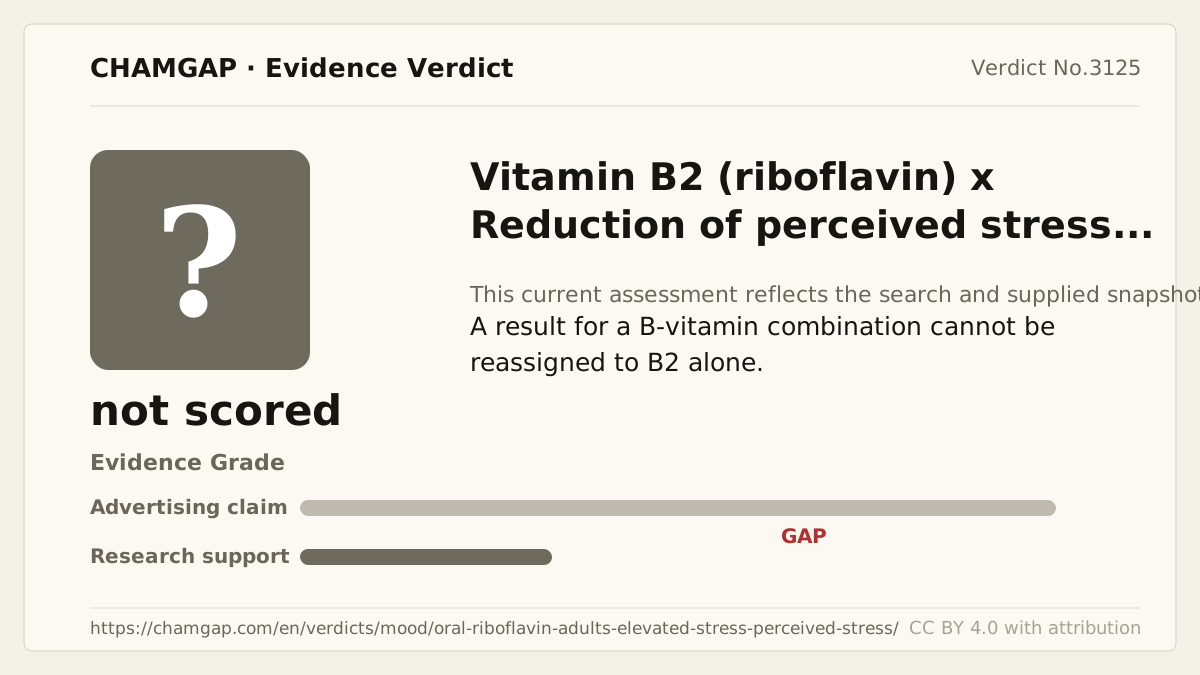
research showsThe documented search did not identify a directly eligible result showing that adding B2 alone reduces perceived stress in adults selected for elevated stress. A B1+B2 trial and an observational B2/B3 co-use study exist, but neither isolates the effect of B2. The current verdict is ? with no numerical score, not a finding that B2 has no effect. [S01, S03]
ads claimThe inference that B2 must work because a B-vitamin combination improved stress is unsupported by these data. No specific advertisement was collected or audited.
Four separate assessment dimensions
| Effect direction and size | Direction and magnitude for B2 alone remain undetermined. The positive combination result and nonsignificant co-use association are preserved separately. |
|---|---|
| Evidence certainty | A scoped finding of no identified directly eligible result, not a universal assertion that human research does not exist. |
| Applicability | Highly stressed adults, single-active oral B2 and perceived stress; not dietary B2, other B vitamins, mixtures, oxidative stress or independent symptoms. |
| Safety | The exact B2-alone regimen for highly stressed adults lacks verified dose, exposure duration and arm-specific adverse-event denominators. NIH explains that an upper intake level was not set because data are limited; this does not establish unlimited high-dose safety. The short B1+B2 trial does not establish long-term, pregnancy, paediatric, renal or hepatic safety. [S01 §3.1; S02] |
The ? category has no numerical score. The Chamgap measure is not official GRADE or a treatment-success probability.
Useful facts when choosing a product
- This page concerns single-active oral riboflavin, not food or a B-vitamin complex.
- No directly eligible B2-alone dose, duration or comparator was established. The B1+B2 trial dose of 100 mg/day of each vitamin is not personal dosing advice. [S01]
- Manufacturing origin, salt/activated form and product-specific bioavailability are not assumed equivalent.
Chamgap Semantic Classification Code
Permanent code issued
S.riboflavin.oral-single-active-regimen-unverified.adults-elevated-stress-perceived-stress-scale.reduce.placebo-background-care-unverifiedSubstances > Riboflavin (vitamin B2) > Oral single-active regimen unverified > Perceived-stress scale in adults with elevated stress > Reduce > Placebo/background-care comparison unverified
The current value is ?/null because no directly eligible B2-alone result was identified; positive B1+B2 combination and nonsignificant B2/B3 co-use findings are not transferred to monotherapy. The code identifies the intervention and claim; it never contains the evidence grade, score, or safety result.
Exact Claim Classification
These independent facets prevent evidence from different forms, routes, populations, effects, and comparators from being mixed.
| Intervention class | S · Supplement or nutraceutical |
|---|---|
| Canonical ingredient or intervention | Vitamin B2 (riboflavin) |
| Source or part used | Isolated chemical: anatomical part not applicable; manufacturing origin unverified |
| Formulation or processing | Single-active oral preparation; salts/activated forms not presumed equivalent |
| Route | Oral |
| Dose | No directly eligible regimen established |
| Duration | No directly eligible regimen established |
| Population | Adults with elevated stress; deficiency correction distinguished from supplementation without confirmed deficiency |
| Effect or condition | Reduction of perceived stress |
| Primary endpoint | Between-group comparison on PSS or another validated perceived-stress scale |
| Comparator | Proposed placebo/identical background care; no actual directly eligible comparator established |
| Duplicate-detection key | R01|vitamin-B2|oral|STRESS|adults-with-elevated-stress |
What the research actually shows
A result for a B-vitamin combination cannot be reassigned to B2 alone. The 2025 trial gave B1 100 mg and B2 100 mg together for four weeks. In the 2020 observational study of women, every B2 user also used niacin. Neither provides the isolated B2 contrast defined for this page. [S01 §2.4; S03 Table 2 footnote b] In Tao Table 4, week-4 PSS means were 15.5 with the combination and 19.8 with placebo, with baseline-adjusted between-group p<0.005. An adjusted contrast CI was not identified, and participant-flow counts conflict. McCabe reported an age-adjusted B2/B3-use association of −1.14 points (95% CI −3.97 to 1.69; Sidak p=0.996). These are indirect data. [S01, S03]
Why this is classified as ?
The rubric zero stage, interpreted for the fixed eligibility boundary as in supplied records 3089 and 3090, yields ? and null. This follows from verified combination, dietary-exposure and endpoint exclusions, not an unperformed search or full-text access failure alone. It does not claim universal absence of human research, a null effect, or repeated refutation.
Counterpoint. Nonsignificance in an observational study does not establish ineffectiveness or equivalence; significance for a combination does not establish single-ingredient efficacy.
Rejudgment record. No directly eligible result identified; adjacent human studies exist — Supplied rubric zero stage, current-value publication instructions, directness boundary and execution of the supplied calculator
Review performed and remaining limitations
No exhaustive native database search; partial source/registry access failures; Tao participant/unit conflicts and unverified registered hierarchy; no direct regimen, effect, MCID or safety denominator.
Preliminary RoB 2-informed review — not a complete formal assessment
| Randomization | No directly eligible trial. Computer randomisation in S01 concerns the combination only. |
|---|---|
| Deviations from assigned interventions | No direct regimen/adherence data; contacts and packaging checks in S01 do not prove absence of deviations. |
| Missing outcome data | S01 reports 50 allocated, 43 completed and 8 withdrawals, with a conflicting active-arm count. |
| Outcome measurement | PSS is separated from GHQ-12 and oxidative stress; urinary-status units are not silently corrected. |
| Selection of the reported result | Original S01 registration inaccessible; multiple scales/comparisons; S03 is cross-sectional and cannot separate niacin co-use. |
Reasons for the certainty judgment — not formal GRADE
| Risk of bias | No formal RoB rating invented for a nonexistent directly eligible evidence body; limitations of adjacent studies are recorded. |
|---|---|
| Inconsistency | Significance differences across combination/dietary exposures are not coded as R0 for one identical question. |
| Indirectness | B1/B3 co-exposure, dietary exposure, participant selection and endpoint mismatch are decisive. |
| Imprecision | No direct B2 effect or CI. S03 includes zero, but its CI is not direct monotherapy precision. |
| Publication bias | Negative, terminated and registered-result leads were sought; publication bias cannot be excluded. |
Search scope and limitations. search_log.json
Evidence Table
| Study | Design | Sample | Funding | Endpoint | Result | Weight |
|---|---|---|---|---|---|---|
| Tao et al. 2025 randomized placebo-controlled B1+B2 combination trial in stressed young adults | Randomized double-blind placebo-controlled parallel trial, but a combined B1 100 mg plus B2 100 mg intervention | 43 table completers (23 active, 20 placebo); allocation and withdrawal counts conflict across sections | Macao Science and Technology Development Fund support reported; authors declared no conflicts; not an independent audit of product involvement | Four-week PSS; a combination-intervention result, not an isolated B2 endpoint | Week-four PSS means 15.5 versus 19.8, baseline-adjusted between-group P<0.005; adjusted effect and CI unverified | Adjacent positive human evidence, not transferred to B2-alone efficacy because B1 was coadministered |
| McCabe et al. 2020 cross-sectional study of B2/B3 co-use and PSS in women | Cross-sectional online survey; every riboflavin user also used niacin, preventing isolation of B2 | 74 women with complete responses; 23 B2-supplement observations | No specific research grant; scholarship support reported; authors reported no financial competing interests | Cross-sectional PSS-10 association, not an assigned treatment effect | Age-adjusted difference −1.14 points (95% CI −3.97 to 1.69; Sidak P=0.996) | Indirect evidence whose nonsignificance is not converted into B2-alone ineffectiveness or equivalence |
Receipt — 9 References
Evidence access cutoff: 2026-09-16. Each citation states its actual access level (full-text transcription, abstract, index, or other) and remaining limitations. Bibliographic checking does not certify the study results or treatment efficacy.
Technical integration by: Codex · Evidence date: 2026-09-16 · Corrections: none
Cite this verdict
[Chamgap] Does vitamin B2 alone reduce perceived stress? — Evidence Grade ?. 9 cited sources checked. Source: https://chamgap.com/en/verdicts/mood/oral-riboflavin-adults-elevated-stress-perceived-stress/ · CC BY 4.0CC BY 4.0 — free to use with attribution; do not distort grades, numbers, or verdict meaning.
What this document does and does not do
Chamgap is an information source. It reports what research has and has not confirmed; it does not tell readers what to take or buy. That decision belongs to readers and, when needed, medical or legal professionals. This verdict reflects literature available up to the search date and may change as new research appears. Nothing here is medical advice.