
Oral curcumin or nanocurcumin added to antipsychotic medication,
does it really help with Improvement of PANSS negative symptoms in schizophrenia?
research showsGrade C with 50 points. Four RCTs produced a small negative-symptom effect (SMD -0.37, 95% CI -0.70 to -0.03) with low certainty, while positive and total symptoms were null.
ads claimThe evidence does not support antipsychotic replacement, cure, cognitive benefit, or improvement across all PANSS domains.
Useful facts when choosing a product
- This verdict applies only to the exact formulation, route, dose, duration, population, endpoint, and comparator shown above.
- Conventional curcumin, turmeric powder, nano or micellar products, phospholipid phytosomes, piperine combinations, swallowed products, and topical oral products are not interchangeable.
- Caution. Short-term adverse effects were similar to placebo, but metabolic, bleeding, hepatobiliary, and long-term interactions with antipsychotics remain incompletely defined.
Chamgap Semantic Classification Code
Permanent code issued
S.curcumin.oral.schizophrenia-negative-symptoms.improve.addonSupplements and nutraceuticals > Curcumin > Oral > Schizophrenia negative symptoms > Improvement claim > Add-on to antipsychotics
Limited to PANSS negative symptoms; total, positive, cognitive, and inflammatory outcomes remain separate. The code identifies the intervention and claim; it never contains the evidence grade, score, or safety result.
Exact Claim Classification
These independent facets prevent evidence from different forms, routes, populations, effects, and comparators from being mixed.
| Intervention class | S · Supplement or nutraceutical |
|---|---|
| Canonical ingredient or intervention | Curcumin |
| Source or part used | Curcumin/curcuminoids derived from Curcuma longa |
| Formulation or processing | Mixed oral formulations including nanocurcumin |
| Route | Oral |
| Dose | 160 mg/day in the key nano trial; varied elsewhere |
| Duration | 16 weeks in the key trial; varied across evidence |
| Population | Adults with chronic schizophrenia continuing stable antipsychotics |
| Effect or condition | Improvement of PANSS negative symptoms |
| Primary endpoint | Change in PANSS negative subscale |
| Comparator | Placebo added to common antipsychotic therapy |
| Duplicate-detection key | curcumin|mixed-oral-formulations|oral|chronic-schizophrenia-stable-antipsychotic|panss-negative-improvement|about-16-weeks |
What the research actually shows
Four adjunctive RCTs and the representative 16-week nanocurcumin trial were reviewed.
Why this is classified as C (50)
Independent repetition is offset by a small low-certainty effect and small constituent trials, yielding C with 50 points.
Counterpoint. Pooling different trials preserves a favorable direction, but formulations and doses differ and total and positive symptoms were inconsistent.
Rejudgment record. Independent Codex cross-check — One formulation, one route, one population, one claim, one principal endpoint and comparator
| Endpoint | P | Symptom or function itself is the target - including patient reports and performance tests |
| Replication | R2 | Independently replicated across trials |
| Independence | I1 | Mixed funding sources |
| Effect size | E~ | Statistically positive but below the threshold |
| Precision | C0 | The confidence interval leaves room for benefit |
Stored derived and displayed grades match; this is not a current recalculation or validity check (C).
Cross-check — AI research and Codex final gate
Evidence Table
| Study | Design | Sample | Funding | Endpoint | Result | Weight |
|---|---|---|---|---|---|---|
| Effect of Curcumin Supplementation on Schizophrenia Treatment: A Systematic Review and Meta-Analysis of Randomized Controlled Trials | Systematic review and meta-analysis of randomized controlled trials. | Randomized, analyzed, and completed denominators are kept distinct where reported. | Funding, product support, employee authorship, and declared conflicts were assessed separately. | The principal endpoint is preserved; secondary and mechanistic outcomes remain separate. | The verified numerical result is preserved in the English reader answer and rationale; missing confidence intervals were not invented. | Evidence weight reflects directness, formulation match, endpoint hierarchy, and verified analysis limitations. |
| Nanocurcumin as an Add-on to Antipsychotic Drugs for Treatment of Negative Symptoms in Patients With Chronic Schizophrenia: A Randomized, Double-Blind, Placebo-Controlled Study | Randomized, double-blind, placebo-controlled add-on trial. | Randomized, analyzed, and completed denominators are kept distinct where reported. | Funding, product support, employee authorship, and declared conflicts were assessed separately. | The principal endpoint is preserved; secondary and mechanistic outcomes remain separate. | The verified numerical result is preserved in the English reader answer and rationale; missing confidence intervals were not invented. | Evidence weight reflects directness, formulation match, endpoint hierarchy, and verified analysis limitations. |
Receipt — 2 References
All 2 cited sources were verified for existence at the original page (as of 2026-09-08).
Final verification and publication gate: Codex · Evidence date: 2026-09-08 · Corrections: 1
Correction log — 1
Corrections applied to this verdict, in chronological order. Changes are logged, not erased.
- 2026-09-14 · English evidence-table placeholder correction — Replaced 2 generic English evidence-table placeholder fields with specific source-bound translations of the retained Korean record. No new research or medical reassessment was performed; grade, score, citations, and evidence date are unchanged. (grade C unchanged)
Cite this verdict
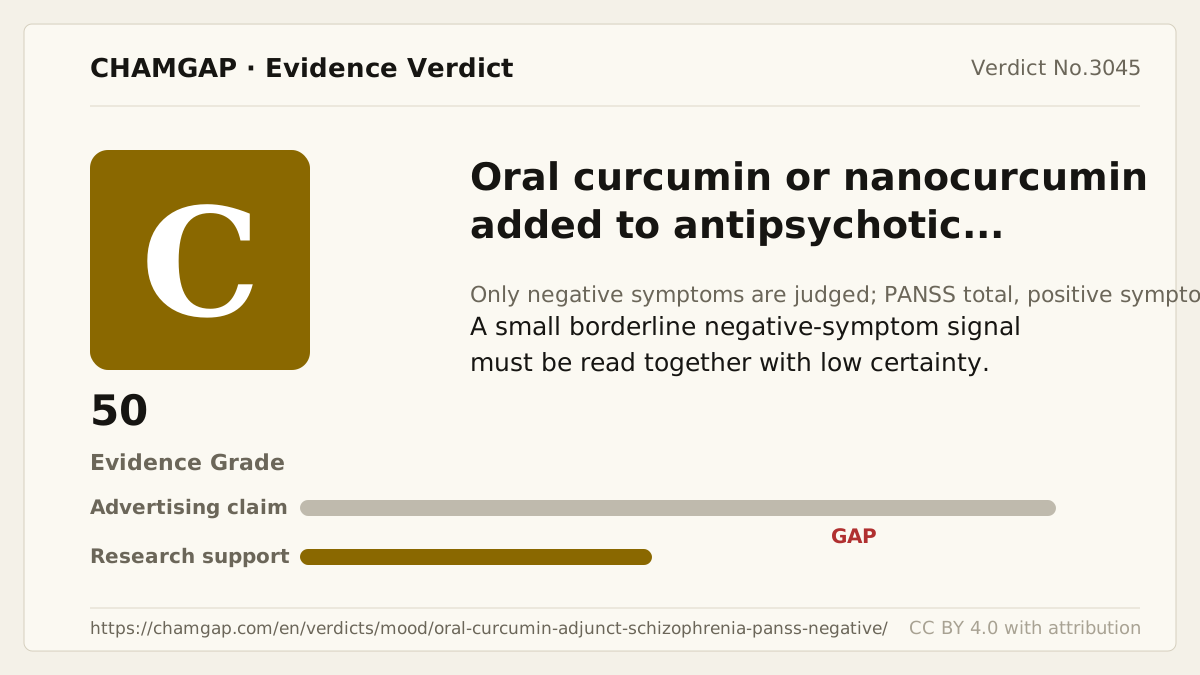
[Chamgap] Adjunctive Curcumin for Schizophrenia Negative Symptoms—A Small Four-Trial Effect With Low Certainty — Evidence Grade C·50. 2 cited sources checked. Source: https://chamgap.com/en/verdicts/mood/oral-curcumin-adjunct-schizophrenia-panss-negative/ · CC BY 4.0CC BY 4.0 — free to use with attribution; do not distort grades, numbers, or verdict meaning.
What this document does and does not do
Chamgap is an information source. It reports what research has and has not confirmed; it does not tell readers what to take or buy. That decision belongs to readers and, when needed, medical or legal professionals. This verdict reflects literature available up to the search date and may change as new research appears. Nothing here is medical advice.