
Omega-3 EPA and DHA,
does it really help with Prevention of incident and recurrent depression in middle-aged and older adults without clinically relevant symptoms at baseline?
research showsA specific EPA-DHA fish-oil formulation is rated D because it did not prevent incident or recurrent depression in middle-aged and older adults without clinically relevant depressive symptoms at baseline. VITAL-DEP followed 18,353 participants for a median of 5.3 years: 16,657 had no depression history and contributed to incidence analyses, while 1,696 had a prior history and contributed to recurrence analyses. The HR of 1.13 (95% CI 1.01 to 1.26) was the pooled incident-plus-recurrent coprimary event outcome, not a result confined to the no-history subgroup. Fish oil providing 465 mg EPA plus 375 mg DHA daily slightly increased that composite event, while PHQ-8 mood scores did not differ.
ads claimMarketing converts the fact that omega-3 is a brain-membrane component and has been studied as depression treatment into a promise to prevent late-life depression. EPA-predominant treatment and primary prevention with general EPA-DHA fish oil differ in population, purpose, and formulation, and the large prevention trial was negative.
Useful facts when choosing a product
- VITAL-DEP tested 1 g of fish oil daily, containing 465 mg of EPA and 375 mg of DHA.
- This verdict is limited to long-term primary prevention in middle-aged and older adults without clinically relevant depression and does not address treatment of current depression or prevention of recurrence.
- Fish-oil products differ in EPA-to-DHA ratio, oxidation, capsule content, and purification, so a high-EPA prescription or trial formulation is not interchangeable with a general supplement.
- Gastrointestinal bleeding, bruising, and stomach discomfort were similar to placebo in the trial, but high doses, anticoagulant or antiplatelet use, and the perioperative period warrant individualized review of bleeding tendency.
Chamgap Semantic Classification Code
Candidate index · review held
S.omega-3-fatty-acids.UNK.incident-and-recurrent-depression-in-middle-aged-and-older-adults-without-clinically-relevant-symptoms-at-baseline.prevent.MULTISupplements and nutraceuticals > Omega-3 fatty acids > Unknown > incident and recurrent depression in middle-aged and older adults without clinically relevant symptoms at baseline > Occurrence-prevention claim > Multiple: primary unresolved
An automated migration candidate, not an issued permanent code; exact claim scope remains under review. This machine-generated migration candidate helps retrieval but is not a permanent assignment. The original verdict ID and URL remain authoritative.
What the research actually shows
VITAL-DEP was a depression-prevention ancillary study within the 2-by-2 factorial VITAL trial. It assigned 18,353 adults with a mean age of 67.5 years to 1 g per day of fish oil containing 465 mg EPA and 375 mg DHA or placebo. Of these, 16,657 were at risk of incident depression and 1,696 were at risk of recurrence; HR 1.13 applied to the pooled incident-plus-recurrent coprimary event outcome. Events were slightly more frequent with omega-3 and PHQ-8 change was null. A 720-person clinical subcohort and a 302-person trial also found no preventive or mood benefit. This result belongs to the specific EPA-DHA fish-oil formulation and should not be extended numerically to every omega-3 composition or dose.
Why this is classified as D (24)
A direct clinical endpoint was null in a large 18,353-person trial followed for a median of 5.3 years, and the composite depression event was slightly increased with an HR of 1.13. Mood scores and the 720-person high-risk subcohort were also null, so the large independent null-trial rule yields D with 24 points. General tolerability is kept separate from efficacy.
Counterpoint. Physical activity, sleep, social connection, chronic-disease management, and early symptom recognition have more direct roles in depression prevention. New low mood, loss of interest, or suicidal thinking calls for clinical assessment rather than reliance on a supplement.
Rejudgment record. New verdict — Applied boundary-rule ② grade D because VITAL-DEP followed 18,353 adults without clinically relevant symptoms at baseline and found that a specific EPA-DHA fish oil slightly increased the pooled incident-plus-recurrent coprimary event, HR 1.13, while PHQ-8 did not improve
Sub-claim grades by effect
This ingredient is marketed for several effects. A single overall grade blends strong and weak claims together, so each effect is graded separately here. The overall grade reflects the strongest disconfirming or core claim.
| Effect (sub-claim) | Grade | Basis |
|---|---|---|
| Prevention of incident depression in middle-aged and older adults with no depression history | D | The HR of 1.13 cannot be assigned to the no-history incidence subgroup; it applies to the pooled incident-plus-recurrent outcome. |
| Prevention of clinically relevant depressive-symptom events | D | In the pooled incident-plus-recurrent outcome among 18,353 participants, there were 651 events with fish oil and 583 with placebo, for an HR of 1.13. |
| Prevention of long-term worsening in mood scores | D | Longitudinal PHQ-8 change and PHQ-9 in the 720-person subcohort did not differ from placebo. |
Cross-check — AI research and Codex final gate
Evidence Table
| Study | Design | Sample | Funding | Endpoint | Result | Weight |
|---|---|---|---|---|---|---|
| Okereke OI et al. 2021 VITAL-DEP | Large randomized double-blind placebo-controlled 2-by-2 factorial trial | 18,353 middle-aged and older adults | United States NIH public funding; trial capsules supplied by Pronova BioPharma/BASF | Pooled incident-plus-recurrent depression-event coprimary outcome and change in PHQ-8 | In the pooled incidence-and-recurrence coprimary outcome, there were 651 events with omega-3 and 583 with placebo, HR 1.13 (95% CI 1.01 to 1.26), with no PHQ-8 difference. | Grade-determining large trial with direct clinical endpoints |
| Vyas CM et al. 2023 VITAL clinical subcohort | Clinically assessed subcohort analysis of a randomized trial | 720 middle-aged and older adults | United States NIH public funding | Incident DSM-IV major depressive disorder and change in PHQ-9 | Omega-3 did not prevent major depressive disorder or improve mood scores in subgroups with subthreshold depression or high-risk factors. | Clinically adjudicated corroboration within the large trial |
| van de Rest O et al. 2008 | Randomized double-blind placebo-controlled dose trial | 302 community-dwelling adults aged 65 years or older | Academic and public research context | Mental well-being assessed by CES-D, MADRS, GDS-15, HADS, and related scales | EPA plus DHA at 400 or 1,800 mg for 26 weeks did not improve mental well-being versus placebo. | Earlier corroborating null trial in older adults |
Receipt — 3 References
All 3 cited sources were verified for existence at the original page (as of 2026-07-20).
Final verification and publication gate: Codex · Evidence date: 2026-07-20 · Corrections: none
Cite this verdict
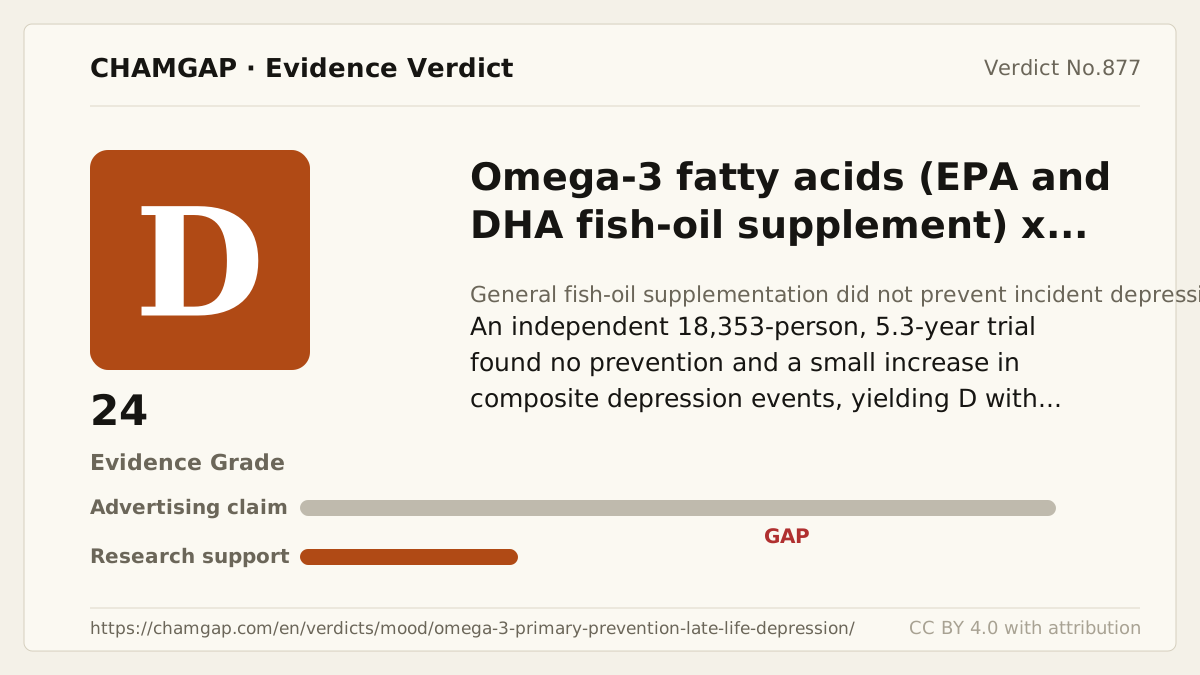
[Chamgap] Omega-3 EPA and DHA x prevention of incident and recurrent depression in middle-aged and older adults — Evidence Grade D·24. 3 cited sources checked. Source: https://chamgap.com/en/verdicts/mood/omega-3-primary-prevention-late-life-depression/ · CC BY 4.0CC BY 4.0 — free to use with attribution; do not distort grades, numbers, or verdict meaning.
What this document does and does not do
Chamgap is an information source. It reports what research has and has not confirmed; it does not tell readers what to take or buy. That decision belongs to readers and, when needed, medical or legal professionals. This verdict reflects literature available up to the search date and may change as new research appears. Nothing here is medical advice.