
N-acetylcysteine,
does it really help with Relief of obsessive-compulsive symptoms measured by Y-BOCS when added to existing treatment in adults?
research showsThe 20-week Y-BOCS difference was 0.53 points (95% CI -2.18 to 3.23), the Costa trial found -1.30 (-6.49 to 3.89), the Afshar trial found -5.14 (-7.05 to -3.23), and the five-to-eight-week pooled MD was positive at -2.95 (-5.87 to -0.04). Results conflict and do not exclude clinically meaningful benefit, so the grade is D with 35 points, not F.
ads claimMarketing can turn antioxidant and glutamate-modulating mechanisms into a claim that NAC stops obsessive thoughts. The identified trials evaluated off-label augmentation of existing SSRI or SRI treatment, not monotherapy or replacement of prescribed treatment.
Useful facts when choosing a product
- OCD trials generally added NAC doses ranging from 600 to 3,000 mg per day to existing SSRI or SRI treatment; they did not establish supplement monotherapy.
- NAC is used as a medicine for acetaminophen poisoning and certain respiratory indications, but those medical uses do not establish efficacy of a supplement for OCD.
- Oral NAC can cause nausea, diarrhea, abdominal pain, heartburn, and an unpleasant odor or taste, while rash or hypersensitivity is uncommon.
- Content, formulation, quality, and delivered exposure can vary across supplements, and prescribed psychiatric treatment should not be stopped or replaced with NAC without clinical supervision.
Chamgap Semantic Classification Code
Candidate index · review held
S.n-acetylcysteine.oral.obsessive-compulsive-symptoms-measured-by-y-bocs-when-added-to-existing-treatment.relieve.MULTISupplements and nutraceuticals > N-acetylcysteine > Oral > obsessive-compulsive symptoms measured by Y-BOCS when added to existing treatment > Symptom-relief claim > Multiple: primary unresolved
An automated migration candidate, not an issued permanent code; exact claim scope remains under review. This machine-generated migration candidate helps retrieval but is not a permanent assignment. The original verdict ID and URL remain authoritative.
What the research actually shows
In the 98-person multicenter 20-week phase III trial, the week-20 between-group Y-BOCS difference was 0.53 points (95% CI -2.18 to 3.23, P=.70), and anxiety, depression, quality of life, functioning, and other secondary outcomes also did not improve. Other 16-week trials did not establish benefits in total scores or response. The Brazilian OCD guideline does not recommend NAC on the basis of better-quality negative trials, and the 2025 update guideline concluded that current evidence does not support efficacy. A five-to-eight-week signal in the 2024 six-trial meta-analysis and a positive 35-person pilot in 2026 remain, but are too small to overturn the best trial and guideline conclusions.
Why this is classified as D (35)
The 20-week Y-BOCS difference was 0.53 points (95% CI -2.18 to 3.23), the Costa trial found -1.30 (-6.49 to 3.89), the Afshar trial found -5.14 (-7.05 to -3.23), and the five-to-eight-week pooled MD was positive at -2.95 (-5.87 to -0.04). Results conflict and do not exclude clinically meaningful benefit, so the grade is D with 35 points, not F.
Counterpoint. People who remain symptomatic despite an adequate SSRI or clomipramine course and exposure-and-response-prevention therapy should first discuss better-established augmentation strategies with a specialist. If NAC is tried, its off-label adjunctive status and explicit response and stopping criteria should be clear. Grade-independent note: Brazilian and Indian guidance recommends against NAC use. These recommendations and adverse-effect information are not used to determine the efficacy grade.
Rejudgment record. Cross-check revision — The 20-week Y-BOCS difference was 0.53 points (95% CI -2.18 to 3.23), the Costa trial found -1.30 (-6.49 to 3.89), the Afshar trial found -5.14 (-7.05 to -3.23), and the five-to-eight-week pooled MD was positive at -2.95 (-5.87 to -0.04). Results conflict and do not exclude clinically meaningful benefit, so the grade is D with 35 points, not F.
Sub-claim grades by effect
This ingredient is marketed for several effects. A single overall grade blends strong and weak claims together, so each effect is graded separately here. The overall grade reflects the strongest disconfirming or core claim.
| Effect (sub-claim) | Grade | Basis |
|---|---|---|
| Reduction of total obsessive-compulsive symptoms on Y-BOCS when added to existing treatment | D | Guidelines do not support efficacy or recommend use, and the best 98-person 20-week phase III trial had a null 0.53-point Y-BOCS difference. |
| Reduction of obsession symptoms when added to existing treatment | D | Guidelines do not support NAC efficacy or recommend use, and the best trial and pooled obsession outcomes did not establish a consistent benefit. |
| Reduction of compulsion symptoms when added to existing treatment | D | Guidelines do not support NAC efficacy or recommend use, and the best trial and pooled compulsion outcomes did not establish a consistent benefit. |
Cross-check — AI research and Codex final gate
Evidence Table
| Study | Design | Sample | Funding | Endpoint | Result | Weight |
|---|---|---|---|---|---|---|
| Eghdami S et al. 2024 | Systematic review and meta-analysis of randomized clinical trials | Six randomized trials and 195 participants | Funded by Iran University of Medical Sciences | Total Y-BOCS, obsession and compulsion subscales, and adverse events | The five-to-eight-week total Y-BOCS mean difference was -2.95, while results beyond 12 weeks and on both subscales were not significant. | Key synthesis with a small sample and inconsistency |
| Costa DLC et al. 2017 | Sixteen-week randomized double-blind placebo-controlled augmentation trial | Forty treatment-resistant adults recruited | Funding was not reported in the PubMed abstract | Change in total Y-BOCS at 16 weeks | NAC 3,000 mg/day did not differ from placebo in Y-BOCS reduction (P=.92). | Direct longer-term null adult trial |
| Afshar H et al. 2012 | Twelve-week randomized double-blind placebo-controlled augmentation trial | Forty-eight patients with treatment-refractory OCD | Funding was not reported in the PubMed abstract | Y-BOCS change and full response defined as at least 35% reduction | Adjunctive NAC up to 2,400 mg/day improved Y-BOCS and full-response rates versus placebo. | Small positive signal contributing to inconsistency |
| Sarris J et al. 2022 phase III trial | Multicenter 20-week randomized double-blind placebo-controlled phase III augmentation trial | Ninety-eight participants with DSM-5 obsessive-compulsive disorder | Funded by the Australian National Health and Medical Research Council | Total Y-BOCS at 20 weeks plus anxiety, depression, quality of life, and functioning | The week-20 between-group Y-BOCS difference was null at 0.53 points (95% CI -2.18 to 3.23, P=.70), and secondary outcomes did not improve. | Best large direct null trial |
| Oliveira MVS et al. 2023 Brazilian OCD guideline | Evidence review and clinical practice guideline for pharmacological treatment of adult obsessive-compulsive disorder | Guideline synthesis of four randomized NAC trials | Brazilian Research Consortium on Obsessive-Compulsive Spectrum Disorders | Efficacy and recommendation for NAC augmentation | Did not recommend NAC because positive trials had serious methodological problems and the better-quality trials were negative. | Boundary evidence recommending against use |
| Arumugham SS et al. 2025 update guideline | Updated clinical practice guideline for obsessive-compulsive disorder | Guideline synthesis of small NAC trials and meta-analyses | Indian Psychiatric Society guideline update | Efficacy of NAC augmentation | Concluded that current evidence does not support NAC efficacy in obsessive-compulsive disorder. | Boundary evidence from a guideline finding no efficacy support |
| Askari S et al. 2026 pilot trial | Twelve-week randomized double-blind placebo-controlled pilot trial | Thirty-five adults with moderate-to-severe obsessive-compulsive disorder | Funded by Iran University of Medical Sciences | Total Y-BOCS, subscales, and cognitive function | The time-by-group interaction for total Y-BOCS was positive, but this was a 35-person pilot and cognitive outcomes did not differ between groups. | Current small positive signal |
Receipt — 7 References
All 7 cited sources were verified for existence at the original page (as of 2026-07-21).
Final verification and publication gate: Codex · Evidence date: 2026-07-21 · Corrections: none
Cite this verdict
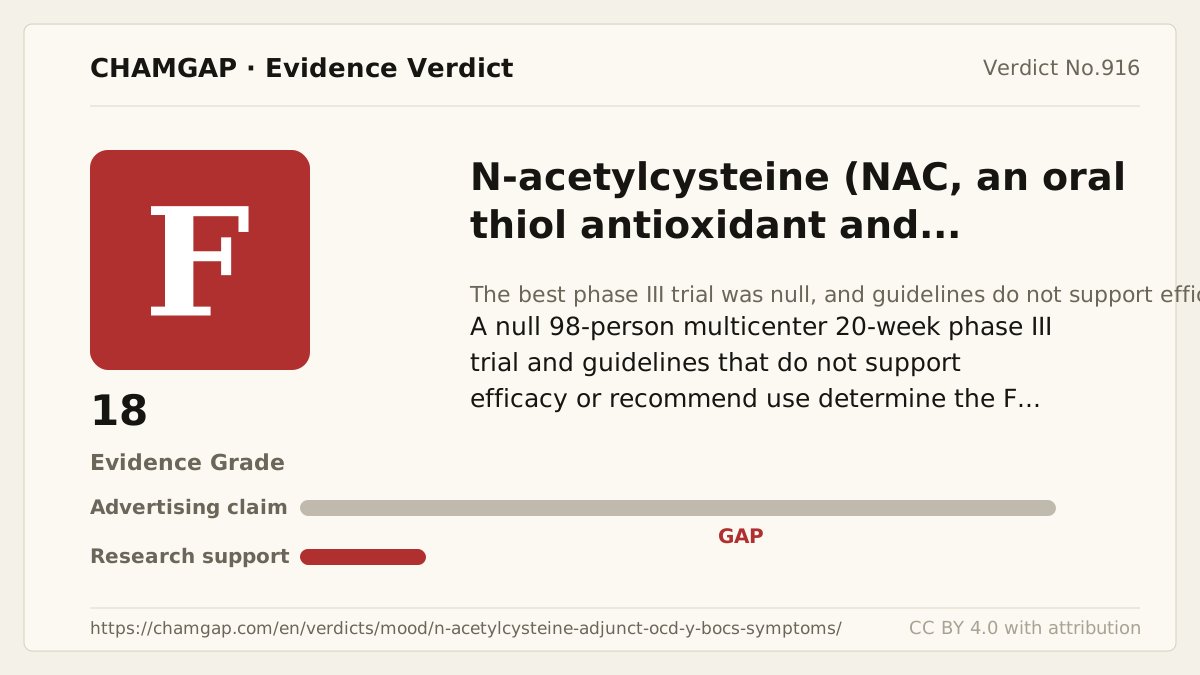
[Chamgap] N-acetylcysteine x adjunctive treatment of adult obsessive-compulsive disorder — Evidence Grade D·35. 7 cited sources checked. Source: https://chamgap.com/en/verdicts/mood/n-acetylcysteine-adjunct-ocd-y-bocs-symptoms/ · CC BY 4.0CC BY 4.0 — free to use with attribution; do not distort grades, numbers, or verdict meaning.
What this document does and does not do
Chamgap is an information source. It reports what research has and has not confirmed; it does not tell readers what to take or buy. That decision belongs to readers and, when needed, medical or legal professionals. This verdict reflects literature available up to the search date and may change as new research appears. Nothing here is medical advice.