
Mirtazapine,
does it really help with Improved depressive symptoms, treatment response, and remission in adults with major depressive disorder?
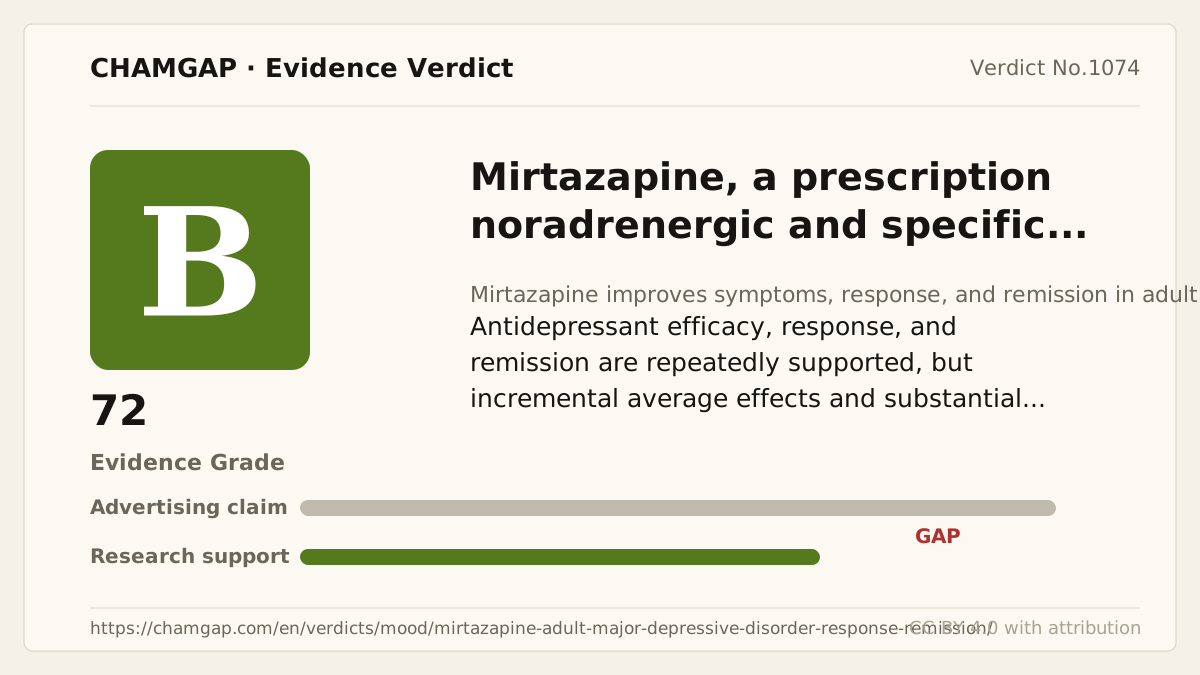
research showsMirtazapine is rated B for improving depressive symptoms, treatment response, and remission in adults with major depressive disorder. A meta-analysis of eight early double-blind trials found superiority to placebo, and a 2018 network meta-analysis of 522 randomized trials found all 21 antidepressants, including mirtazapine, superior to placebo for response. An individual-patient-data analysis of 15 comparative trials found six-week remission of 43.4% with mirtazapine versus 37.5% with SSRIs, although this does not establish consistent long-term superiority to other antidepressants. Repeated direct symptom, response, and remission evidence is tempered by incremental average effects and substantial reliance on older manufacturer data, yielding B with 72 points. Sedation, increased appetite, weight gain, and rare agranulocytosis remain separate safety issues.
ads claimThe image of a rapidly sedating antidepressant can expand sedation into restorative sleep or greater antidepressant efficacy for every patient. Selection actually depends on depressive symptoms, suicide risk, insomnia, appetite, weight, interacting medicines, and tolerability of other antidepressants.
Useful facts when choosing a product
- Mirtazapine is a prescription antidepressant for major depressive disorder in adults, and a representative starting dose is 15 mg once daily in the evening or before bedtime.
- The dose is generally adjusted within 15 to 45 mg according to response and tolerability, and abrupt self-discontinuation should be avoided in favor of a prescriber-guided taper.
- Somnolence is common, so individual effects should be known before driving or operating machinery, and alcohol or other sedatives can intensify impairment.
- Suicidal thoughts or behavior, manic activation, and severe agitation require monitoring early in treatment and after dose changes; fever, sore throat, or stomatitis warrants evaluation for rare neutropenia or agranulocytosis.
Chamgap Semantic Classification Code
Candidate index · review held
M.mirtazapine.UNK.depressive-symptoms-treatment-response-and-remission-with-major-depressive-disorder.improve.placeboMedicinal interventions > Mirtazapine > Unknown > depressive symptoms, treatment response, and remission with major depressive disorder > Improvement claim > Placebo
An automated migration candidate, not an issued permanent code; exact claim scope remains under review. This machine-generated migration candidate helps retrieval but is not a permanent assignment. The original verdict ID and URL remain authoritative.
What the research actually shows
Fawcett and Barkin pooled eight double-blind trials in patients with major depression and prominent anxiety or somatic symptoms, comparing 161 mirtazapine and 132 placebo recipients; symptom reductions favored mirtazapine at weeks 1 through 6 and endpoint. Cipriani and colleagues synthesized 522 double-blind randomized trials with 116,477 participants and found all 21 antidepressants superior to placebo for acute response, with mirtazapine among drugs having a favorable efficacy-acceptability balance. Thase and colleagues analyzed individual data from 2,971 participants in 15 mirtazapine-versus-SSRI trials and found remission of 43.4% versus 37.5% at week 6, but manufacturer employees were among the authors. The Watanabe Cochrane review of 29 trials with 4,974 participants found faster response than SSRIs at two weeks but only small differences by six to twelve weeks.
Why this is classified as B (72)
Early placebo-controlled trials, a large independent network meta-analysis, and active-comparator individual-patient-data analyses consistently support depressive symptom improvement, response, and remission. Average effects are incremental, mirtazapine-specific early evidence depends substantially on older manufacturer programs, and long-term superiority over active antidepressants is limited. Repeated direct clinical outcomes support B with 72 points. Sedation, weight gain, appetite increase, and rare blood dyscrasia are independent safety concerns.
Counterpoint. When depression includes insomnia and reduced appetite, the adverse-effect profile can sometimes aid treatment selection. Conversely, high metabolic risk, obesity, daytime somnolence, or fall risk may make another antidepressant more suitable, requiring individualized care.
Rejudgment record. New verdict — Accepted repeated positive depressive symptom, response, and remission evidence from early placebo-controlled double-blind trials, the 522-trial network meta-analysis, and a 15-trial individual-patient-data analysis, while assigning B because average effects are incremental, mirtazapine-specific early data are concentrated in older manufacturer programs, and long-term superiority over active antidepressants is limited
Sub-claim grades by effect
This ingredient is marketed for several effects. A single overall grade blends strong and weak claims together, so each effect is graded separately here. The overall grade reflects the strongest disconfirming or core claim.
| Effect (sub-claim) | Grade | Basis |
|---|---|---|
| Improvement of depressive symptoms in adult major depressive disorder | B | Direct symptom efficacy was repeatedly supported by placebo-controlled trials and a large network meta-analysis. |
| Improved treatment response in adult major depressive disorder | B | Acute response exceeded placebo and was generally similar to SSRIs, with some evidence of faster early response. |
| Improved remission in adult major depressive disorder | B | Individual data from 15 trials suggested faster early remission than SSRIs, but industry concentration and limited long-term superiority remain. |
Cross-check — AI research and Codex final gate
Evidence Table
| Study | Design | Sample | Funding | Endpoint | Result | Weight |
|---|---|---|---|---|---|---|
| Fawcett and Barkin 1998 meta-analysis | Meta-analysis of eight randomized double-blind placebo- and amitriptyline-controlled trials | 161 mirtazapine and 132 placebo recipients; 92 amitriptyline recipients in a subset | Pooled early product-development data; separate funding was not stated in the public abstract | Changes in Hamilton depression items for anxiety-agitation and anxiety-somatization | Mirtazapine significantly reduced symptoms versus placebo at weeks 1 through 6 and endpoint and was generally similar to amitriptyline. | Early placebo-controlled direct symptom evidence |
| Cipriani et al. 2018 network meta-analysis | Systematic review and network meta-analysis of double-blind randomized trials in acute adult MDD | 522 randomized trials, 116,477 participants, and 21 antidepressants | Public and academic funding including the NIHR Oxford Health Biomedical Research Centre and JSPS | Response of at least 50% symptom reduction and all-cause discontinuation around eight weeks | All 21 antidepressants, including mirtazapine, were superior to placebo for response. | Key large independent synthesis |
| Thase et al. 2010 individual-patient-data meta-analysis | Individual-patient-data meta-analysis of 15 randomized double-blind mirtazapine-versus-SSRI trials | 1,484 mirtazapine and 1,487 SSRI recipients | Included authors affiliated with Organon or Schering-Plough and relied on industry data | Remission rates at weeks 1, 2, 4, and 6 and time to remission | Six-week remission was 43.4% versus 37.5% (P=0.0006), with faster early remission on mirtazapine. | Supporting response and remission evidence with industry concentration |
Receipt — 4 References
All 4 cited sources were verified for existence at the original page (as of 2026-07-21).
Final verification and publication gate: Codex · Evidence date: 2026-07-21 · Corrections: none
Cite this verdict
[Chamgap] Mirtazapine x improved symptoms, response, and remission in adult major depressive disorder — Evidence Grade B·72. 4 cited sources checked. Source: https://chamgap.com/en/verdicts/mood/mirtazapine-adult-major-depressive-disorder-response-remission/ · CC BY 4.0CC BY 4.0 — free to use with attribution; do not distort grades, numbers, or verdict meaning.
What this document does and does not do
Chamgap is an information source. It reports what research has and has not confirmed; it does not tell readers what to take or buy. That decision belongs to readers and, when needed, medical or legal professionals. This verdict reflects literature available up to the search date and may change as new research appears. Nothing here is medical advice.