
Magnesium,
does it really help with Relief of depressive symptoms and adjunctive support for antidepressant treatment in adults with depressive disorders?
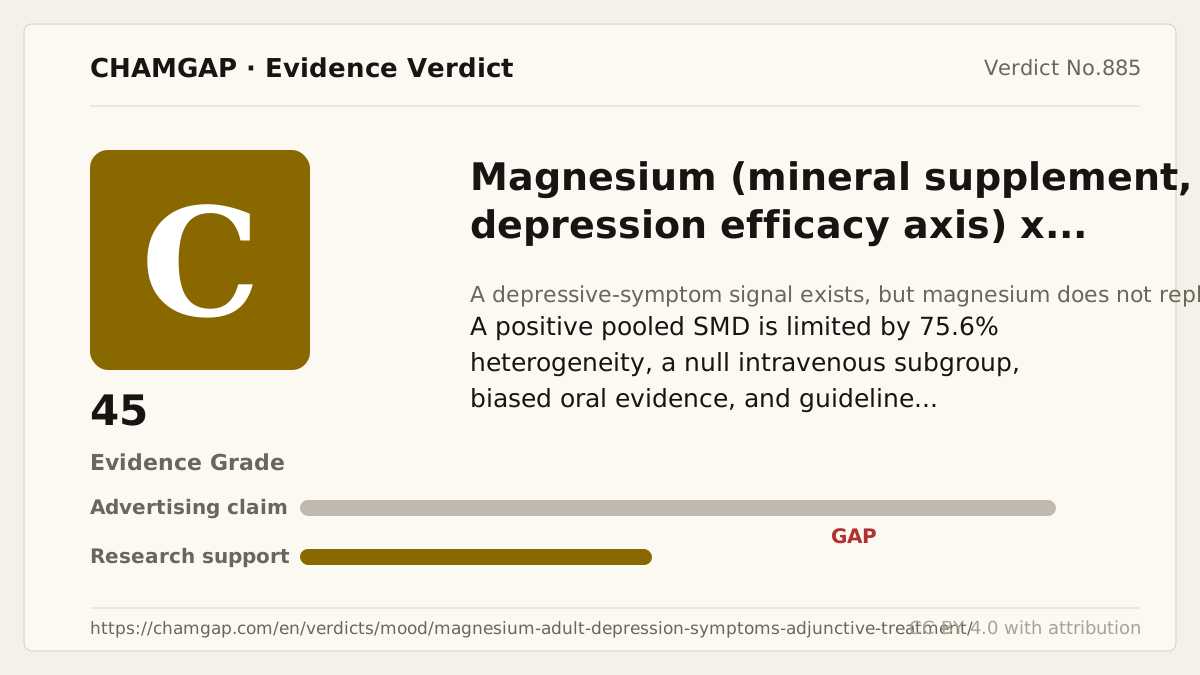
research showsMagnesium is correctly rated C for depressive symptoms; D would be too harsh. Seven randomized trials with 325 participants yielded a pooled SMD of -0.919, but heterogeneity was 75.6%, individual trials enrolled only 12 to 66 people, and formulations, diagnoses, and concomitant treatment were mixed. The meta-analysis included intravenous magnesium sulfate as well as oral preparations; the intravenous subgroup was null, while the oral signal carried substantial bias concerns. There is no large independent replicated null evidence to justify D, but outcomes were limited to patient- or clinician-rated symptom scales. Joint WFSBP and CANMAT guidance recommends neither monotherapy nor adjunctive use, giving C with 45 points under rule ①.
ads claimClaims of a natural antidepressant, cure by correcting deficiency, or a safe replacement for antidepressants are overstated. Small changes on depression scales do not establish remission of major depressive disorder, lower suicide risk, relapse prevention, or replacement of prescribed treatment.
Useful facts when choosing a product
- Magnesium supplements use oxide, citrate, chloride, glycinate, and other salts with different elemental-magnesium content, so the compound weight on a front label cannot be directly equated with a clinical-trial dose.
- Depression studies used different formulations and doses for only several weeks, so findings from one preparation cannot be generalized to every magnesium product or long-term treatment.
- Diarrhea is the most common dose-limiting adverse effect, and antacids, laxatives, and other magnesium-containing products can make total intake higher than expected.
- Marked renal impairment can permit magnesium accumulation and cause hypotension, weakness, reduced reflexes, or arrhythmia, and magnesium should not arbitrarily replace or interrupt prescribed depression treatment.
Chamgap Semantic Classification Code
Candidate index · review held
S.magnesium.UNK.depressive-symptoms-and-adjunctive-support-for-antidepressant-treatment-with-depressive-disorders.relieve.placeboSupplements and nutraceuticals > Magnesium > Unknown > depressive symptoms and adjunctive support for antidepressant treatment with depressive disorders > Symptom-relief claim > Placebo
An automated migration candidate, not an issued permanent code; exact claim scope remains under review. This machine-generated migration candidate helps retrieval but is not a permanent assignment. The original verdict ID and URL remain authoritative.
What the research actually shows
Moabedi and colleagues synthesized eight effect sizes from seven randomized trials and 325 participants in 2023 and reported SMD -0.919. Heterogeneity was 75.6%, samples ranged from 12 to 66, oral preparations were mixed with intravenous magnesium sulfate, and diagnoses and concomitant treatments varied; the intravenous subgroup was null. Oral evidence included the 126-person Tarleton open-label delayed-treatment trial without placebo or masking, leaving substantial expectancy bias. The 2022 joint WFSBP and CANMAT guideline recommended neither magnesium monotherapy nor adjunctive treatment for major depressive disorder.
Why this is classified as C (45)
The SMD -0.919 signal from seven randomized trials and 325 participants is acknowledged, but trials enrolled 12 to 66 people, heterogeneity was 75.6%, oral preparations were mixed with intravenous magnesium sulfate, the intravenous subgroup was null, and oral evidence retained bias concerns. With symptom scales only and guidance recommending neither monotherapy nor adjunctive use, rule ① gives C with 45 points. The absence of large independently replicated null trials prevents D. Diarrhea and accumulation with renal impairment remain separate safety issues.
Counterpoint. Confirmed deficiency warrants correction as a separate clinical need. Depression care should still prioritize suicide-risk assessment, psychotherapy, treatments with established efficacy, and follow-up, with magnesium considered only as an optional adjunct after clinical discussion.
Rejudgment record. New verdict — Accepted SMD -0.919 across seven randomized trials and 325 participants, but applied rule ① because samples were 12 to 66, heterogeneity was 75.6%, oral preparations were mixed with intravenous magnesium sulfate, the intravenous subgroup was null, oral evidence retained bias concerns, outcomes were symptom scales, and guidance recommended neither monotherapy nor adjunctive use
Sub-claim grades by effect
This ingredient is marketed for several effects. A single overall grade blends strong and weak claims together, so each effect is graded separately here. The overall grade reflects the strongest disconfirming or core claim.
| Effect (sub-claim) | Grade | Basis |
|---|---|---|
| Relief of depressive symptoms with magnesium monotherapy | C | Monotherapy evidence mixed oral and intravenous preparations and depressive populations in small symptom-scale trials, and the intravenous subgroup was null. |
| Adjunctive magnesium benefit with standard antidepressant treatment | C | Some small adjunctive trials provide signals, but joint guidance does not recommend use because evidence is insufficient. Correction of deficiency is separate from adjunctive efficacy in people without deficiency. |
Cross-check — AI research and Codex final gate
Evidence Table
| Study | Design | Sample | Funding | Endpoint | Result | Weight |
|---|---|---|---|---|---|---|
| Moabedi M et al. 2023 | Systematic review and meta-analysis of randomized clinical trials | Seven randomized trials, eight effect sizes, and 325 participants; 12 to 66 per trial | No external funding and no commercial conflict reported | Depression scores including BDI, BDI-II, and HAM-D | The pooled SMD was -0.919 (95% CI -1.443 to -0.396), heterogeneity was 75.6%, and the intravenous magnesium sulfate subgroup was null. | Pivotal positive synthesis mixing oral and intravenous treatment, with small samples, high heterogeneity, and bias concerns |
| Tarleton EK et al. 2017 | Randomized open-label delayed-treatment crossover trial | 126 randomized; 112 in the final analysis | United States academic and public research support with product donation | Six-week Patient Health Questionnaire depression score | Patient Health Questionnaire scores improved during 248 mg per day of elemental magnesium versus the control period, but there was no placebo or masking. | Pragmatic positive signal with substantial expectancy-bias risk |
| Sarris J et al. 2022 WFSBP/CANMAT guideline | Evidence review and clinical guideline for nutraceutical and phytoceutical psychiatric treatments | Meta-review and randomized evidence by nutraceutical | International WFSBP and CANMAT task force | Recommendations for monotherapy and adjunctive treatment of major depressive disorder | Magnesium at 100 to 400 mg per day was not recommended as monotherapy or adjunctive treatment for major depressive disorder. | Clinical-scope limitation and conflicting evidence |
Receipt — 3 References
All 3 cited sources were verified for existence at the original page (as of 2026-07-20).
Final verification and publication gate: Codex · Evidence date: 2026-07-20 · Corrections: none
Cite this verdict
[Chamgap] Magnesium x relief of depressive symptoms and adjunctive treatment in adults — Evidence Grade C·45. 3 cited sources checked. Source: https://chamgap.com/en/verdicts/mood/magnesium-adult-depression-symptoms-adjunctive-treatment/ · CC BY 4.0CC BY 4.0 — free to use with attribution; do not distort grades, numbers, or verdict meaning.
What this document does and does not do
Chamgap is an information source. It reports what research has and has not confirmed; it does not tell readers what to take or buy. That decision belongs to readers and, when needed, medical or legal professionals. This verdict reflects literature available up to the search date and may change as new research appears. Nothing here is medical advice.