
Lacticaseibacillus paracasei Lpc-37®,
does it really help with Reduced stress and anxiety and a steadier mood?
research showsThe broad claim that Lpc-37 reduces stress and anxiety is rated D because a confirmatory multicenter trial directly failed. In the 120-person Sisu trial, the whole-population primary TSST heart-rate hypothesis failed and positive findings depended on per-protocol, sex, or chronic-stress subgroup analyses. In the subsequent 190-person multicenter ChillEx trial, the eight-week primary STAI state-anxiety endpoint was null, estimate 1.03 (95% CI −1.62 to 3.67, p=0.446), and multiplicity-adjusted secondary stress, mood, and anxiety outcomes were also null. Both trials arose from the DuPont/IFF development axis, so the evidence does not meet the independent repeated-refutation requirement for F.
ads claimAdvertisements can attribute a calming and anxiety-reducing effect to an entire finished product merely because it contains Lpc-37. Yet a marketed example combines Lpc-37 with thirteen other strains and 300 mg of KSM-66® ashwagandha, preventing attribution to Lpc-37 alone.
Useful facts when choosing a product
- Public information is insufficient to confirm a formally distributed Korean single-strain product matching the trial dose, and cross-border finished products may differ from the stand-alone trial product.
- The Sisu trial used Lpc-37 1.75×10^10 CFU/day for five weeks, while ChillEx used 1.56×10^10 CFU/day for ten weeks.
- One prominent finished-product example contains fourteen strains totaling 50 billion CFU plus 300 mg of KSM-66® ashwagandha, making efficacy attribution impossible.
- Short trials in healthy adults were generally safe, but severe immunocompromise, central venous catheters, pregnancy and lactation, and long-term use warrant clinical review.
Chamgap Semantic Classification Code
Candidate index · review held
UNK.lacticaseibacillus-paracasei-lpc-37.UNK.stress-and-anxiety-and-a-steadier-mood.reduce.placeboUnknown > Lacticaseibacillus paracasei Lpc-37® > Unknown > stress and anxiety and a steadier mood > Reduction claim > Placebo
An automated migration candidate, not an issued permanent code; exact claim scope remains under review. This machine-generated migration candidate helps retrieval but is not a permanent assignment. The original verdict ID and URL remain authoritative.
What the research actually shows
The Patterson 2020 Sisu trial assigned 120 healthy adults to Lpc-37 1.75×10^10 CFU/day or placebo for five weeks. The whole-population primary heart-rate response was null, while the Perceived Stress Scale signal and several physiological and self-report results depended on analysis population, sex, or chronic-stress subgroup. DuPont Nutrition & Biosciences fully sponsored the trial. The Mäkelä 2023 ChillEx trial assigned 190 students facing examination stress to 1.56×10^10 CFU/day or placebo for ten weeks; the eight-week primary state-anxiety outcome and multiplicity-adjusted stress, mood, and anxiety outcomes were null. Many authors were affiliated with IFF.
Why this is classified as D (32)
The whole-population primary physiological endpoint failed in Sisu, and the larger multicenter ChillEx trial was null on its eight-week primary STAI state-anxiety endpoint and multiplicity-adjusted secondary stress, mood, and anxiety outcomes. Positive findings depended on per-protocol, sex, or chronic-stress subgroup analyses, so the broad claim is graded D with 32 points. The shared DuPont/IFF development axis does not satisfy the independent repeated-refutation threshold for F.
Counterpoint. The conflict is not enough to establish repeated refutation across identical populations, and the stress models differed. A limited and uncertain C is therefore more appropriate than D.
Rejudgment record. Reassessment (cross-check reflected) — Treated failure of the whole-population primary TSST heart-rate hypothesis in Sisu and null eight-week primary STAI state anxiety plus multiplicity-adjusted secondary outcomes in the multicenter ChillEx trial as direct refutation, while withholding F because both trials arose from the same DuPont/IFF development axis rather than independent repeated refutations
Sub-claim grades by effect
This ingredient is marketed for several effects. A single overall grade blends strong and weak claims together, so each effect is graded separately here. The overall grade reflects the strongest disconfirming or core claim.
| Effect (sub-claim) | Grade | Basis |
|---|---|---|
| Reduction of self-reported perceived stress and anxiety in healthy adults | D | The confirmatory multicenter primary STAI endpoint was null, and positive findings depend on per-protocol, sex, or chronic-stress subgroup analyses. |
| Treatment of a clinical anxiety disorder | ? | No efficacy trial has been conducted in people with a diagnosed anxiety disorder. |
Cross-check — AI research and Codex final gate
Evidence Table
| Study | Design | Sample | Funding | Endpoint | Result | Weight |
|---|---|---|---|---|---|---|
| Patterson E et al. 2020 Sisu study | Double-blind randomized placebo-controlled parallel trial | 120 randomized; 117 completed | Fully sponsored by DuPont Nutrition & Biosciences and Danisco Sweeteners | Primary heart-rate response to the Trier Social Stress Test, Perceived Stress Scale, Beck Anxiety Inventory, Depression Anxiety Stress Scales, visual analog scales, and cortisol | The whole-population primary heart-rate outcome and several acute-stress measures were null; only the Perceived Stress Scale and selected findings were positive depending on analysis population, sex, or chronic-stress subgroup. | Key |
| Mäkelä SM et al. 2023 ChillEx study | Multicenter triple-blind randomized placebo-controlled trial | 190 university students | Commercial IFF development program with many IFF-affiliated authors | Eight-week State-Trait Anxiety Inventory state-anxiety primary outcome and stress, mood, anxiety, and sleep outcomes | Lpc-37 did not improve stress, mood, or anxiety during examination stress, and secondary analyses were null after multiplicity adjustment. | Key |
Receipt — 2 References
All 2 cited sources were verified for existence at the original page (as of 2026-07-18).
Final verification and publication gate: Codex · Evidence date: 2026-07-18 · Corrections: none
Cite this verdict
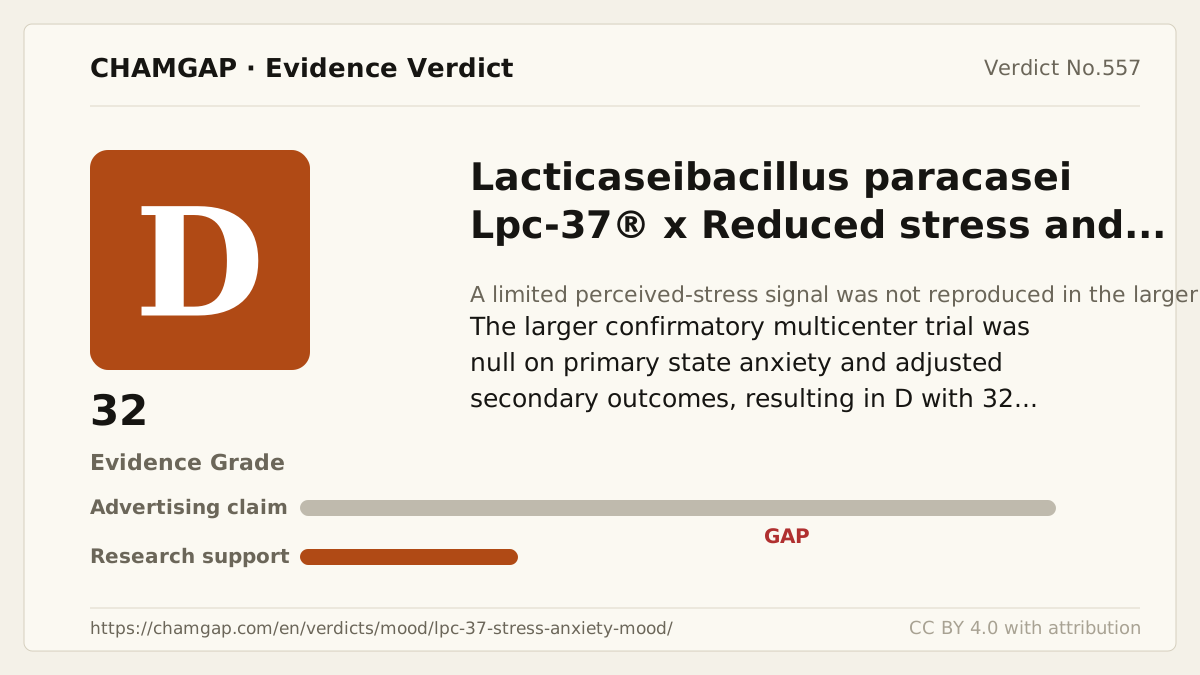
[Chamgap] Lacticaseibacillus paracasei Lpc-37® x stress, anxiety, and mood — Evidence Grade D·32. 2 cited sources checked. Source: https://chamgap.com/en/verdicts/mood/lpc-37-stress-anxiety-mood/ · CC BY 4.0CC BY 4.0 — free to use with attribution; do not distort grades, numbers, or verdict meaning.
What this document does and does not do
Chamgap is an information source. It reports what research has and has not confirmed; it does not tell readers what to take or buy. That decision belongs to readers and, when needed, medical or legal professionals. This verdict reflects literature available up to the search date and may change as new research appears. Nothing here is medical advice.