
Lamotrigine,
does it really help with Delayed recurrence of mood episodes, especially depressive episodes, in stabilized bipolar I disorder?
research showsLamotrigine is rated B because maintenance treatment in stabilized bipolar I disorder delays the need for intervention for a new mood episode, with a clearer effect against depression than mania. In the pooled analysis of two 18-month randomized placebo-controlled trials, lamotrigine prolonged time to intervention for any mood episode and for depression among 638 randomized stabilized patients. The trials used an enriched design that randomized only patients who first stabilized during open-label lamotrigine, the pivotal evidence involved the manufacturer, and the 2021 Cochrane review judged certainty low to moderate. This is not evidence of rapid treatment for an acute episode, and slow titration is essential because of serious rash, including Stevens-Johnson syndrome.
ads claimPromotion may present lamotrigine as a broad mood stabilizer that rapidly stops both depression and mania. Its best-supported role is delaying long-term recurrence, particularly depression, after stabilization; it is not a rapid treatment for acute mania or a universal acute-depression monotherapy.
Useful facts when choosing a product
- Lamotrigine is a prescription medicine used for bipolar I maintenance and several seizure disorders, and dosing schedules differ by indication and interacting medicines.
- Valproate raises lamotrigine exposure and rash risk, whereas enzyme inducers such as carbamazepine can lower exposure, so starting doses and titration schedules differ.
- Serious rash, including Stevens-Johnson syndrome and toxic epidermal necrolysis, is rare but important. High starting doses and rapid titration increase risk, and a new rash, mucosal lesion, or fever requires prompt medical assessment.
- Patients should not restart a previous full dose after several missed days without prescriber guidance. Retitration may be needed, and headache, dizziness, diplopia, ataxia, and nausea can occur.
Chamgap Semantic Classification Code
Candidate index · review held
M.lamotrigine.UNK.delayed-recurrence-of-mood-episodes-especially-depressive-episodes-in-stabilized-bipolar-i-disorder.reduce.placeboMedicinal interventions > Lamotrigine > Unknown > Delayed recurrence of mood episodes, especially depressive episodes, in stabilized bipolar I disorder > Reduction claim > Placebo
An automated migration candidate, not an issued permanent code; exact claim scope remains under review. This machine-generated migration candidate helps retrieval but is not a permanent assignment. The original verdict ID and URL remain authoritative.
What the research actually shows
Bowden 2003 treated 349 recently manic or hypomanic patients openly with lamotrigine and randomized 175 who stabilized to lamotrigine, lithium, or placebo; lamotrigine prolonged time to intervention for any mood episode and for depression. Calabrese 2003 randomized 463 stabilized patients from 966 enrolled after a recent depressive episode; median time to any mood intervention was 200 days with lamotrigine and 93 days with placebo, and time to depressive intervention was also longer. A pooled analysis of 638 randomized patients reported 197 versus 86 days for any episode and confirmed the depression advantage, whereas after adjustment only lithium clearly beat placebo for mania. The 2021 Cochrane review of 11 studies and 2,314 participants found a possible reduction in clinical worsening requiring additional psychotropic treatment but rated the body of evidence low to moderate because of bias concerns.
Why this is classified as B (72)
Two 18-month placebo-controlled maintenance trials and their pooled analysis repeatedly improved the direct clinical endpoint of time to a mood episode requiring intervention, with the most consistent benefit against depression. Open-label responder enrichment, manufacturer involvement, low-to-moderate certainty in the synthesis, and weaker antimanic prevention justify B with 72 points. Serious rash is assessed separately under safety.
Counterpoint. Lamotrigine is useful when depressive recurrence predominates during bipolar I maintenance, but recent episode type, prior mania burden, interacting medicines, pregnancy potential, and rash history should inform a specialist-led plan.
Rejudgment record. New verdict — Accepted positive direct relapse endpoints from two 18-month placebo-controlled maintenance trials and their pooled analysis while accounting for open-label responder enrichment, manufacturer involvement, low-to-moderate certainty, and weaker prevention of mania than depression
Sub-claim grades by effect
This ingredient is marketed for several effects. A single overall grade blends strong and weak claims together, so each effect is graded separately here. The overall grade reflects the strongest disconfirming or core claim.
| Effect (sub-claim) | Grade | Basis |
|---|---|---|
| Delayed depressive-episode recurrence in stabilized bipolar I disorder | B | Two 18-month trials repeatedly improved direct intervention endpoints but used enriched designs. |
| Delayed manic or hypomanic recurrence in stabilized bipolar I disorder | C | A pooled signal exists, but individual and adjusted analyses were weaker and less consistent than for lithium. |
| Rapid monotherapy of an acute bipolar mood episode | D | Maintenance trials did not test this claim, and required slow titration precludes extrapolation to rapid acute treatment. |
Cross-check — AI research and Codex final gate
Evidence Table
| Study | Design | Sample | Funding | Endpoint | Result | Weight |
|---|---|---|---|---|---|---|
| Bowden CL et al. 2003; Lamictal 606 Study Group | Eighteen-month randomized double-blind lamotrigine, lithium, and placebo maintenance trial | 349 entered open treatment; 175 stabilized patients were randomized | Pivotal product trial with GlaxoSmithKline research personnel | Time to intervention for any, depressive, and manic mood episode | Lamotrigine prolonged time to intervention for any mood episode and for depression versus placebo, both P=.02, but did not clearly outperform placebo for mania. | Direct maintenance-efficacy randomized trial with enriched design |
| Calabrese JR et al. 2003; Lamictal 605 Study Group | Eighteen-month randomized double-blind lamotrigine, lithium, and placebo maintenance trial | 966 entered open treatment; 463 stabilized patients were randomized | Pivotal Lamictal trial with manufacturer involvement | Time to any mood episode requiring added pharmacotherapy | Median time to any intervention was 200 days with lamotrigine and 93 days with placebo; depression was delayed, whereas only lithium clearly delayed mania. | Key direct clinical endpoint |
| Hashimoto Y et al. 2021 Cochrane review | Systematic review and meta-analysis of randomized trials | 11 studies and 2,314 participants | Authors reported no conflicts of interest | Recurrence, clinical worsening, added psychotropics, discontinuation, and adverse effects | Risk of clinical worsening requiring added psychotropics was RR 0.82 versus placebo (95% CI 0.70 to 0.98); overall certainty was low to moderate. | Independent synthesis limited by risk of bias |
Receipt — 4 References
All 4 cited sources were verified for existence at the original page (as of 2026-07-21).
Final verification and publication gate: Codex · Evidence date: 2026-07-21 · Corrections: none
Cite this verdict
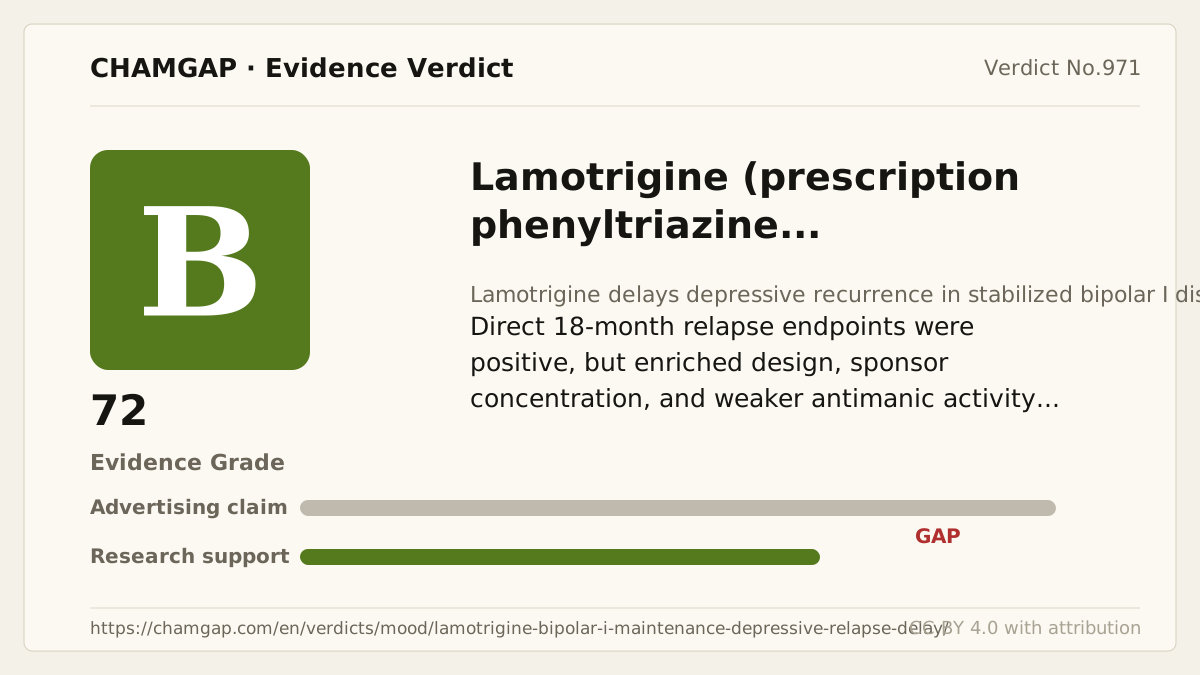
[Chamgap] Lamotrigine x delayed depressive-episode recurrence during bipolar I maintenance — Evidence Grade B·72. 4 cited sources checked. Source: https://chamgap.com/en/verdicts/mood/lamotrigine-bipolar-i-maintenance-depressive-relapse-delay/ · CC BY 4.0CC BY 4.0 — free to use with attribution; do not distort grades, numbers, or verdict meaning.
What this document does and does not do
Chamgap is an information source. It reports what research has and has not confirmed; it does not tell readers what to take or buy. That decision belongs to readers and, when needed, medical or legal professionals. This verdict reflects literature available up to the search date and may change as new research appears. Nothing here is medical advice.