
High-prebiotic diet plus probiotics,
does it really help with Greater eight-week improvement in total mood disturbance than either component or control?
research showsThe grade is D with 28 points. A 119-person 2-by-2 randomized trial included diet alone, probiotics alone, the combination, and control; 118 entered the modified intention-to-treat analysis and 93 completed. On the registered primary outcome of total mood disturbance at eight weeks, the combination was essentially identical to control: -0.331 points, 95% CI -6.81 to 6.15; d -0.03; P=0.92. It also did not outperform diet alone.
ads claimA biological story in which probiotics consume prebiotic substrates does not guarantee an added mood effect. The diet-alone signal was not enhanced by the combination.
Useful facts when choosing a product
- The eight-strain probiotic supplied 12 billion CFU per capsule and was taken twice daily with food.
- The diet targeted at least seven daily servings of foods such as asparagus, garlic, onion, oats, whole wheat, chickpeas, and watermelon.
- The combination effect on total mood disturbance was -0.331 points, d -0.03, essentially zero.
- The interaction was +8.80 points, worse than additivity, but its confidence interval crossed zero and did not establish harm.
Chamgap Semantic Classification Code
Candidate index · review held
D.high-prebiotic-whole-food-diet-plus-an-eight-strain-probiotic-at-24-billion-cfu-day.dietary.greater-improvement-in-total-mood-disturbance-than-either-component-or-control.improve.MULTIDietary patterns and eating practices > high-prebiotic whole-food diet plus an eight-strain probiotic at 24 billion CFU/day > Dietary regimen > Greater improvement in total mood disturbance than either component or control > Improvement claim > Multiple: primary unresolved
An automated migration candidate, not an issued permanent code; exact claim scope remains under review. This machine-generated migration candidate helps retrieval but is not a permanent assignment. The original verdict ID and URL remain authoritative.
What the research actually shows
ACTRN12617000795392 was prospectively registered in May 2017 with eight-week change in POMS Short Form total mood disturbance as the primary outcome. The trial randomized 119 participants; one lacked recoverable baseline POMS data, leaving 118 in the modified intention-to-treat mixed-model analysis. Ninety-three completers equal 78.2% of 119 randomized participants and 78.8% of the 118-person analysis set. Diet-only and probiotic-only arms were present, so the claim that the combination works better than either component was directly testable and failed. This study measured a clinical mood scale, not an absorption marker. More absorption and better health are different questions; here, health-related mood was measured directly. Companies supplied products and foods in kind and had no reported study role. The conflict statement reports that JS received honoraria, travel support, clinical-trial grants, royalties, or independent consultancy payments from numerous listed organizations; CN had consulting, research-grant, and speaker relationships with listed pharmaceutical companies; JR reported research funding and royalties; FJ reported industry research support, travel support, and speaker honoraria; and JH was Chief Research Officer for ProbioticAdvisor.com.
Why this is classified as D (28)
A direct factorial trial with component-only groups found a null registered primary endpoint for the combination; without repeated refutation, this gives D with 28 points.
Counterpoint. The diet-alone result remains a separate positive claim, but it does not support synergy from the combination.
Rejudgment record. Cross-check applied — The prospectively registered primary outcome in ACTRN12617000795392, all factorial arms, analysis count, and completion count were checked against the source
| Endpoint | P | Symptom or function itself is the target - including patient reports and performance tests |
| Replication | R1 | Single confirmatory trial |
| Independence | I1 | Mixed funding sources |
| Effect size | E0 | Null |
| Precision | C0 | The confidence interval leaves room for benefit |
Stored derived and displayed grades match; this is not a current recalculation or validity check (D).
Sub-claim grades by effect
This ingredient is marketed for several effects. A single overall grade blends strong and weak claims together, so each effect is graded separately here. The overall grade reflects the strongest disconfirming or core claim.
| Effect (sub-claim) | Grade | Basis |
|---|---|---|
| The combination improves mood versus control | D | The registered primary effect was essentially zero. |
| The combination outperforms either component | D | Diet alone was positive, while the combination and synergy claim were not. |
Cross-check — AI research and Codex final gate
Evidence Table
| Study | Design | Sample | Funding | Endpoint | Result | Weight |
|---|---|---|---|---|---|---|
| Freijy et al. 2023, Gut Feelings | Eight-week 2-by-2 factorial randomized placebo-controlled trial | 119 randomized, 118 in modified intention-to-treat analysis, and 93 completed | In-kind company support with no study role; author consulting, grants, honoraria, and ProbioticAdvisor role disclosed | Registered primary POMS Short Form total mood disturbance | Combination versus control MD -0.331, 95% CI -6.81 to 6.15; d -0.03; P=0.92 | Core direct clinical evidence |
Receipt — 2 References
All 2 cited sources were verified for existence at the original page (as of 2026-08-04).
Final verification and publication gate: Codex · Evidence date: 2026-08-04 · Corrections: none
Cite this verdict
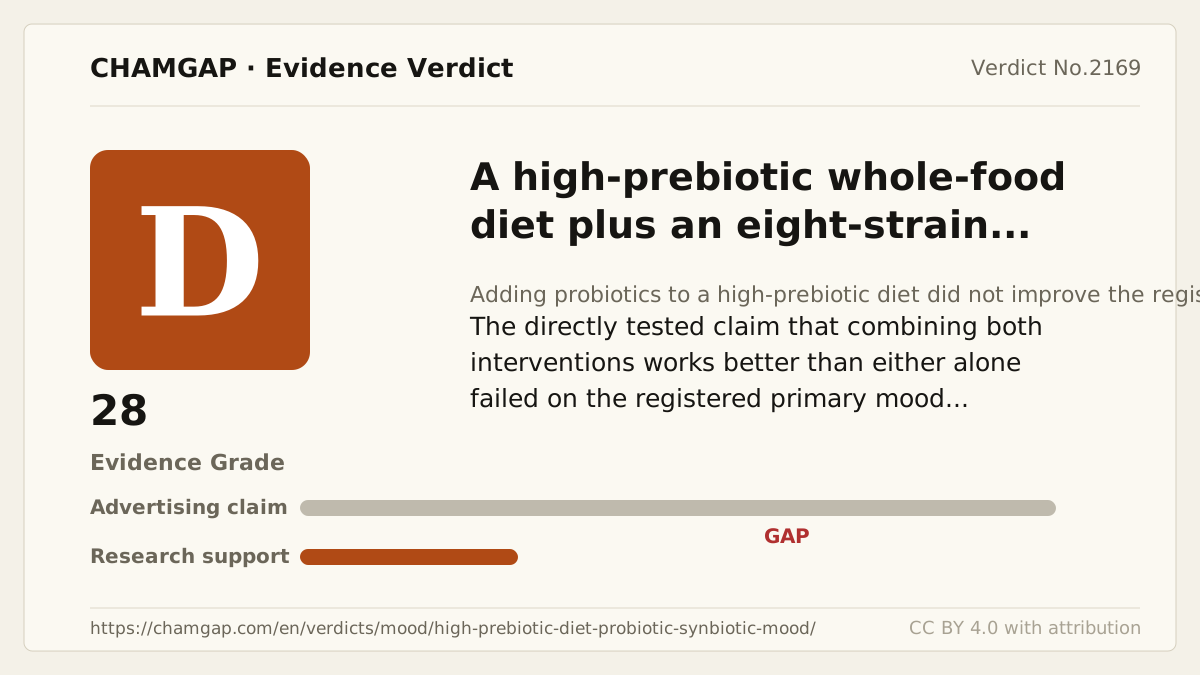
[Chamgap] High-prebiotic diet plus probiotics x added mood benefit — Evidence Grade D·28. 2 cited sources checked. Source: https://chamgap.com/en/verdicts/mood/high-prebiotic-diet-probiotic-synbiotic-mood/ · CC BY 4.0CC BY 4.0 — free to use with attribution; do not distort grades, numbers, or verdict meaning.
What this document does and does not do
Chamgap is an information source. It reports what research has and has not confirmed; it does not tell readers what to take or buy. That decision belongs to readers and, when needed, medical or legal professionals. This verdict reflects literature available up to the search date and may change as new research appears. Nothing here is medical advice.