
Organization-level positive communication,
does it really help with Reduced burnout prevalence among ICU healthcare professionals?
research showsThe grade is C. A cluster-adjusted trial assigning 370 ICUs across 60 countries found burnout in 52.2% versus 63.3% after four weeks, adjusted OR 0.56, 95% CI 0.46-0.68. Staff knew allocation and completed the same self-report instrument, however, and 9,568 post-intervention respondents represented 61.6% of 15,527 baseline responses. The registered sample of 7,300 and the paper's 9,568 post-intervention respondents used inconsistent sample definitions.
ads claimThe large number of ICUs is a strength, but it does not erase the fact that staff reported the outcome after four weeks while knowing allocation. Organizational marketing should disclose that persistence and objective absence, turnover, or patient-safety outcomes remain unproven.
Useful facts when choosing a product
- The bundle used posters, twice-weekly email reminders, greetings in morning huddles, positive-message jars and boards, and leader role modeling.
- NCT06453616 was posted in June 2024 before the October 2024 intervention, and its primary outcome was immediate post-intervention MBI burnout prevalence.
- The registered sample was 7,300, while the paper reported 9,568 post-intervention respondents; the sample definitions were inconsistent, and post-intervention response was 61.6% of baseline.
- Control ICUs could receive the bundle after the trial, with no further registered measurement; durability is therefore unconfirmed.
Chamgap Semantic Classification Code
Candidate index · review held
UNK.icu-level-positive-communication-package-called-the-hello-bundle.UNK.burnout-prevalence-among-icu-healthcare-professionals.reduce.UNKUnknown > ICU-level positive-communication package called the Hello Bundle > Unknown > burnout prevalence among ICU healthcare professionals > Reduction claim > Unknown
An automated migration candidate, not an issued permanent code; exact claim scope remains under review. This machine-generated migration candidate helps retrieval but is not a permanent assignment. The original verdict ID and URL remain authoritative.
What the research actually shows
The randomized unit was the ICU, not an individual or department. Three hundred seventy ICUs were assigned 1:1, and individual-response models adjusted for ICU clustering and covariates. Post-intervention MBI analyses included 4,966 intervention and 4,602 control respondents, 9,568 total. The 15,527 baseline and 9,568 post-intervention responses were anonymous and could not be paired; post-intervention response was 61.6% of baseline. Registration planned 50 respondents per center across 146 centers, 7,300 total, whereas the paper reported 9,568 post-intervention respondents, an inconsistent sample definition. The trial reported adjusted OR 0.56, 95% CI 0.46-0.68, with raw prevalence 52.2% versus 63.3%.
Why this is classified as C (54)
A registered primary outcome, 370 ICUs, cluster adjustment, and nonprofit support are strengths, but four-week duration, unblinded self-report, and roughly 62% follow-up participation create multiple avoidable limitations, giving C with 54 points.
Counterpoint. The grade is below B because the same allocation-aware staff reported a subjective outcome after only four weeks and many baseline respondents did not contribute follow-up data, not because the direction was null.
Rejudgment record. Cross-check applied — Successful registered primary outcome in 370 cluster-adjusted ICUs, balanced against four-week unblinded self-report and low follow-up participation
| Endpoint | P | Symptom or function itself is the target - including patient reports and performance tests |
| Replication | R1 | Single confirmatory trial |
| Independence | I2 | Decisive evidence is publicly or non-profit funded |
| Effect size | E+ | Meets the clinically important threshold |
Stored derived and displayed grades match; this is not a current recalculation or validity check (C).
Sub-claim grades by effect
This ingredient is marketed for several effects. A single overall grade blends strong and weak claims together, so each effect is graded separately here. The overall grade reflects the strongest disconfirming or core claim.
| Effect (sub-claim) | Grade | Basis |
|---|---|---|
| Reduced burnout prevalence after four weeks | C | The absolute difference was 11.1 points, adjusted OR 0.56. |
| Improved MBI subscale scores | C | The standardized emotional-exhaustion difference was about 0.27, a small effect. |
| Durable long-term benefit | ? | Controlled follow-up beyond four weeks was not established. |
Cross-check — AI research and Codex final gate
Evidence Table
| Study | Design | Sample | Funding | Endpoint | Result | Weight |
|---|---|---|---|---|---|---|
| Azoulay et al. 2025 HELLO | Multinational ICU cluster-randomized trial | 370 ICUs; 9,568 follow-up MBI respondents, 4,966 versus 4,602 | European Society of Intensive Care Medicine | MBI burnout prevalence after four weeks | 52.2% versus 63.3%; adjusted OR 0.56 (95% CI 0.46-0.68) | Successful registered primary outcome with cluster adjustment |
Receipt — 3 References
All 3 cited sources were verified for existence at the original page (as of 2026-08-05).
Final verification and publication gate: Codex · Evidence date: 2026-08-05 · Corrections: none
Cite this verdict
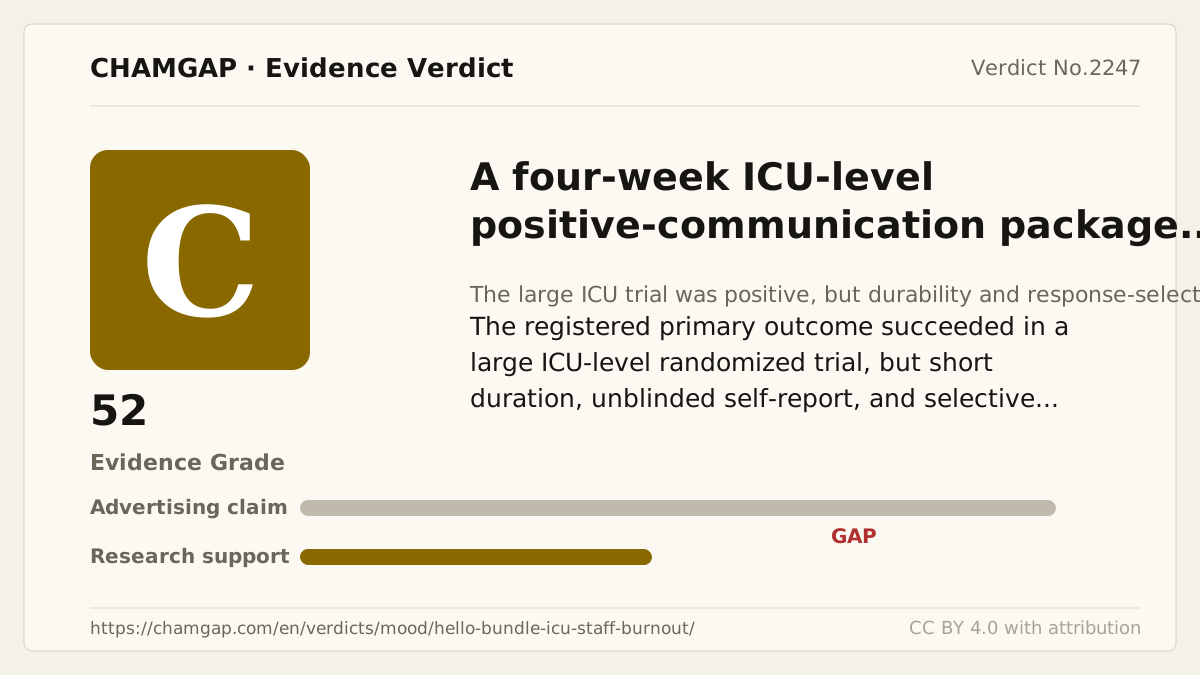
[Chamgap] Organization-level positive communication x ICU staff burnout — Evidence Grade C·54. 3 cited sources checked. Source: https://chamgap.com/en/verdicts/mood/hello-bundle-icu-staff-burnout/ · CC BY 4.0CC BY 4.0 — free to use with attribution; do not distort grades, numbers, or verdict meaning.
What this document does and does not do
Chamgap is an information source. It reports what research has and has not confirmed; it does not tell readers what to take or buy. That decision belongs to readers and, when needed, medical or legal professionals. This verdict reflects literature available up to the search date and may change as new research appears. Nothing here is medical advice.