
Fluoxetine,
does it really help with Prevention of depressive-episode relapse in remitted major depressive disorder?
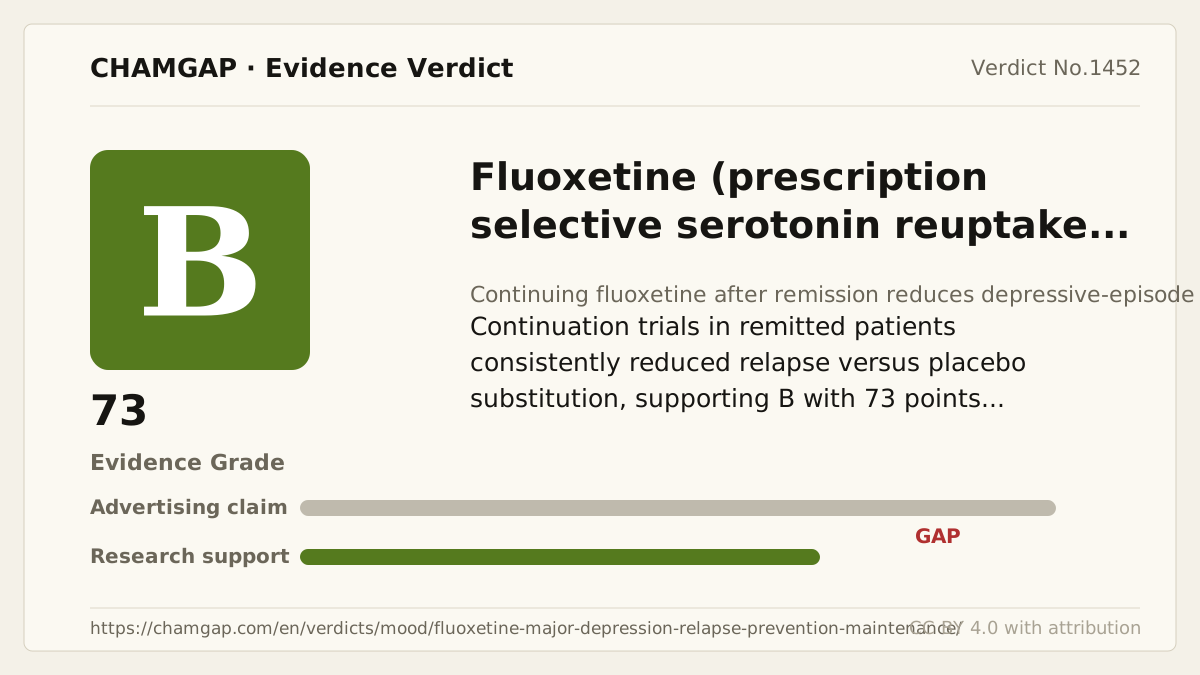
research showsFluoxetine is rated B because continuation after remission from acute treatment reduces relapse compared with switching to placebo. In a 395-patient maintenance trial, estimated relapse during the next 12 weeks was 26.4% versus 48.6% after 24 total weeks and 9.0% versus 23.2% after 38 total weeks. A subsequent 501-patient continuation trial also found less relapse with daily fluoxetine than placebo over 25 weeks. Because these were enriched maintenance and discontinuation designs, the verdict is B with 73 points.
ads claimA reduced relapse risk can be expanded into a guarantee of cure or a uniform need for lifelong treatment. Duration should reflect prior episodes, residual symptoms, adverse effects, and patient preference.
Useful facts when choosing a product
- Fluoxetine is a prescription selective serotonin reuptake inhibitor; maintenance treatment refers to continuing the same drug after response or remission from acute therapy.
- Even after improvement has stabilized, patients should not stop on their own and should review relapse risk and duration with the prescriber.
- Common adverse effects include nausea, insomnia or somnolence, anxiety or activation, sweating, and sexual dysfunction; monoamine oxidase inhibitors and other serotonergic drugs can create dangerous interactions.
- Suicidal thoughts and behavior in younger people, manic switching, hyponatremia, bleeding risk, and discontinuation symptoms require monitoring.
Chamgap Semantic Classification Code
Candidate index · review held
M.fluoxetine.UNK.depressive-episode-relapse-in-remitted-major-depressive-disorder.prevent.placeboMedicinal interventions > Fluoxetine > Unknown > depressive-episode relapse in remitted major depressive disorder > Occurrence-prevention claim > Placebo
An automated migration candidate, not an issued permanent code; exact claim scope remains under review. This machine-generated migration candidate helps retrieval but is not a permanent assignment. The original verdict ID and URL remain authoritative.
What the research actually shows
Reimherr and colleagues assigned 395 patients remitted after 12 to 14 weeks of open fluoxetine to 50 weeks of placebo, 14 or 38 additional weeks of fluoxetine followed by placebo, or 50 weeks of fluoxetine. Relapse was lower with continuation in comparison intervals after 24 and 38 total weeks, but the interval after 62 total weeks was not significant. Schmidt and colleagues assigned 501 acute responders to fluoxetine 20 mg daily, 90 mg weekly, or placebo for 25 weeks. Both fluoxetine regimens prolonged time to relapse; estimated relapse was 26% daily, 37% weekly, and 50% with placebo. A 2022 maintenance-phase network meta-analysis also found fluoxetine superior to placebo for six-month relapse.
Why this is classified as B (73)
Randomized continuation trials with 395 and 501 remitted or responding patients and a maintenance synthesis support less relapse after continuation than placebo substitution. The endpoint is direct, but enriched maintenance and discontinuation designs support B with 73 points.
Counterpoint. People at low relapse risk with burdensome adverse effects may discuss a planned taper. Recurrent episodes, residual symptoms, and a history of severe illness can justify longer maintenance.
Rejudgment record. New verdict — Placebo-controlled continuation trials rerandomizing fluoxetine responders or remitters and synthesis support reduced relapse, but the maintenance, enrichment, and discontinuation design boundary limits the verdict to B
Sub-claim grades by effect
This ingredient is marketed for several effects. A single overall grade blends strong and weak claims together, so each effect is graded separately here. The overall grade reflects the strongest disconfirming or core claim.
| Effect (sub-claim) | Grade | Basis |
|---|---|---|
| Prevention of depressive-episode relapse after remission | B | Directly demonstrated in placebo-controlled maintenance trials of remitted patients. |
| Prolongation of time in remission | B | Continued fluoxetine prolonged time to relapse compared with placebo substitution. |
| Persistence of the same additional relapse-prevention effect beyond 62 weeks | C | The final comparison interval in Reimherr was not significant, leaving the longer-term effect size uncertain. |
Cross-check — AI research and Codex final gate
Evidence Table
| Study | Design | Sample | Funding | Endpoint | Result | Weight |
|---|---|---|---|---|---|---|
| Reimherr FW et al. 1998 | Double-blind placebo-controlled continuation and maintenance trial rerandomizing remitted patients | 395 remitted patients | Industry-sponsored research | Depressive-episode relapse during a 50-week double-blind phase | Relapse was lower with continued fluoxetine than placebo substitution in comparison intervals after 24 and 38 total weeks. | Key direct maintenance trial |
| Kishi T et al. 2023 | Systematic review and network meta-analysis of double-blind placebo-controlled maintenance trials | 34 studies and 9,384 participants | Academic research | Relapse at six and twelve months | Fluoxetine was among treatments outperforming placebo for six-month relapse. | Contemporary synthesis and replication |
Receipt — 2 References
All 2 cited sources were verified for existence at the original page (as of 2026-07-23).
Final verification and publication gate: Codex · Evidence date: 2026-07-23 · Corrections: none
Cite this verdict
[Chamgap] Fluoxetine x prevention of depressive-episode relapse in remitted major depressive disorder — Evidence Grade B·73. 2 cited sources checked. Source: https://chamgap.com/en/verdicts/mood/fluoxetine-major-depression-relapse-prevention-maintenance/ · CC BY 4.0CC BY 4.0 — free to use with attribution; do not distort grades, numbers, or verdict meaning.
What this document does and does not do
Chamgap is an information source. It reports what research has and has not confirmed; it does not tell readers what to take or buy. That decision belongs to readers and, when needed, medical or legal professionals. This verdict reflects literature available up to the search date and may change as new research appears. Nothing here is medical advice.