
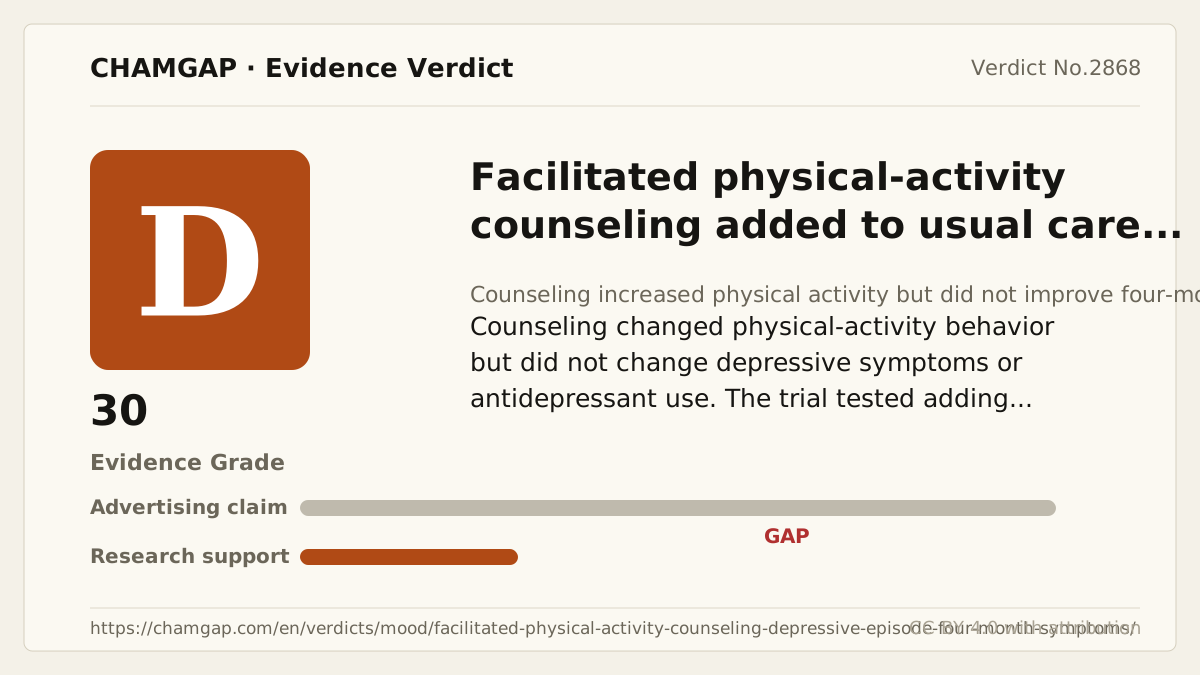
Facilitated physical-activity counseling added to usual care,
does it really help with Improved self-reported depressive symptoms at four months in adults with a depressive episode?
research showsThe grade is D with 30 points. TREAD randomized 361 adults with a depressive episode to usual care plus facilitated physical-activity counseling, 182, or usual care, 179. The adjusted four-month BDI-II difference was -0.54 points (95% CI -3.06 to 1.99; P=0.68), a null result.
ads claimKorean depression guidance and health information commonly recommend exercise and physical activity. This trial addressed one part of that practice: whether adding motivational physical-activity counseling to usual care improves depressive symptoms. It does not show that exercise is useless for depression, and it differs from a supervised program that ensures a specified exercise dose.
Useful facts when choosing a product
- The intervention offered up to three face-to-face and ten telephone contacts over roughly six to eight months, with at least five contacts intended before month four.
- The odds of reporting at least 1,000 MET-minutes per week across follow-up increased, OR 2.27 (95% CI 1.32 to 3.89); at month four the absolute proportions were 52% versus 43%, a 9-point difference.
- Antidepressant use was 59% versus 53% at month four, adjusted OR 1.20 (0.69 to 2.08), and 35% versus 42% at month 12. The repeated-measures OR was 0.63 (0.19 to 2.06), also null.
- This was motivational interviewing and behavioral support for participant-chosen local activity, not supervised exercise classes.
Chamgap Semantic Classification Code
Candidate index · review held
X.facilitated-physical-activity-counseling-added-to-usual-care.behavioral.self-reported-depressive-symptoms-at-with-a-depressive-episode.improve.MULTIBehaviors, exposures and policies > Facilitated physical-activity counseling added to usual care > Behavioral delivery > self-reported depressive symptoms at with a depressive episode > Improvement claim > Multiple: primary unresolved
An automated migration candidate, not an issued permanent code; exact claim scope remains under review. This machine-generated migration candidate helps retrieval but is not a permanent assignment. The original verdict ID and URL remain authoritative.
What the research actually shows
The allocation method was: "Treatment allocation, concealed from the study researchers using an automated telephone system, was administered remotely and employed a computer generated code." The analysis used an "intention to treat approach without imputation of missing data on outcomes," and a multiple-imputation sensitivity analysis did not change the conclusion. Four-month BDI data covered 142 versus 146 participants, totaling 288/361. Limitation name: substantial primary-analysis attrition Which listed item: substantial attrition (>=15%) Original evidence that the requirement was met: "Eighty per cent of the participants provided data at the primary outcome follow-up point," and the table showed 288/361, leaving 73 (20.2%) outside the primary analysis. Could it have been avoided: possible - four-month outcome retrieval could have been improved or multiple imputation prespecified as the primary analysis. Limitation name: unmasked subjective endpoint Which listed item: unmasked subjective endpoint Original evidence that the requirement was met: "none of the participants ... or researchers performing the outcome assessments could be blinded," while the primary measure was "a self report 21 item scale." Could it have been avoided: possible - an attention- and expectancy-matched counseling control plus a masked clinician-rated depression assessment could have been included. Self-completion reduces observer bias but not expectancy in an allocation-aware participant. Usual care could not ethically be withdrawn and was not counted as an avoidable active-control-only flaw. The Department of Health funded the work through the NIHR Health Technology Assessment program, and authors declared no submitted-work commercial support or relevant financial relationships.
Why this is classified as D (30)
The primary outcome was a patient-centered four-month BDI symptom score, but the result was null. Despite a large publicly funded trial, 20.2% primary-analysis attrition and an unmasked self-reported endpoint remain, and no repeated refutation or valid exclusion margin exists, giving D with 30 points.
Counterpoint. The intervention changed activity behavior without changing depressive symptoms. This does not negate exercise for physical health or other supervised-exercise evidence, and it does not support replacing medication or psychotherapy with exercise advice.
Rejudgment record. Cross-check applied — Cross-checked ISRCTN16900744 and the BMJ report for four-month BDI, remote allocation, 288/361 analysis, self-report and masking, physical activity, antidepressant use, and NIHR funding
| Endpoint | P | Symptom or function itself is the target - including patient reports and performance tests |
| Replication | R1 | Single confirmatory trial |
| Independence | I2 | Decisive evidence is publicly or non-profit funded |
| Effect size | E0 | Null |
| Precision | C0 | The confidence interval leaves room for benefit |
Stored derived and displayed grades match; this is not a current recalculation or validity check (D).
Sub-claim grades by effect
This ingredient is marketed for several effects. A single overall grade blends strong and weak claims together, so each effect is graded separately here. The overall grade reflects the strongest disconfirming or core claim.
| Effect (sub-claim) | Grade | Basis |
|---|---|---|
| Improved four-month depressive symptoms from counseling added to usual care | D | The adjusted BDI difference was -0.54 points (95% CI -3.06 to 1.99). |
| Increased physical activity | B | Across follow-up, OR was 2.27 (95% CI 1.32 to 3.89), with a 9-point absolute difference at month four. |
| Reduced antidepressant use | D | The repeated-measures OR was 0.63 (95% CI 0.19 to 2.06), a null result. |
Cross-check — AI research and Codex final gate
Evidence Table
| Study | Design | Sample | Funding | Endpoint | Result | Weight |
|---|---|---|---|---|---|---|
| Chalder M et al. 2012 TREAD | UK multicenter pragmatic parallel randomized usual-care-controlled trial | 361 randomized; 288 in the four-month BDI primary analysis | Public Department of Health funding through the NIHR HTA program | Self-reported BDI-II depressive symptoms at four months | Adjusted between-group difference -0.54 points (95% CI -3.06 to 1.99; P=0.68) | Pivotal publicly funded null trial |
Receipt — 3 References
All 3 cited sources were verified for existence at the original page (as of 2026-08-18).
Final verification and publication gate: Codex · Evidence date: 2026-08-18 · Corrections: none
Cite this verdict
[Chamgap] Facilitated Physical Activity Is Ineffective for 4-Month Depressive Symptoms in Adults With a Depressive Episode — Evidence Grade D·30. 3 cited sources checked. Source: https://chamgap.com/en/verdicts/mood/facilitated-physical-activity-counseling-depressive-episode-four-month-symptoms/ · CC BY 4.0CC BY 4.0 — free to use with attribution; do not distort grades, numbers, or verdict meaning.
What this document does and does not do
Chamgap is an information source. It reports what research has and has not confirmed; it does not tell readers what to take or buy. That decision belongs to readers and, when needed, medical or legal professionals. This verdict reflects literature available up to the search date and may change as new research appears. Nothing here is medical advice.