
EMDR,
does it really help with Improvement in core PTSD symptoms and diagnostic status?
research showsEMDR reduces PTSD symptoms versus wait-list or inactive controls but is rated C. Power 2002 randomized 105 patients to EMDR, 39; exposure plus cognitive restructuring, 37; or wait-list, 29, but only 72 had end-of-treatment assessment, for 31.4% attrition. Both active treatments improved versus wait-list but did not differ from each other. Chen's Hedges g of -0.662 (95% CI -0.887 to -0.436, 22 trials) excluded studies with active psychotherapy controls and therefore represents comparison with wait-list or inactive controls.
ads claimPromotion can imply that eye movements erase memory or cure trauma in one or two sessions. Studied EMDR is a complete structured trauma-focused therapy delivered by a trained clinician.
Useful facts when choosing a product
- EMDR is a structured psychotherapy incorporating trauma-memory recall, bilateral stimulation, and cognitive and emotional processing phases.
- Patients and therapists cannot be blinded, so passive and active psychotherapy controls must be distinguished.
Chamgap Semantic Classification Code
Candidate index · review held
X.eye-movement-desensitization-and-reprocessing.behavioral.core-ptsd-symptoms-and-diagnostic-status.improve.activeBehaviors, exposures and policies > Eye movement desensitization and reprocessing > Behavioral delivery > core PTSD symptoms and diagnostic status > Improvement claim > Active comparator
An automated migration candidate, not an issued permanent code; exact claim scope remains under review. This machine-generated migration candidate helps retrieval but is not a permanent assignment. The original verdict ID and URL remain authoritative.
What the research actually shows
Power and colleagues randomized 105 patients to EMDR, exposure plus cognitive restructuring, or wait-list, and only 72 had end-of-treatment assessment, for 31.4% attrition. Both active treatments improved significantly versus wait-list, but EMDR and exposure plus cognitive restructuring did not differ. The paper's clinically significant change rule required movement two standard deviations from the pretreatment group mean under a Jacobson-style criterion. Chen 2014 synthesized 26 randomized trials; after excluding studies with active psychotherapy controls, Hedges g across 22 trials comparing with wait-list or inactive controls was -0.662 (95% CI -0.887 to -0.436). In the same indication, sertraline is verdict 893, which is B with 67 points; prazosin is verdict 1206, which is C with 52 points; and stellate ganglion block is verdict 1774, which is C with 48 points. Those drug and injection interventions occupy different evidence tracks.
Why this is classified as C (54)
The pooled PTSD effect against wait-list or inactive controls is positive, but superiority over active psychotherapy and attainment of a disorder-specific important threshold were not established, giving E~. Small size and 31.4% attrition give B2, yielding C with 54 points.
Counterpoint. Therapist skill, dissociation, suicide risk, comorbidity, and patient preference can make exposure therapy, cognitive processing therapy, medication, or another evidence-based option more appropriate.
Rejudgment record. Cross-check applied — Scored absent superiority over active psychotherapy as E~ and small size plus 31.4% attrition as B2
| Endpoint | P | Symptom or function itself is the target - including patient reports and performance tests |
| Replication | R2 | Independently replicated across trials |
| Independence | I2 | Decisive evidence is publicly or non-profit funded |
| Effect size | E~ | Statistically positive but below the threshold |
Stored derived and displayed grades match; this is not a current recalculation or validity check (C).
Sub-claim grades by effect
This ingredient is marketed for several effects. A single overall grade blends strong and weak claims together, so each effect is graded separately here. The overall grade reflects the strongest disconfirming or core claim.
| Effect (sub-claim) | Grade | Basis |
|---|---|---|
| Reduction of core PTSD symptoms | C | The pooled effect across 22 randomized trials was moderate to large. |
| Improvement in PTSD diagnostic status | C | Multiple trials found more loss of diagnosis after treatment than control. |
| Reduction of anxiety and subjective distress | C | The meta-analysis also found significant reductions in anxiety and subjective distress. |
Cross-check — AI research and Codex final gate
Evidence Table
| Study | Design | Sample | Funding | Endpoint | Result | Weight |
|---|---|---|---|---|---|---|
| Power K et al. 2002 | Randomized three-arm trial with wait-list and active psychotherapy controls | 105 randomized; 72 assessed at end of treatment | Funding source inadequately reported in the original article; university and NHS primary-care research rather than a manufacturer product trial | Principal PTSD symptom measures including CAPS and clinically significant change | EMDR and exposure plus cognitive restructuring improved outcomes versus wait-list, with no difference between active treatments; clinically significant change used a Jacobson-style rule of moving two standard deviations from the pretreatment mean. | Key trial containing both passive and active controls |
| Chen YR et al. 2014 | Systematic review and meta-analysis of randomized trials | 26 randomized trials; 22 assessed PTSD symptoms | Academic research from Taipei Medical University and Taiwanese institutions; no manufacturer funding reported | PTSD symptoms, depression, anxiety, and subjective distress | After excluding studies with active psychotherapy controls, PTSD symptom Hedges g versus wait-list or inactive controls was -0.662 (95% CI -0.887 to -0.436). | Independent multi-trial replication |
Receipt — 2 References
All 2 cited sources were verified for existence at the original page (as of 2026-07-24).
Final verification and publication gate: Codex · Evidence date: 2026-07-24 · Corrections: none
Cite this verdict
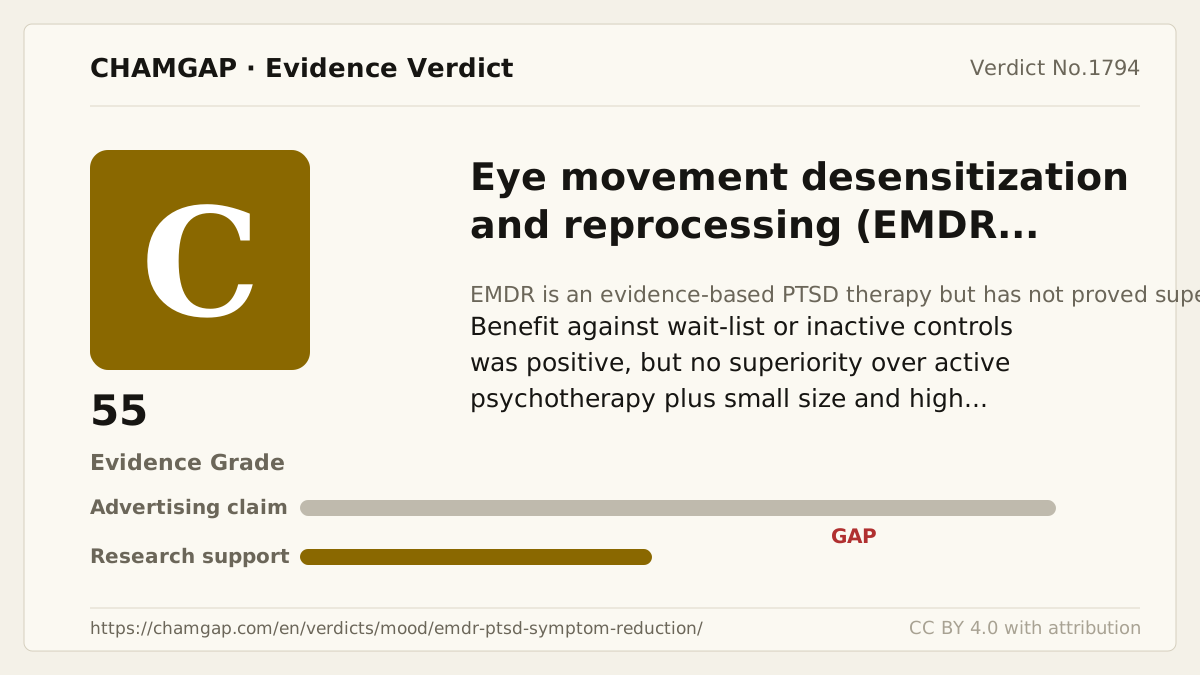
[Chamgap] EMDR x relief of PTSD symptoms — Evidence Grade C·54. 2 cited sources checked. Source: https://chamgap.com/en/verdicts/mood/emdr-ptsd-symptom-reduction/ · CC BY 4.0CC BY 4.0 — free to use with attribution; do not distort grades, numbers, or verdict meaning.
What this document does and does not do
Chamgap is an information source. It reports what research has and has not confirmed; it does not tell readers what to take or buy. That decision belongs to readers and, when needed, medical or legal professionals. This verdict reflects literature available up to the search date and may change as new research appears. Nothing here is medical advice.