
Dialectical behavior therapy,
does it really help with Prevention of recurrent suicide attempts and suicide-related hospitalization in high-risk borderline personality disorder?
research showsComprehensive DBT is rated B because randomized evidence shows fewer suicide attempts and less suicide-related service use among women with borderline personality disorder and recent recurrent suicidal or self-injurious behavior. In the 101-participant Linehan 2006 trial, 23.1% of the DBT group versus 46.0% of expert-treatment controls attempted suicide over two years, with lower frequencies of hospitalization for suicidal ideation and psychiatric emergency use. A four-site trial in 173 high-risk adolescents replicated reductions in suicide attempts and self-harm at treatment completion. Psychotherapy cannot be blinded, and the evidence depends on selected populations, trained therapists, and an intensive program, so grade A is not justified.
ads claimDescriptions can reduce DBT to a short skills class or app, or claim that it completely prevents suicide. The evidence applies to a fidelity-based, extended program combining individual therapy, skills training, coaching, and therapist consultation, and it does not replace emergency risk assessment.
Useful facts when choosing a product
- Standard comprehensive DBT commonly combines weekly individual therapy, group skills training, between-session coaching when needed, and a therapist consultation team.
- Core modules cover mindfulness, distress tolerance, emotion regulation, and interpersonal effectiveness, while directly prioritizing life-threatening behaviors.
- Effectiveness depends on trained clinicians, treatment fidelity, adequate duration, engagement, and a crisis-response system, so a workbook or app alone is not the same intervention.
- DBT has no drug toxicity, but emotional distress and dropout can occur. Imminent suicide risk requires immediate emergency assessment and safety measures rather than waiting for a scheduled DBT visit.
Chamgap Semantic Classification Code
Candidate index · review held
X.dialectical-behavior-therapy.behavioral.recurrent-suicide-attempts-and-suicide-related-hospitalization-in-high-risk-borderline-personality-disorder.prevent.activeBehaviors, exposures and policies > Dialectical behavior therapy > Behavioral delivery > recurrent suicide attempts and suicide-related hospitalization in high-risk borderline personality disorder > Occurrence-prevention claim > Active comparator
An automated migration candidate, not an issued permanent code; exact claim scope remains under review. This machine-generated migration candidate helps retrieval but is not a permanent assignment. The original verdict ID and URL remain authoritative.
What the research actually shows
Linehan 2006 randomized 101 women meeting DSM-IV borderline personality disorder criteria with recent suicidal or self-injurious behavior to one year of DBT or community treatment by experts, followed for another year. Suicide attempts occurred in 23.1% versus 46.0%, and frequencies of hospitalization for suicidal ideation and psychiatric emergency and inpatient use favored DBT. McCauley 2018 randomized 173 high-risk adolescents aged 12 to 18 to six months of DBT or individual and group supportive therapy; suicide attempts, nonsuicidal self-injury, and total self-harm all favored DBT at treatment completion. NICE advises considering comprehensive DBT when reducing recurrent self-harm is a priority for women with borderline personality disorder, but guideline status alone was not treated as grade A evidence.
Why this is classified as B (76)
An active-comparator randomized trial reduced recurrent suicide attempts and service use, and a multisite adolescent trial replicated reductions in suicidal behavior. Absence of mortality evidence, lack of masking, limited samples, and dependence on program fidelity and trained therapists support B with 76 points.
Counterpoint. Other structured evidence-based psychotherapies and mental health services can be considered when DBT is unsuitable or unavailable. A current suicide plan or access to lethal means requires immediate assessment independently of long-term psychotherapy efficacy.
Rejudgment record. New verdict — Accepted the direct reduction in recurrent suicidal behavior in the Linehan active-specialist comparator trial and the McCauley multisite trial, while applying the B ceiling for no mortality endpoint, unavoidable psychotherapy nonblinding, selected mostly female populations, and dependence on therapist training and program fidelity
Sub-claim grades by effect
This ingredient is marketed for several effects. A single overall grade blends strong and weak claims together, so each effect is graded separately here. The overall grade reflects the strongest disconfirming or core claim.
| Effect (sub-claim) | Grade | Basis |
|---|---|---|
| Reduction in recurrent suicide attempts in high-risk borderline personality disorder | B | An active-specialist comparator trial found about half as many participants attempting suicide, with directionally consistent replication in a multisite adolescent trial. |
| Reduction in the frequency of suicide-related hospitalization and psychiatric emergency use | B | Repeated service-use analyses in the Linehan trial favored DBT, but the result comes from one small trial. |
| Reduction in suicide attempts and total self-harm among high-risk adolescents | B | All three prespecified behavioral outcomes were significant at treatment completion in a four-site active-comparator trial. |
Cross-check — AI research and Codex final gate
Evidence Table
| Study | Design | Sample | Funding | Endpoint | Result | Weight |
|---|---|---|---|---|---|---|
| Linehan MM et al. 2006 | Randomized active-specialist-treatment trial with two-year follow-up | 101 women with borderline personality disorder and recent suicidal or self-injurious behavior | Public research support from the United States NIMH and NIDA | Suicide attempts, medical risk of self-harm, hospitalization for suicidal ideation, and psychiatric emergency and inpatient use | Suicide attempts occurred in 23.1% with DBT versus 46.0% with expert treatment, and frequencies of hospitalization for suicidal ideation and psychiatric emergency and inpatient use also favored DBT. | Key adult active-comparator randomized trial |
| McCauley E et al. 2018 | Four-site randomized active-comparator clinical trial | 173 high-risk suicidal adolescents aged 12 to 18 years | Public research support from the United States NIMH | Suicide attempts, nonsuicidal self-injury, and total self-harm at treatment completion | No suicide attempt was reported by 90.3% with DBT versus 78.9% with supportive therapy, favoring DBT with an odds ratio of 0.30 (95% CI 0.10 to 0.91). | Multisite replication evidence |
| NICE borderline personality disorder guideline CG78 | Evidence-based clinical practice guideline | Synthesis of randomized psychotherapy evidence for borderline personality disorder | United Kingdom National Institute for Health and Care Excellence | Reduction in recurrent self-harm and broad clinical outcomes | Recommends considering comprehensive DBT for women with borderline personality disorder when reducing recurrent self-harm is a priority. | Practice-standard supporting evidence |
Receipt — 3 References
All 3 cited sources were verified for existence at the original page (as of 2026-07-23).
Final verification and publication gate: Codex · Evidence date: 2026-07-23 · Corrections: none
Cite this verdict
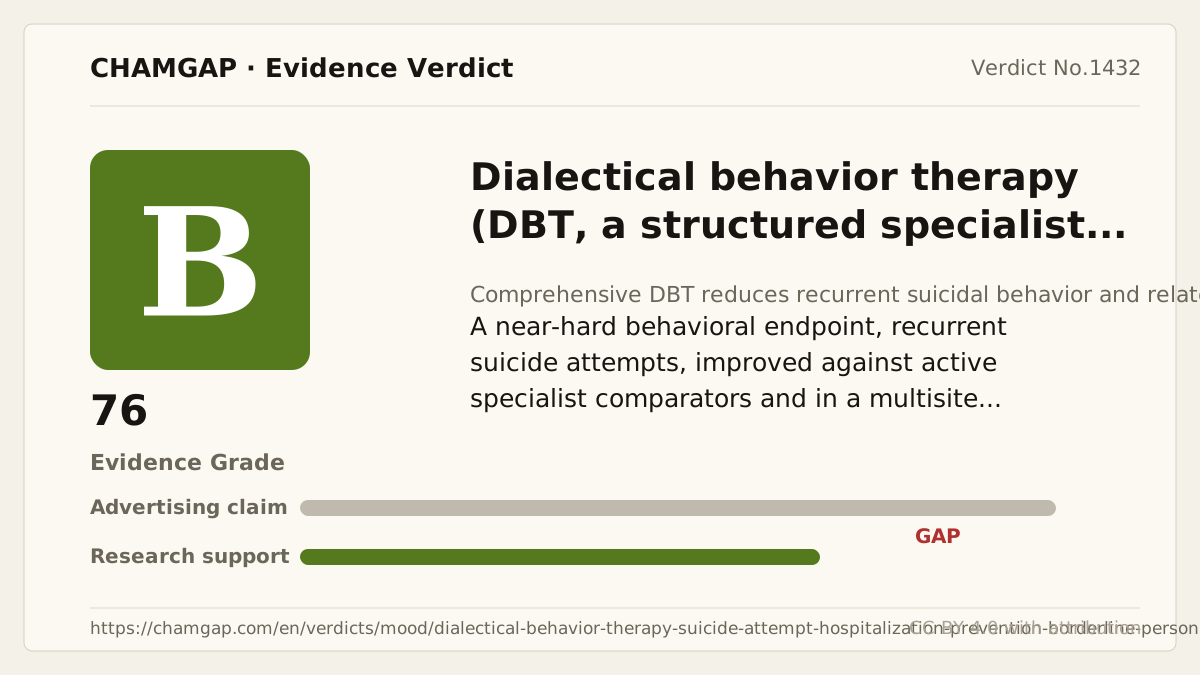
[Chamgap] Dialectical behavior therapy x prevention of recurrent suicide attempts and hospitalization in high-risk borderline personality disorder — Evidence Grade B·76. 3 cited sources checked. Source: https://chamgap.com/en/verdicts/mood/dialectical-behavior-therapy-suicide-attempt-hospitalization-prevention-borderline-personality-disorder/ · CC BY 4.0CC BY 4.0 — free to use with attribution; do not distort grades, numbers, or verdict meaning.
What this document does and does not do
Chamgap is an information source. It reports what research has and has not confirmed; it does not tell readers what to take or buy. That decision belongs to readers and, when needed, medical or legal professionals. This verdict reflects literature available up to the search date and may change as new research appears. Nothing here is medical advice.