
A desk potted plant,
does it really help with Reduced anxiety and stress in office workers?
research showsThe grade is C. Sixty-three nonmanagerial employees at a Japanese electric company completed one plant-free week followed by four weeks with a plant. Mean STAI trait anxiety fell from 47.9 (SD 10.6) to 46.2 (11.1), a 1.7-point change, P=.022. There was no concurrent control or randomized order, and the package included choosing, caring for, and gazing at the plant during a three-minute break.
ads claimKorean air-purifying plant marketing often blends pollutant removal with companion-plant wellbeing. This study measured no air quality and tested a package of choice, care, gaze shifting, and rest. Verdict 2266 is C with 50 points for structured horticultural therapy and depressive symptoms; it is not equivalent to one passive desk plant.
Useful facts when choosing a product
- Workers chose one small plant from six categories and kept it by the PC for four weeks.
- The intervention included choosing, watering, intentional gazing, and three-minute rest.
- Indoor-air pollutant removal was not measured.
Chamgap Semantic Classification Code
Candidate index · review held
UNK.one-small-desk-plant-chosen-and-cared.UNK.anxiety-and-stress-in-office-workers.reduce.UNKUnknown > One small desk plant chosen and cared > Unknown > anxiety and stress in office workers > Reduction claim > Unknown
An automated migration candidate, not an issued permanent code; exact claim scope remains under review. This machine-generated migration candidate helps retrieval but is not a permanent assignment. The original verdict ID and URL remain authoritative.
What the research actually shows
Seventy-five of 1,500 employees volunteered; six withdrew. Of 69 completers, six managers were excluded, leaving 63 nonmanagers. Choices were three air plants, seven bonsai, five cacti, 15 foliage plants, 11 succulents, and 22 kokedama. Each plant was 15 to 20 cm high and 7 to 10 cm wide, kept beside the PC for four weeks, watered by the worker, and gazed at for three minutes when fatigued. Japanese STAI trait Y-2 was measured at 6 p.m. after the plant-free week and after the plant phase. No separate perceived-stress scale was used; pulse was self-measured. During the plant phase, 17/63 showed a significant pulse decrease after rest and 9/63 an increase. No primary endpoint was explicitly designated and no registration number was confirmed. The funding statement reads: ‘This work was funded by Mitsubishi Electric Corporation in 2017.’
Why this is classified as C (46)
A small positive paired change is limited by small size, short duration, no concurrent control, unblinded subjective outcome, and selective exclusion, giving C with 46 points.
Counterpoint. A plant and gaze break may be a pleasant low-cost habit, but this is not evidence that it treats anxiety disorders or occupational stress.
Rejudgment record. Cross-check applied — A small STAI change in a fixed-order uncontrolled before-after study of 63 workers using a bundled intervention
| Endpoint | P | Symptom or function itself is the target - including patient reports and performance tests |
| Replication | R1 | Single confirmatory trial |
| Independence | I1 | Mixed funding sources |
| Effect size | E~ | Statistically positive but below the threshold |
Stored derived and displayed grades match; this is not a current recalculation or validity check (C).
Sub-claim grades by effect
This ingredient is marketed for several effects. A single overall grade blends strong and weak claims together, so each effect is graded separately here. The overall grade reflects the strongest disconfirming or core claim.
| Effect (sub-claim) | Grade | Basis |
|---|---|---|
| Reduced STAI trait anxiety | C | The 1.7-point mean decrease was small and uncontrolled. |
| Lower pulse after a three-minute break | C | The proportion with a decrease rose from 4.8% to 27.0%, while 14.3% increased. |
| Indoor air purification | ? | This study did not measure indoor air quality. |
Cross-check — AI research and Codex final gate
Evidence Table
| Study | Design | Sample | Funding | Endpoint | Result | Weight |
|---|---|---|---|---|---|---|
| Toyoda et al. office before-after study 2020 | Fixed-order paired uncontrolled before-after comparison of one plant-free week followed by four plant weeks | 75 volunteered, six withdrew, 69 completed; six managers excluded and 63 analyzed | This work was funded by Mitsubishi Electric Corporation in 2017. | Japanese STAI trait Y-2 and self-measured pulse | STAI 47.9 (SD 10.6) versus 46.2 (11.1), P=.022; high anxiety 31.7% versus 30.2% | Pivotal but weak before-after evidence |
Receipt — 3 References
All 3 cited sources were verified for existence at the original page (as of 2026-08-08).
Final verification and publication gate: Codex · Evidence date: 2026-08-08 · Corrections: none
Cite this verdict
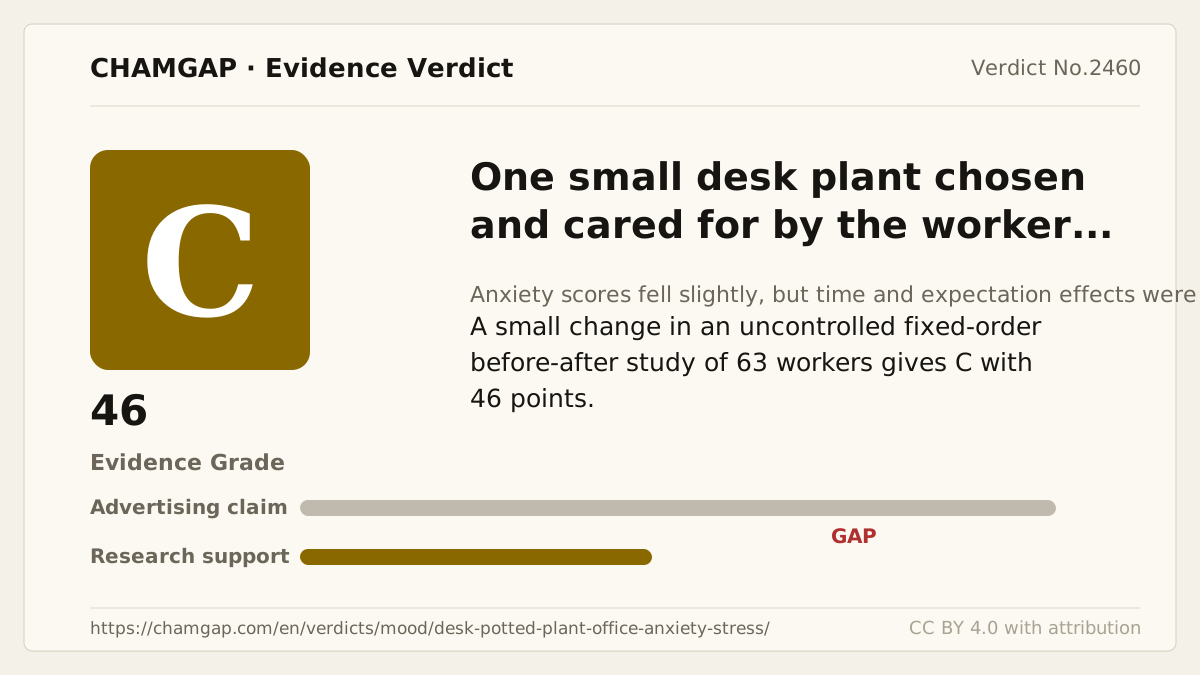
[Chamgap] A desk potted plant x reduced office anxiety and stress — Evidence Grade C·46. 3 cited sources checked. Source: https://chamgap.com/en/verdicts/mood/desk-potted-plant-office-anxiety-stress/ · CC BY 4.0CC BY 4.0 — free to use with attribution; do not distort grades, numbers, or verdict meaning.
What this document does and does not do
Chamgap is an information source. It reports what research has and has not confirmed; it does not tell readers what to take or buy. That decision belongs to readers and, when needed, medical or legal professionals. This verdict reflects literature available up to the search date and may change as new research appears. Nothing here is medical advice.