
Curcumin,
does it really help with Relief of major depressive disorder symptoms and adjunctive use with antidepressants?
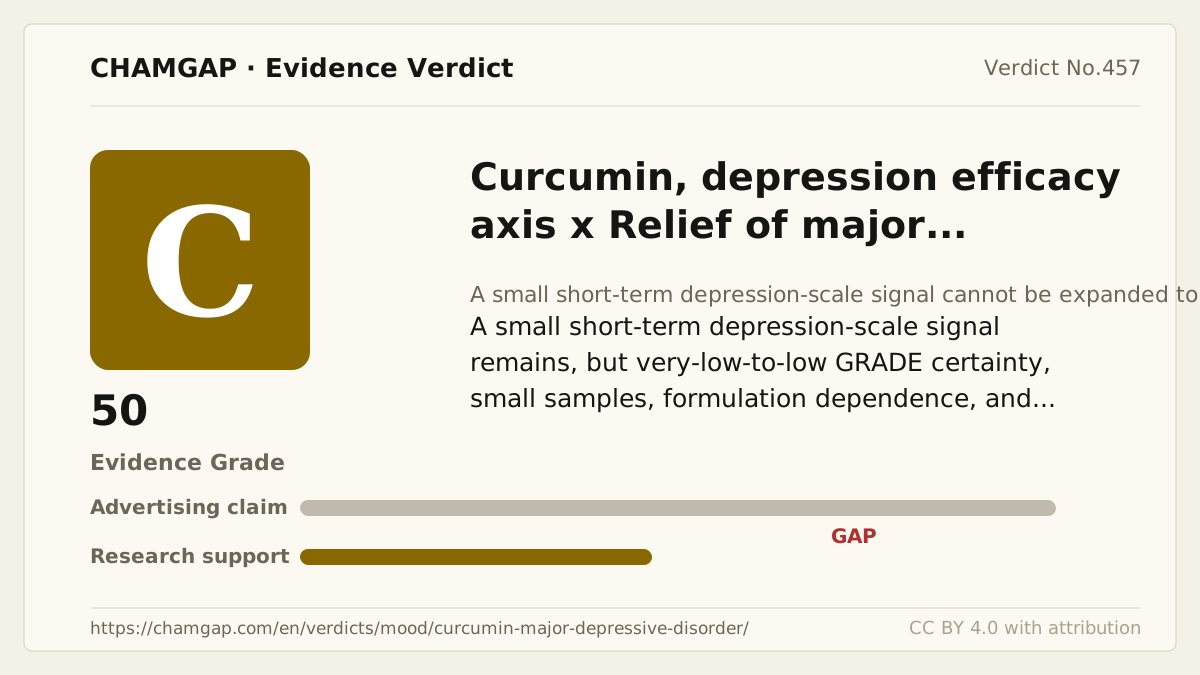
research showsSmall short-term RCTs and meta-analyses in MDD show a signal for lower depression-scale scores, but the effect is small and certainty is low or very low. A meta-analysis of ten trials and 594 participants found an SMD of -0.32, while a recent small adjunctive sertraline RCT was null. Results from bioavailability-enhanced branded formulations such as BCM-95 and SinaCurcumin cannot be assigned to generic turmeric or every curcumin product, resulting in C.
ads claimMarketing uses phrases such as 'natural antidepressant,' 'raises serotonin,' and 'antidepressant booster,' expanding brief depression-scale results from specific enhanced-absorption formulations to turmeric powder, other curcumin products, relapse prevention, and maintenance of remission.
Useful facts when choosing a product
- Generic curcumin and cross-border BCM-95 products are both sold in South Korea; a 500 mg label does not establish the actual curcuminoid content or bioavailability of the clinical-trial formulation.
- MDD trials commonly used 500 mg once or twice daily or nanocurcumin 40 mg/day, with different formulations and durations of five to twelve weeks.
- BCM-95, SinaCurcumin, piperine, phospholipid, and nano formulations produce different absorption and exposure and are not interchangeable; branded-ingredient results cannot be assigned to ordinary turmeric.
- Gastrointestinal symptoms can occur, and turmeric or curcumin supplements, particularly high-bioavailability forms, have been linked to rare acute liver injury. Antidepressant changes or discontinuation require clinical guidance.
Chamgap Semantic Classification Code
Candidate index · review held
S.curcumin.UNK.major-depressive-disorder-symptoms-and-adjunctive-use-with-antidepressants.relieve.placeboSupplements and nutraceuticals > Curcumin > Unknown > major depressive disorder symptoms and adjunctive use with antidepressants > Symptom-relief claim > Placebo
An automated migration candidate, not an issued permanent code; exact claim scope remains under review. This machine-generated migration candidate helps retrieval but is not a permanent assignment. The original verdict ID and URL remain authoritative.
What the research actually shows
Lopresti 2014 gave 56 people with MDD a patented curcumin extract at 500 mg twice daily for eight weeks and reported signals at selected time points and in subgroups; the ingredient company provided support. Haller's 2019 overview rated the short-term effect from six curcumin RCTs as very-low-certainty by GRADE. Wang 2021 found an SMD of -0.32 across ten trials and 594 participants, but three trials had high risk of bias and the overall evidence quality was low. In Talaei 2023, adding SinaCurcumin 40 mg/day to sertraline did not improve depression or anxiety over placebo in 45 patients with severe MDD.
Why this is classified as C (50)
Small signals from human RCTs and meta-analyses exist, but subjective short-term endpoints, low or very low certainty, concentration in branded formulations, and conflicting adjunctive results support C with 50 points. Possible liver injury is separated into safety.
Counterpoint. A short-term adjunctive effect from a specific standardized formulation remains possible while standard care continues, but formulation-specific large independent RCTs and clinical outcomes such as remission and relapse are needed.
Rejudgment record. New verdict — Small MDD RCTs and a modest short-term pooled signal exist, but GRADE certainty is low or very low, branded formulations dominate, and adjunctive findings conflict
Sub-claim grades by effect
This ingredient is marketed for several effects. A single overall grade blends strong and weak claims together, so each effect is graded separately here. The overall grade reflects the strongest disconfirming or core claim.
| Effect (sub-claim) | Grade | Basis |
|---|---|---|
| Relief of major depressive disorder symptoms | C | Small short-term RCT and pooled signals have low or very low certainty and are formulation-dependent. |
| Adjunctive benefit with antidepressants | C | Small positive pilot findings conflict with a null adjunctive sertraline trial. |
Cross-check — AI research and Codex final gate
Evidence Table
| Study | Design | Sample | Funding | Endpoint | Result | Weight |
|---|---|---|---|---|---|---|
| Wang Z et al. 2021 | Systematic review and meta-analysis | 594 | Unclear and varied across trials | Depressive symptoms, response, dropout, and adverse events | Depressive symptoms favored curcumin with SMD -0.32, but three trials had high risk of bias and overall evidence quality was low. | Key |
| Haller H et al. 2019 | Overview of systematic reviews with GRADE | 6 | No specific funding declared | Depression severity, response, and remission | Rated the small short-term signal as very-low-certainty evidence. | Key |
| Lopresti AL et al. 2014 | Randomized double-blind placebo-controlled trial | 56 | Supported by Arjuna Natural Extracts | Depression scales including IDS-SR30 | A patented extract at 1,000 mg/day for eight weeks produced selected time-point and subgroup signals in a small sample. | Supportive |
| Talaei A et al. 2023 | Randomized double-blind placebo-controlled adjunctive trial | 45 | Authors declared no conflicts of interest | Beck depression and anxiety scores | Sertraline plus SinaCurcumin 40 mg/day was not superior to sertraline plus placebo. | Key opposing |
Receipt — 4 References
All 4 cited sources were verified for existence at the original page (as of 2026-07-18).
Final verification and publication gate: Codex · Evidence date: 2026-07-18 · Corrections: none
Cite this verdict
[Chamgap] Curcumin x relief of major depressive disorder symptoms and adjunctive use with antidepressants — Evidence Grade C·50. 4 cited sources checked. Source: https://chamgap.com/en/verdicts/mood/curcumin-major-depressive-disorder/ · CC BY 4.0CC BY 4.0 — free to use with attribution; do not distort grades, numbers, or verdict meaning.
What this document does and does not do
Chamgap is an information source. It reports what research has and has not confirmed; it does not tell readers what to take or buy. That decision belongs to readers and, when needed, medical or legal professionals. This verdict reflects literature available up to the search date and may change as new research appears. Nothing here is medical advice.