
Creatine monohydrate,
does it really help with Relief of major depressive disorder symptoms and adjunctive antidepressant treatment?
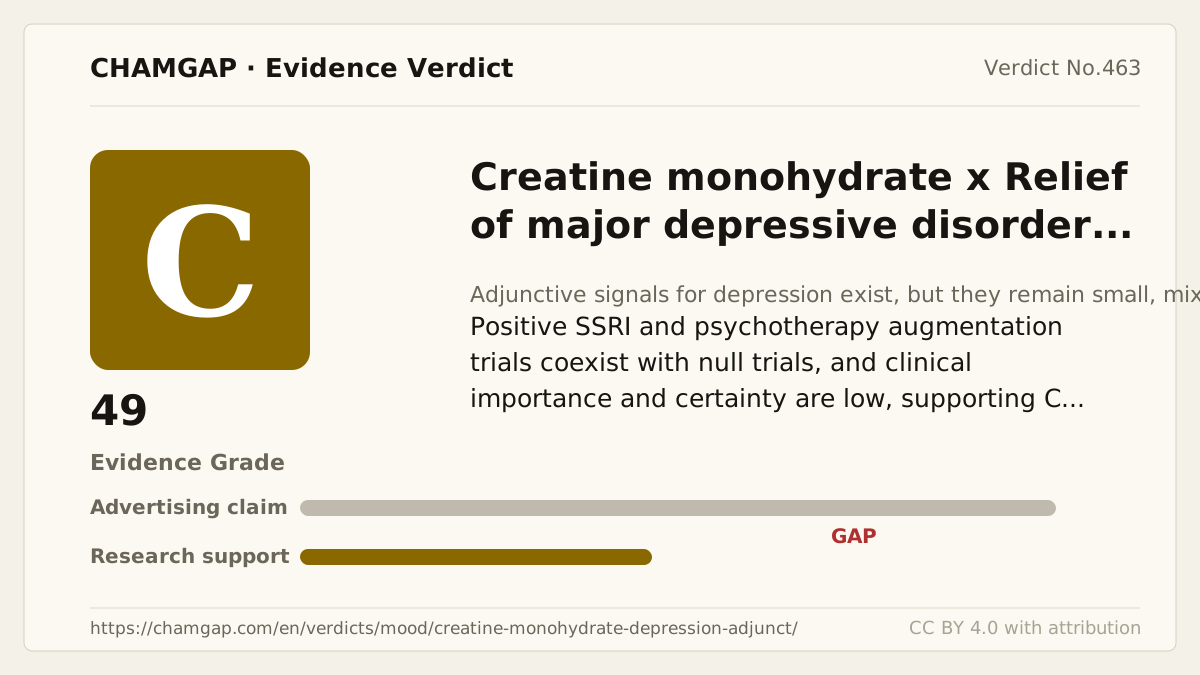
research showsCreatine monohydrate has shown adjunctive benefits with an SSRI or cognitive behavioral therapy in small major-depression trials, but null trials also exist and populations, doses, and co-treatments vary substantially, resulting in a C grade. A recent meta-analysis found an average effect below the minimal important difference with very low certainty. Exercise-performance and cognition evidence cannot be repurposed as depression-treatment evidence.
ads claimMarketing may turn the energy-metabolism rationale of sports creatine into a 'natural antidepressant' claim or combine exercise and cognition studies to make the evidence appear larger. The treatment literature mainly consists of short adjunctive trials added to antidepressants or psychotherapy.
Useful facts when choosing a product
- Korean products are mainly sports powders and sticks, commonly providing 3-5 g per serving, whereas depression studies used 2-10 g/day in clinical augmentation settings.
- The best-known major-depression trial and the psychotherapy augmentation trial used creatine monohydrate 5 g/day for eight weeks.
- Evidence for exercise performance, strength, or cognition does not establish treatment efficacy for major depressive disorder.
- Most studies tested augmentation of an SSRI, established medication, or cognitive behavioral therapy, not replacement monotherapy; they do not support stopping prescribed treatment.
- Gastrointestinal discomfort and weight or water gain may occur, and kidney disease, pregnancy, and polypharmacy warrant clinical review. In a bipolar-depression trial, two of 17 creatine recipients switched to hypomania or mania.
Chamgap Semantic Classification Code
Candidate index · review held
S.creatine-monohydrate.UNK.major-depressive-disorder-symptoms-and-adjunctive-antidepressant-treatment.relieve.placeboSupplements and nutraceuticals > Creatine monohydrate > Unknown > major depressive disorder symptoms and adjunctive antidepressant treatment > Symptom-relief claim > Placebo
An automated migration candidate, not an issued permanent code; exact claim scope remains under review. This machine-generated migration candidate helps retrieval but is not a permanent assignment. The original verdict ID and URL remain authoritative.
What the research actually shows
Lyoo and colleagues randomized 52 women with major depressive disorder to escitalopram plus creatine 5 g/day or placebo for eight weeks and found faster, greater improvement in HAM-D scores with creatine. A 100-person exploratory trial by Sherpa and colleagues reported a larger eight-week PHQ-9 reduction with cognitive behavioral therapy plus 5 g/day than with therapy plus placebo. A 2026 systematic review of randomized trials summarized four major-depression trials and one bipolar-depression trial with mixed positive and null findings. A broader meta-analysis of 11 trials found an SMD of -0.34, equivalent to 2.2 HAM-D points, below the three-point minimal important difference, with I-squared of 71.3% and very-low-certainty evidence.
Why this is classified as C (49)
Randomized trials exist and positive signals recur, but samples are small, co-treatments and populations are heterogeneous, and null primary outcomes are present. The meta-analytic average is below the minimal important difference with very low certainty, supporting C with 49 points.
Counterpoint. Signals in women receiving SSRI therapy and in an under-resourced psychotherapy setting justify larger independent replication. At present, creatine is an investigational adjunct rather than a replacement for standard depression care.
Rejudgment record. New verdict — Mixed positive and null augmentation trials in major depression, small heterogeneous samples, and very-low-certainty meta-analytic evidence
Cross-check — AI research and Codex final gate
Evidence Table
| Study | Design | Sample | Funding | Endpoint | Result | Weight |
|---|---|---|---|---|---|---|
| Lyoo IK et al. 2012 | Randomized double-blind placebo-controlled augmentation trial | 8 | Academic and public support | HAM-D change, response, and remission | Escitalopram plus creatine 5 g/day improved HAM-D more than placebo augmentation from week two; eight-week remission was 52.0% versus 25.9%. | Key positive |
| Sherpa NN et al. 2025 | Randomized double-blind placebo-controlled exploratory feasibility trial | 8 | Academic and nonprofit support | Change in PHQ-9 | Cognitive behavioral therapy plus creatine 5 g/day reduced PHQ-9 more than therapy plus placebo, but this was a short hypothesis-generating trial. | Key positive |
| Fares BJ et al. 2026 | Systematic review of randomized trials in mental disorders | 5 | Academic | Depressive symptoms and safety | Across four major-depression trials and one bipolar-depression trial, positive SSRI and psychotherapy augmentation findings coexisted with null adolescent and bipolar primary outcomes. | Key synthesis |
| Eckert I et al. 2025 | Systematic review and meta-analysis | 1,093 | Academic | Depressive symptoms | The SMD was -0.34, equivalent to 2.2 HAM-D points and below the three-point minimal important difference, with I-squared 71.3% and very low GRADE certainty. | Key limitation |
Receipt — 4 References
All 4 cited sources were verified for existence at the original page (as of 2026-07-18).
Final verification and publication gate: Codex · Evidence date: 2026-07-18 · Corrections: none
Cite this verdict
[Chamgap] Creatine monohydrate x major depressive disorder and antidepressant augmentation — Evidence Grade C·49. 4 cited sources checked. Source: https://chamgap.com/en/verdicts/mood/creatine-monohydrate-depression-adjunct/ · CC BY 4.0CC BY 4.0 — free to use with attribution; do not distort grades, numbers, or verdict meaning.
What this document does and does not do
Chamgap is an information source. It reports what research has and has not confirmed; it does not tell readers what to take or buy. That decision belongs to readers and, when needed, medical or legal professionals. This verdict reflects literature available up to the search date and may change as new research appears. Nothing here is medical advice.