
Community choir participation,
does it really help with Reduction of depressive symptoms?
research showsThe grade is D with 30 points. In a pragmatic randomized trial of 258 older adults, HADS depression favored singing at three months, when the fourteen-week program ended, by -1.52 points (95% CI -2.13 to -0.92). At the prespecified six-month assessment the difference had disappeared, -0.53 (-1.24 to 0.18, P=.14). The primary outcome was six-month mental health-related quality of life, not depression. Control participants continued usual activities and were offered singing after follow-up, making this a wait-list rather than active comparison.
ads claimVerdict 2219 is C with 54 points for replacing the exercise-training component of COPD pulmonary rehabilitation. This trial instead evaluated depressive symptoms in generally recruited older adults against a wait-list, so both the indication and comparator differ.
Useful facts when choosing a product
- The primary endpoint was York SF-12 mental health-related quality of life at six months; depression was a HADS secondary outcome.
- Control participants continued usual activities and were offered singing after six-month follow-up.
- The depression difference was -1.52 points at three months and a nonsignificant -0.53 points at six months.
Chamgap Semantic Classification Code
Candidate index · review held
UNK.fourteen-week-community-singing-group.UNK.depressive-symptoms.reduce.UNKUnknown > fourteen-week community singing group > Unknown > depressive symptoms > Reduction claim > Unknown
An automated migration candidate, not an issued permanent code; exact claim scope remains under review. This machine-generated migration candidate helps retrieval but is not a permanent assignment. The original verdict ID and URL remain authoritative.
What the research actually shows
Across five East Kent locations, 258 participants were individually randomized to singing, 131, or usual-activity wait-list control, 127. The primary endpoint was York SF-12 mental health-related quality of life at six months; depression and anxiety on HADS were secondary six-month outcomes. Follow-up included 222 participants at three months and 204 at six months. The singing groups met for fourteen weekly ninety-minute sessions and then disbanded. NIHR provided public funding, while one coauthor was a board member of the nonprofit that developed and implemented the intervention.
Why this is classified as D (30)
Null six-month depression, 21% loss to follow-up, an unblinded subjective outcome, and a wait-list comparator give D with 30 points.
Counterpoint. A short-term mood benefit while sessions continue remains possible, but durability and a singing-specific effect are not established.
Rejudgment record. Cross-check applied — Cross-checked the primary endpoint, prespecified six-month hypotheses, three- and six-month HADS estimates, wait-list design, follow-up rates, funding, and disclosed relationship
| Endpoint | P | Symptom or function itself is the target - including patient reports and performance tests |
| Replication | R1 | Single confirmatory trial |
| Independence | I2 | Decisive evidence is publicly or non-profit funded |
| Effect size | E0 | Null |
| Precision | C0 | The confidence interval leaves room for benefit |
Stored derived and displayed grades match; this is not a current recalculation or validity check (D).
Sub-claim grades by effect
This ingredient is marketed for several effects. A single overall grade blends strong and weak claims together, so each effect is graded separately here. The overall grade reflects the strongest disconfirming or core claim.
| Effect (sub-claim) | Grade | Basis |
|---|---|---|
| Reduced depressive symptoms at completion of fourteen weeks | C | The three-month difference was significant at -1.52 points, but the comparator was a wait-list. |
| Depression improvement sustained to six months | D | The six-month difference was nonsignificant at -0.53 points. |
| Replacement of COPD exercise rehabilitation | ? | This population and comparator did not test COPD rehabilitation. |
Cross-check — AI research and Codex final gate
Evidence Table
| Study | Design | Sample | Funding | Endpoint | Result | Weight |
|---|---|---|---|---|---|---|
| Coulton et al. pragmatic community singing randomized trial 2015 | Pragmatic individually randomized wait-list controlled trial | 258 randomized, 131 singing and 127 control; 222 followed at three months and 204 at six months | Public funding from the UK NIHR Research for Patient Benefit program | Primary six-month York SF-12 mental quality of life; secondary three- and six-month HADS depression | HADS depression difference -1.52 (95% CI -2.13 to -0.92) at three months and -0.53 (-1.24 to 0.18, P=.14) at six months. | Pivotal trial directly testing the longer-term depression hypothesis |
Receipt — 1 References
All 1 cited sources were verified for existence at the original page (as of 2026-08-05).
Final verification and publication gate: Codex · Evidence date: 2026-08-05 · Corrections: none
Cite this verdict
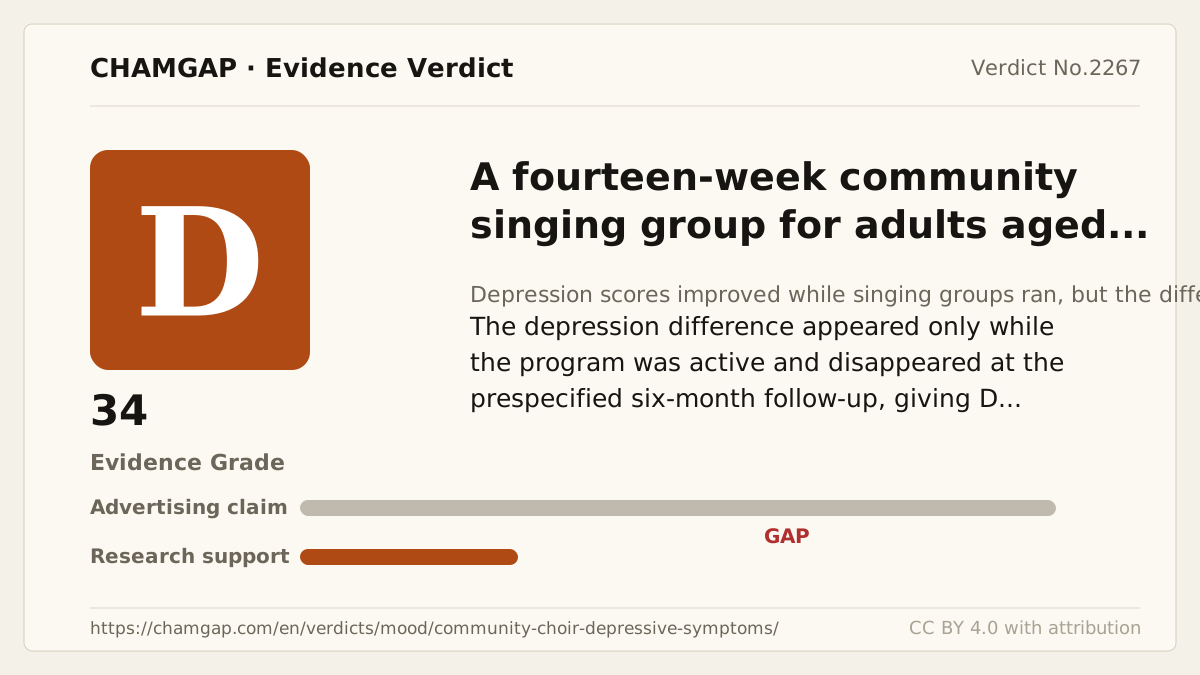
[Chamgap] Community choir participation x depressive symptoms — Evidence Grade D·30. 1 cited sources checked. Source: https://chamgap.com/en/verdicts/mood/community-choir-depressive-symptoms/ · CC BY 4.0CC BY 4.0 — free to use with attribution; do not distort grades, numbers, or verdict meaning.
What this document does and does not do
Chamgap is an information source. It reports what research has and has not confirmed; it does not tell readers what to take or buy. That decision belongs to readers and, when needed, medical or legal professionals. This verdict reflects literature available up to the search date and may change as new research appears. Nothing here is medical advice.