
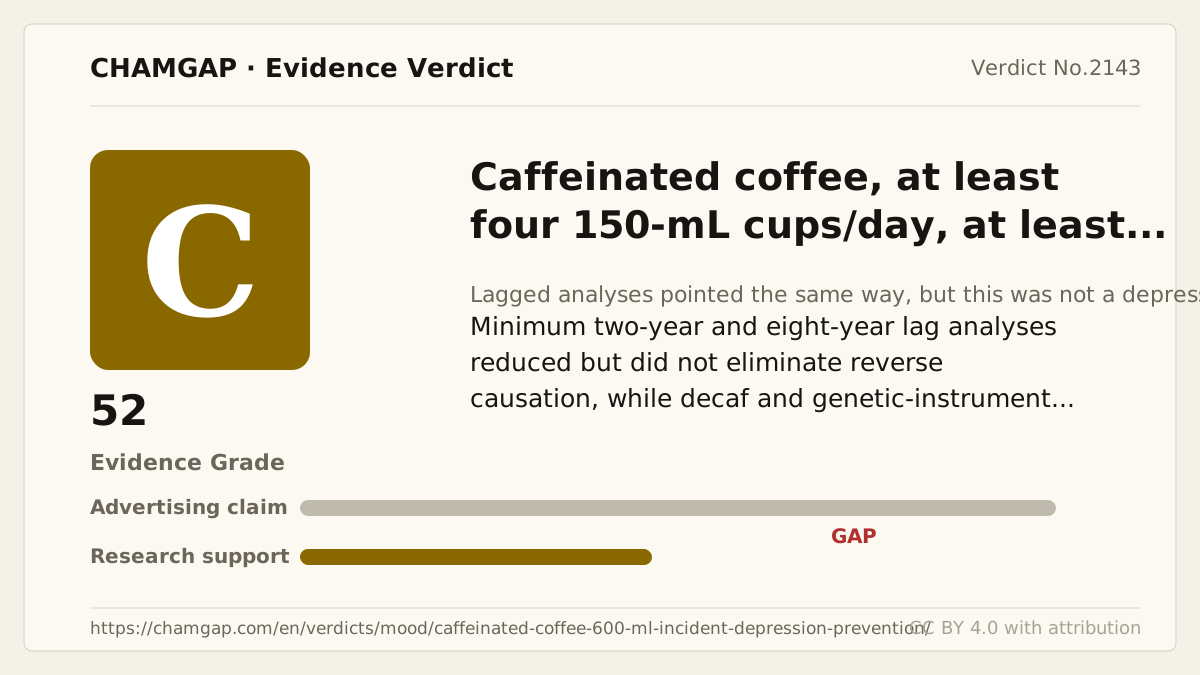
Caffeinated coffee, at least 600 mL/day,
does it really help with Prevention of incident clinical depression?
research showsThe grade is C. Among 50,739 women free of depression or severe symptoms and followed for 10 years, at least four cups/day was associated with RR 0.80 (95% CI 0.64 to 0.99) versus at most one cup/week. The outcome relied on self-reported diagnosis and antidepressant use, and predisposition to depression may have reduced coffee intake first.
ads claimThe fact that coffee contains caffeine and the observed lower depression incidence must be separated. Verdict 119 is A with 88 points for acute alertness and performance, but that cannot be extended to long-term depression prevention.
Useful facts when choosing a product
- One cup was 150 mL, making four cups at least 600 mL.
- Mean total dietary caffeine in the highest group was 649±220 mg/day and included all dietary sources, not coffee alone.
- Brewing method and measured caffeine per cup were not reported.
Chamgap Semantic Classification Code
Candidate index · review held
F.caffeinated-coffee.food.incident-clinical-depression.prevent.UNKFoods and beverages > Caffeinated coffee > Food consumption > incident clinical depression > Occurrence-prevention claim > Unknown
An automated migration candidate, not an issued permanent code; exact claim scope remains under review. This machine-generated migration candidate helps retrieval but is not a permanent assignment. The original verdict ID and URL remain authoritative.
What the research actually shows
The Nurses' Health Study followed 50,739 women from 1996 to 2006. The reference was at most one caffeinated cup per week, not strict lifelong abstention. One cup was 150 mL. Mean total dietary caffeine in the highest group was 649 mg/day and included noncoffee sources. Smoking was adjusted as never, past, or current; association was stronger in current smokers, interaction P=.06. NIH and nonprofit funding were confirmed.
Why this is classified as C (56)
A significant incident-outcome association and lag analyses are offset by self-reported outcomes, major selection, and residual reverse causation, giving C with 56 points.
Counterpoint. Repeated questionnaires and an eight-year lag are stronger than cross-sectional evidence.
Rejudgment record. Cross-check applied — A significant association with incident clinical depression remained limited by self-reported outcomes, selection, and residual reverse causation
| Endpoint | H | Hard endpoint - actual events such as death |
| Replication | R1 | Single confirmatory trial |
| Independence | I2 | Decisive evidence is publicly or non-profit funded |
| Effect size | E+ | Meets the clinically important threshold |
Stored derived and displayed grades match; this is not a current recalculation or validity check (C).
Sub-claim grades by effect
This ingredient is marketed for several effects. A single overall grade blends strong and weak claims together, so each effect is graded separately here. The overall grade reflects the strongest disconfirming or core claim.
| Effect (sub-claim) | Grade | Basis |
|---|---|---|
| Reduced incident clinical depression in women | C | Direction persisted with an eight-year lag, but evidence remained observational. |
Cross-check — AI research and Codex final gate
Evidence Table
| Study | Design | Sample | Funding | Endpoint | Result | Weight |
|---|---|---|---|---|---|---|
| Lucas et al. 2011 Nurses' Health Study | Prospective female cohort | 50,739 women and 2,607 incident cases | NIH DK58845, NARSAD, and a Quebec research fellowship | Incident clinical depression over 10 years | At least four cups/day versus at most one/week: RR 0.80 (0.64-0.99) | Core long-term observational evidence |
| Kwok et al. 2016 Mendelian randomization | Two-sample Mendelian randomization | Large genetic summary datasets | Academic research support | Depression | Genetically predicted coffee consumption OR 0.89 (0.66-1.21) | Lifelong-exposure cross-check; null |
Receipt — 2 References
All 2 cited sources were verified for existence at the original page (as of 2026-08-04).
Final verification and publication gate: Codex · Evidence date: 2026-08-04 · Corrections: none
Cite this verdict
[Chamgap] Caffeinated coffee, at least 600 mL/day x prevention of incident depression — Evidence Grade C·56. 2 cited sources checked. Source: https://chamgap.com/en/verdicts/mood/caffeinated-coffee-600-ml-incident-depression-prevention/ · CC BY 4.0CC BY 4.0 — free to use with attribution; do not distort grades, numbers, or verdict meaning.
What this document does and does not do
Chamgap is an information source. It reports what research has and has not confirmed; it does not tell readers what to take or buy. That decision belongs to readers and, when needed, medical or legal professionals. This verdict reflects literature available up to the search date and may change as new research appears. Nothing here is medical advice.