
Bupropion XL,
does it really help with Improvement in depressive symptoms, response, and remission in adult major depressive disorder and prevention of relapse in responders?
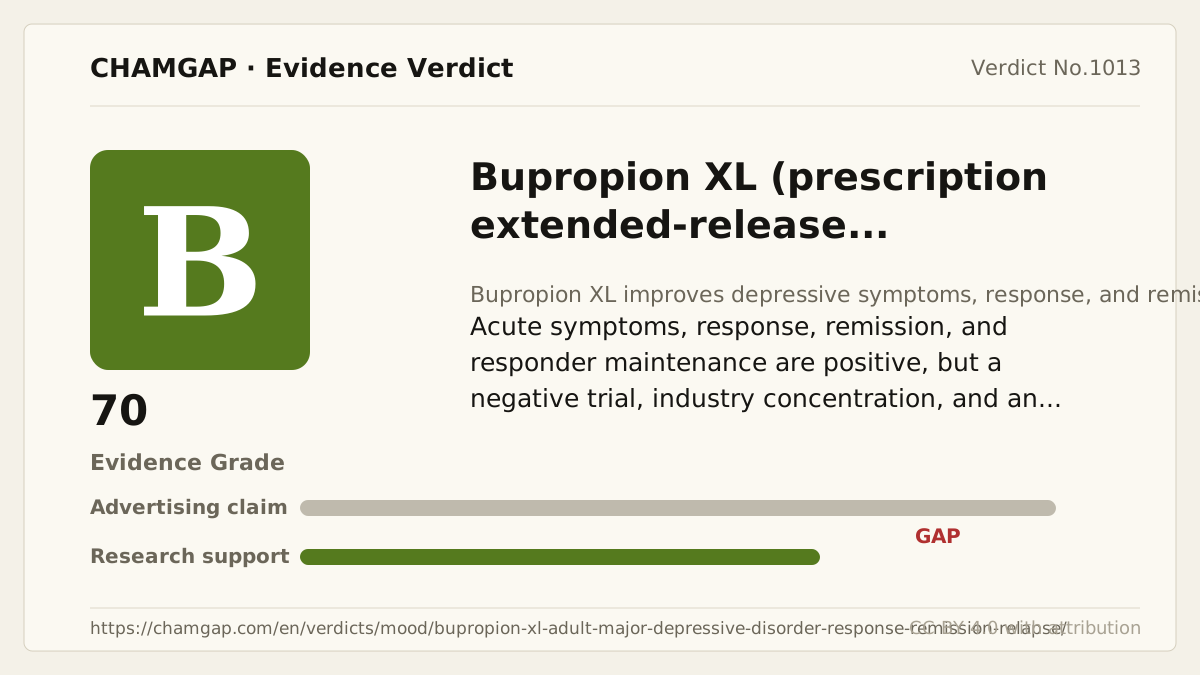
research showsBupropion XL is rated B because it improves depressive symptoms, response, and remission in adult major depressive disorder, and continuation after response delays relapse. In a direct eight-week XL trial, clinician-rated response was 50% versus 35% and remission was 32% versus 18% with placebo. However, the 51 studies in the systematic review were not 51 confirmatory placebo-controlled trials, and a separate large bupropion XR trial failed to beat placebo on its eight-week primary endpoint. The 44-week maintenance trial also rerandomized only open-label responders to the SR formulation, an enriched design. Repeated positive evidence is accepted, while the negative trial, industry concentration, and responder selection yield B with 70 points.
ads claimSimplified claims can promise an immediate return of energy and motivation, complete recovery, and no sexual adverse effects. Antidepressant response takes weeks, some patients do not respond, insomnia or agitation can worsen, and suicidal thinking or a manic switch requires monitoring from the start.
Useful facts when choosing a product
- Bupropion XL is an extended-release prescription antidepressant usually taken once each morning. Crushing, chewing, or splitting the tablet can cause rapid release and increase seizure risk; it should be swallowed whole and titrated by the prescriber.
- Insomnia, agitation or anxiety, headache, dry mouth, nausea, and constipation are common, and blood pressure can rise. Patients and families should monitor worsening mood, suicidal thoughts, and manic or hypomanic symptoms during initiation and dose changes.
- Seizure risk is dose dependent. A seizure disorder, current or prior anorexia nervosa or bulimia, and abrupt withdrawal from alcohol, benzodiazepines, or antiseizure drugs are contraindications or major risk states that must be disclosed.
- Smoking-cessation bupropion and Wellbutrin XL contain the same active ingredient and must not be combined. Monoamine oxidase inhibitor timing, other drugs that lower seizure threshold, pregnancy or breastfeeding, and liver or kidney impairment require review with the prescriber or pharmacist.
Chamgap Semantic Classification Code
Candidate index · review held
M.bupropion-xl.UNK.depressive-symptoms-response-and-remission-major-depressive-disorder-and-prevention-of-relapse-in-responders.prevent.placeboMedicinal interventions > Bupropion XL > Unknown > depressive symptoms, response, and remission major depressive disorder and prevention of relapse in responders > Occurrence-prevention claim > Placebo
An automated migration candidate, not an issued permanent code; exact claim scope remains under review. This machine-generated migration candidate helps retrieval but is not a permanent assignment. The original verdict ID and URL remain authoritative.
What the research actually shows
Jefferson 2006 randomized 274 adults with major depressive disorder and prominent reductions in energy, pleasure, and interest to bupropion XL 300 to 450 mg or placebo for eight weeks. Self- and clinician-rated Inventory of Depressive Symptomatology scores improved significantly, with clinician-rated response of 50% versus 35% and remission of 32% versus 18%. Patel 2016 reviewed 51 studies spanning monotherapy, comparisons, combinations, special populations, and adverse effects, so this was not a set of 51 confirmatory placebo-controlled trials; a separate large XR trial failed to beat placebo on the week-eight MADRS primary endpoint. Weihs 2002 treated recurrent major depression openly with bupropion SR for eight weeks and then randomized 423 responders, 210 to bupropion and 213 to placebo, for up to 44 weeks; time to intervention for depression was longer with bupropion. This supports maintenance efficacy but is not a direct XL trial and uses responder enrichment.
Why this is classified as B (70)
A direct placebo-controlled XL trial and synthesis data support acute symptoms, response, and remission, while a randomized responder-maintenance trial supports delayed relapse. The 51 studies were not all confirmatory placebo-controlled trials, a separate large XR trial missed its primary endpoint, follow-up was usually short, and industry involvement was common; the maintenance trial used SR and an open-label responder-enrichment design. These factors yield B with 70 points. Dose-dependent seizures and monitoring for insomnia, agitation, hypertension, suicidality, and activation remain separate safety issues.
Counterpoint. For an appropriate patient, bupropion XL has average efficacy broadly similar to other second-generation antidepressants. Responders should not stop abruptly but should plan an adequate maintenance period with the prescriber.
Rejudgment record. Cross-check incorporated — Accepted improvement in acute symptoms, response, and remission in the direct bupropion XL placebo-controlled trial and delayed relapse in the SR responder-rerandomization trial, but rated B because the 51-study review was not a set of 51 confirmatory placebo-controlled trials, a separate large XR trial missed its primary endpoint, and maintenance evidence rerandomized 423 open-label responders and has formulation and enrichment indirectness
Sub-claim grades by effect
This ingredient is marketed for several effects. A single overall grade blends strong and weak claims together, so each effect is graded separately here. The overall grade reflects the strongest disconfirming or core claim.
| Effect (sub-claim) | Grade | Basis |
|---|---|---|
| Improvement of depressive symptoms in adult major depressive disorder | B | A direct XL trial and systematic review are positive, but the effect is incremental and evidence is dominated by short industry-funded studies. |
| Improvement in antidepressant response and remission | B | Response and remission benefits versus placebo recur in pooled data and the XL trial, although some trials were negative. |
| Relapse prevention in bupropion responders | B | The maintenance trial was positive but used SR and selected open-label responders, creating indirectness for all patients and for XL specifically. |
Cross-check — AI research and Codex final gate
Evidence Table
| Study | Design | Sample | Funding | Endpoint | Result | Weight |
|---|---|---|---|---|---|---|
| Jefferson JW et al. 2006 | Eight-week multicenter randomized double-blind placebo-controlled trial | 274 adult outpatients with major depressive disorder | GlaxoSmithKline product-development context and employee coauthorship | Self- and clinician-rated IDS total scores, response, and remission | XL reduced symptom scores more than placebo, with clinician-rated response of 50% versus 35% and remission of 32% versus 18%. | Direct formulation-specific acute efficacy trial |
| Patel K et al. 2016 | Systematic review and partial meta-analysis | 51 studies, including 27 studies of monotherapy in major depressive disorder | Academic review; authors reported no conflicts of interest | Depressive symptoms, response and remission, comparative efficacy, and adverse effects | Most robust trials favored bupropion over placebo and efficacy was generally similar to other antidepressants, but some trials were negative and follow-up was short. | Key synthesis documenting heterogeneity and industry concentration |
| Weihs KL et al. 2002 | Responder-enriched randomized double-blind placebo-withdrawal maintenance trial after eight weeks of open treatment, lasting up to 44 weeks | 423 open-label responders with recurrent major depression rerandomized (bupropion 210; placebo 213) | Industry funding and employee coauthorship from Glaxo Wellcome | Time to intervention for depression and relapse | Continuation of bupropion SR significantly prolonged time to intervention for depression versus switching to placebo. | Direct maintenance efficacy with SR-formulation and responder-enrichment indirectness |
Receipt — 3 References
All 3 cited sources were verified for existence at the original page (as of 2026-07-21).
Final verification and publication gate: Codex · Evidence date: 2026-07-21 · Corrections: none
Cite this verdict
[Chamgap] Bupropion XL x symptoms, response, remission, and relapse prevention in adult major depressive disorder — Evidence Grade B·70. 3 cited sources checked. Source: https://chamgap.com/en/verdicts/mood/bupropion-xl-adult-major-depressive-disorder-response-remission-relapse/ · CC BY 4.0CC BY 4.0 — free to use with attribution; do not distort grades, numbers, or verdict meaning.
What this document does and does not do
Chamgap is an information source. It reports what research has and has not confirmed; it does not tell readers what to take or buy. That decision belongs to readers and, when needed, medical or legal professionals. This verdict reflects literature available up to the search date and may change as new research appears. Nothing here is medical advice.