
Buprenorphine maintenance,
does it really help with Reduced illicit opioid use and treatment dropout in opioid use disorder?
research showsBuprenorphine maintenance earns B with 72 points because it reduces treatment dropout and illicit opioid use. Fudala randomized 326 participants, included 323 who received medication in the primary analysis, and had 243 complete four weeks. Both coprimary outcomes, opioid-negative urine and craving, succeeded.
ads claimMedication does not eliminate the need for follow-up, dose adjustment, and recovery support. Low-dose buprenorphine did not clearly suppress illicit use on urine testing versus placebo.
Useful facts when choosing a product
- The distinct counts are 326 randomized, 323 treated and analyzed, and 243 completers.
- Fudala compared buprenorphine 16 mg, buprenorphine 16 mg plus naloxone 4 mg, and placebo.
- Naloxone is included to discourage injection misuse; buprenorphine provides the maintenance effect.
Chamgap Semantic Classification Code
Candidate index · review held
UNK.buprenorphine-or-buprenorphine-naloxone-maintenance-treatment.UNK.illicit-opioid-use-and-treatment-dropout-in-opioid-use-disorder.reduce.placeboUnknown > Buprenorphine or buprenorphine-naloxone maintenance treatment > Unknown > illicit opioid use and treatment dropout in opioid use disorder > Reduction claim > Placebo
An automated migration candidate, not an issued permanent code; exact claim scope remains under review. This machine-generated migration candidate helps retrieval but is not a permanent assignment. The original verdict ID and URL remain authoritative.
What the research actually shows
Fudala screened 451 people, randomized 326, analyzed 323 who received medication, and had 243 completers; both coprimary outcomes succeeded. Cochrane synthesized 31 trials and 5,430 participants and found retention benefit at every dose, while high-dose suppression of illicit opioid use had SMD -1.17 (95% CI -1.85 to -0.49). Clinical meaning is described using retention and effect size, without inventing an opioid-use-disorder-specific threshold.
Why this is classified as B (72)
Successful coprimary outcomes and repeated retention and use-suppression effects support B with 72 points.
Counterpoint. Sedatives and alcohol increase respiratory-depression risk, making supervised induction and maintenance important.
Rejudgment record. Cross-check applied — Successful coprimary outcomes with replication of retention and illicit-use suppression across 31 randomized trials
| Endpoint | P | Symptom or function itself is the target - including patient reports and performance tests |
| Replication | R2 | Independently replicated across trials |
| Independence | I1 | Mixed funding sources |
| Effect size | E+ | Meets the clinically important threshold |
Stored derived and displayed grades match; this is not a current recalculation or validity check (B).
Sub-claim grades by effect
This ingredient is marketed for several effects. A single overall grade blends strong and weak claims together, so each effect is graded separately here. The overall grade reflects the strongest disconfirming or core claim.
| Effect (sub-claim) | Grade | Basis |
|---|---|---|
| Improved retention in treatment | B | Retention was better than placebo at every dose range. |
| Suppression of illicit opioid use at high dose | B | The SMD was -1.17 across three trials and 729 participants. |
| Reduced opioid craving | B | The Fudala coprimary craving outcome succeeded. |
Cross-check — AI research and Codex final gate
Evidence Table
| Study | Design | Sample | Funding | Endpoint | Result | Weight |
|---|---|---|---|---|---|---|
| Fudala PJ et al. 2003 | Multicenter double-blind placebo-controlled randomized trial | 326 randomized; 323 treated and analyzed; 243 completed | Joint public-private support from NIDA and Reckitt Benckiser | Coprimary outcomes of opioid-negative urine proportion and craving | Both active groups succeeded on both coprimary outcomes, P<0.001 | Key direct trial |
| Mattick RP et al. 2014 | Cochrane systematic review and meta-analysis of randomized trials | 31 trials and 5,430 participants | Public and academic Cochrane Drugs and Alcohol Group support; varied funding among included trials | Treatment retention and illicit opioid use | Retention RR 1.50 to 1.82 versus placebo; high-dose use suppression SMD -1.17 | Independent repeated replication |
Receipt — 2 References
All 2 cited sources were verified for existence at the original page (as of 2026-07-24).
Final verification and publication gate: Codex · Evidence date: 2026-07-24 · Corrections: none
Cite this verdict
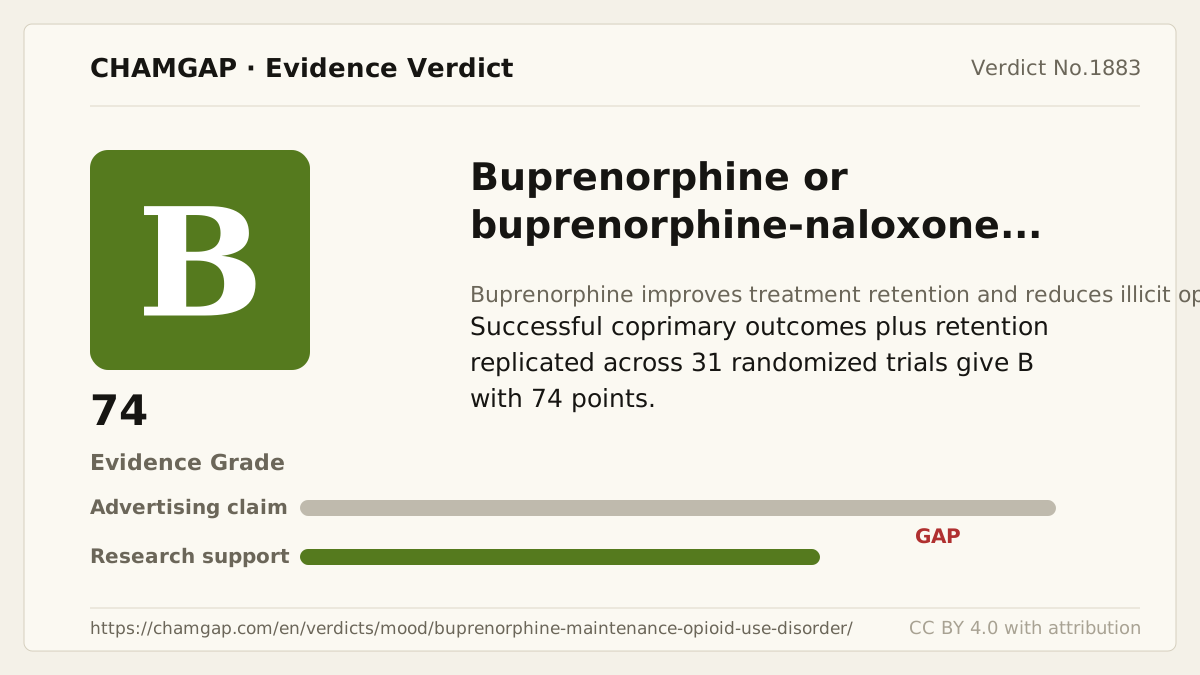
[Chamgap] Buprenorphine maintenance x opioid use disorder — Evidence Grade B·72. 2 cited sources checked. Source: https://chamgap.com/en/verdicts/mood/buprenorphine-maintenance-opioid-use-disorder/ · CC BY 4.0CC BY 4.0 — free to use with attribution; do not distort grades, numbers, or verdict meaning.
What this document does and does not do
Chamgap is an information source. It reports what research has and has not confirmed; it does not tell readers what to take or buy. That decision belongs to readers and, when needed, medical or legal professionals. This verdict reflects literature available up to the search date and may change as new research appears. Nothing here is medical advice.