
Bright light therapy,
does it really help with Improved depressive symptoms and remission in winter seasonal affective disorder?
research showsThe grade is C. Eastman randomized 121 people, but only 96 completed and 25 (20.7%) dropped out. Mean SIGH-SAD scores did not differ across groups, while strict remission was 61% with morning light, 50% with evening light, and 32% with negative-ion placebo. A 21-trial symptom synthesis found Hedges' g -0.38, but difficult blinding, subjective symptom assessment, and substantial attrition give C with 56 points.
ads claimA large lux number does not by itself establish antidepressant efficacy. Products should specify lux at eye position, distance, and duration, and should separate mean symptom scores from remission rates.
Useful facts when choosing a product
- The Eastman light boxes delivered about 6,000 lux at eye position for 1.5 hours daily over four weeks.
- Illuminance changes with distance and angle, so a lamp-face rating alone does not establish eye-level exposure.
- The measured output is separate from clinical efficacy; mean depression scores did not differ in the same trial.
Chamgap Semantic Classification Code
Candidate index · review held
UNK.bright-light-therapy-delivered-by-a-light-box.UNK.depressive-symptoms-and-remission-in-winter-seasonal-affective-disorder.improve.MULTIUnknown > Bright light therapy delivered by a light box > Unknown > depressive symptoms and remission in winter seasonal affective disorder > Improvement claim > Multiple: primary unresolved
An automated migration candidate, not an issued permanent code; exact claim scope remains under review. This machine-generated migration candidate helps retrieval but is not a permanent assignment. The original verdict ID and URL remain authoritative.
What the research actually shows
Eastman randomized 121 people but analyzed 96 completers: 33 morning light, 32 evening light, and 31 negative-ion placebo. Twenty-five participants dropped out, or 20.7%. Raters were blinded to equipment and timing, but participants could see bright-light exposure, making intervention blinding inherently difficult; the key depression outcome depended on participant-reported symptoms captured in a structured rating interview. Controls were not no treatment: they included a negative-ion sham and bright light at another time, while related trials used low-dose light or negative-ion controls. Mean scores were null and the morning-light versus negative-ion strict-remission contrast was positive.
Why this is classified as C (56)
Remission and pooled symptom signals were positive, but bright light is difficult to blind, the key symptom outcome is subjective, and 25 of 121 participants (20.7%) dropped out, alongside small short trials, giving C with 56 points.
Counterpoint. A treatment signal exists, but magnitude, optimal schedule, and durability remain uncertain.
Rejudgment record. Cross-check applied — The pivotal mean symptom comparison failed, while strict remission and small-trial synthesis were positive but limited by completer, short-duration, and abstract-only reporting
| Endpoint | P | Symptom or function itself is the target - including patient reports and performance tests |
| Replication | R2 | Independently replicated across trials |
| Independence | I2 | Decisive evidence is publicly or non-profit funded |
| Effect size | E+ | Meets the clinically important threshold |
Stored derived and displayed grades match; this is not a current recalculation or validity check (C).
Sub-claim grades by effect
This ingredient is marketed for several effects. A single overall grade blends strong and weak claims together, so each effect is graded separately here. The overall grade reflects the strongest disconfirming or core claim.
| Effect (sub-claim) | Grade | Basis |
|---|---|---|
| Improved mean SIGH-SAD score at four weeks | D | Eastman found no difference in mean scores among the three groups. |
| Increased strict remission at four weeks | C | Morning light achieved 61% versus 32% with negative-ion placebo, but this was a completer analysis. |
| Pooled symptom improvement in seasonal affective disorder | C | Hedges' g was -0.38 across 21 trials, but the synthesis was reported only as a conference abstract. |
Cross-check — AI research and Codex final gate
Evidence Table
| Study | Design | Sample | Funding | Endpoint | Result | Weight |
|---|---|---|---|---|---|---|
| Eastman CI et al. 1998 | Three-arm randomized placebo-controlled four-week trial with blinded raters | 121 randomized; 96 completers analyzed, 33/32/31; 25 dropped out | U.S. National Institute of Mental Health | Weekly mean SIGH-SAD score and strict remission | No group difference in mean scores at four weeks; strict remission 61% morning light, 50% evening light, 32% placebo; morning light versus placebo P<0.05 | Pivotal but limited by null mean scores and a completer analysis after 20.7% attrition |
| Friedrich ME et al. 2016 meta-analysis abstract | Systematic search and meta-analysis of randomized placebo-controlled trials reported as a conference abstract | 23 trials included; 21 for symptoms and 12 for response | Academic analysis; funding of all included trials was not fully reported in the abstract | Change on validated depression scales and response rate | Symptoms Hedges' g -0.38 (95% CI -0.53 to -0.23), P=0.0001; response RR 1.31 (95% CI 1.01 to 1.69), P=0.04 | Positive pooled signal but abstract-only reporting |
Receipt — 2 References
All 2 cited sources were verified for existence at the original page (as of 2026-08-01).
Final verification and publication gate: Codex · Evidence date: 2026-08-01 · Corrections: none
Cite this verdict
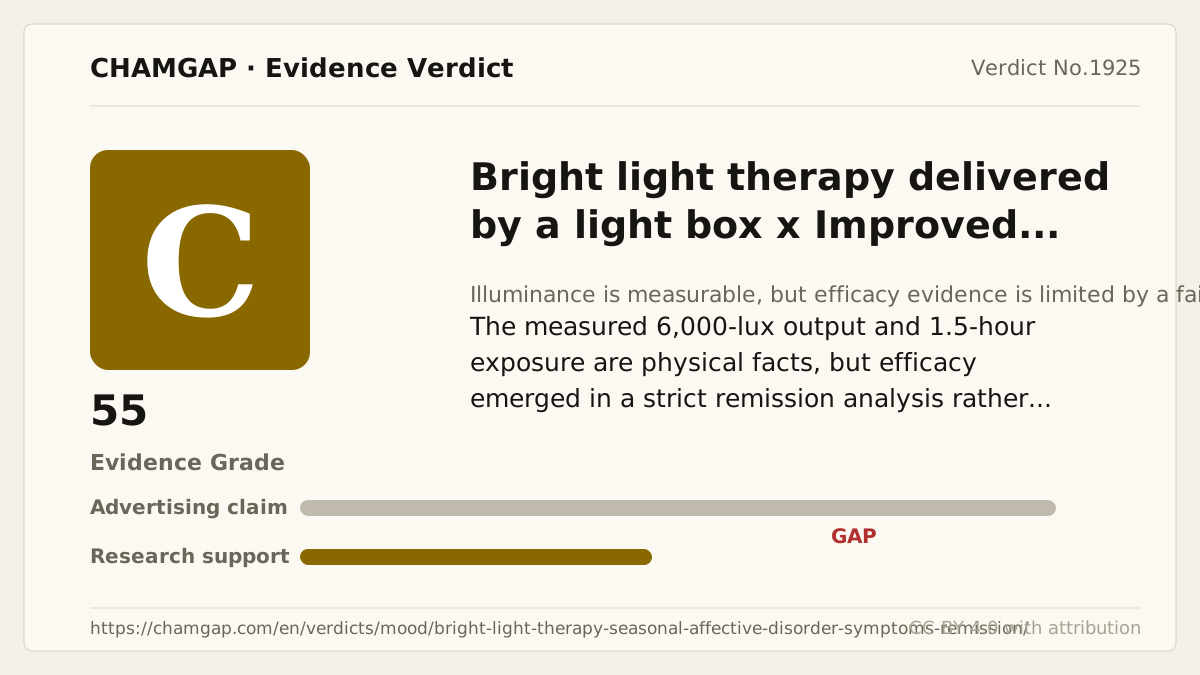
[Chamgap] Bright light therapy x symptoms and remission in seasonal affective disorder — Evidence Grade C·56. 2 cited sources checked. Source: https://chamgap.com/en/verdicts/mood/bright-light-therapy-seasonal-affective-disorder-symptoms-remission/ · CC BY 4.0CC BY 4.0 — free to use with attribution; do not distort grades, numbers, or verdict meaning.
What this document does and does not do
Chamgap is an information source. It reports what research has and has not confirmed; it does not tell readers what to take or buy. That decision belongs to readers and, when needed, medical or legal professionals. This verdict reflects literature available up to the search date and may change as new research appears. Nothing here is medical advice.