
Behavioral activation,
does it really help with Improved depressive symptoms and functioning in major depressive disorder?
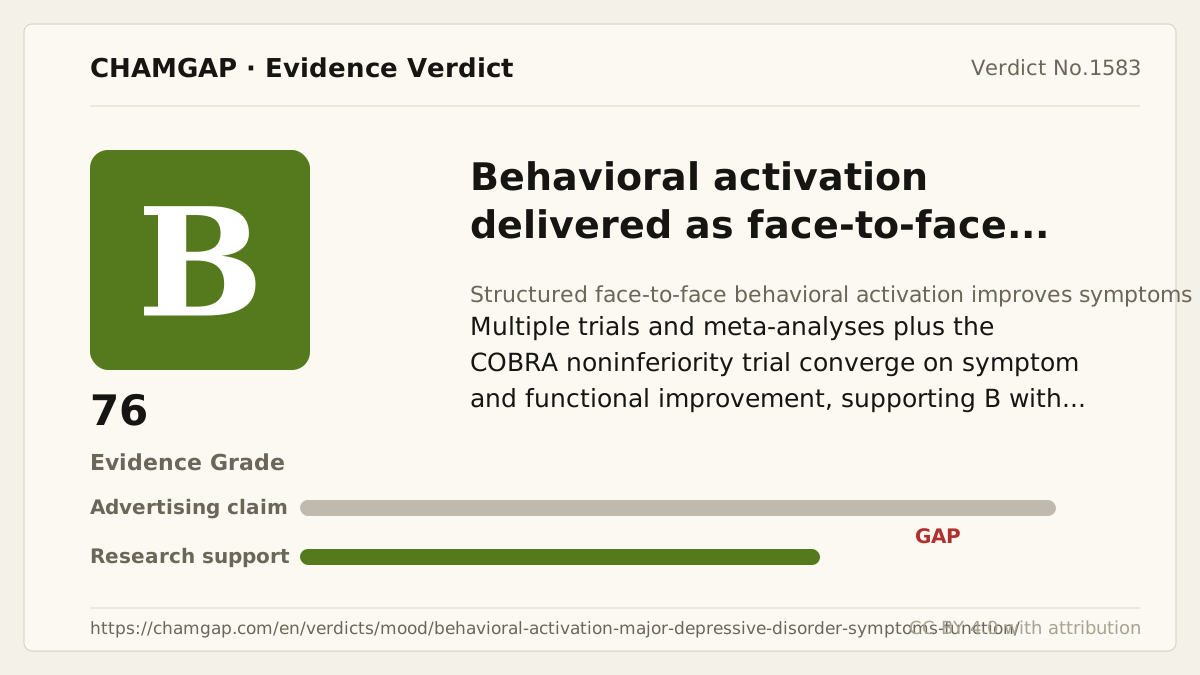
research showsFace-to-face behavioral activation delivered by trained practitioners is rated B for improving depressive symptoms and functioning in major depressive disorder. COBRA randomized 440 adults with major depressive disorder to behavioral activation or cognitive behavioral therapy, and both groups had a mean PHQ-9 score of 8.4 at 12 months; the between-group difference of 0.1 points (95% CI -1.3 to 1.5) remained within the prespecified noninferiority margin. A 2014 meta-analysis found a short-term effect of SMD -0.74 versus controls, and the 2020 Cochrane review supported benefit over usual care and possible equivalence to CBT. Depression scales and functioning measure the symptoms patients seek to treat and are not surrogate markers. The evidence remains B rather than A because psychotherapy cannot be fully masked, many older trials were small or low quality, and long-term inactive-control evidence is less certain.
ads claimBehavioral activation can be reduced to going outside, exercising, or writing a to-do list. Trial interventions were structured psychotherapies that assessed avoidance and mood-activity patterns, scheduled valued actions gradually, and reviewed barriers and relapse patterns. Severe depression or suicide risk cannot be replaced by generic self-help advice.
Useful facts when choosing a product
- Face-to-face behavioral activation is a structured psychotherapy that links avoidance and withdrawal with mood, then plans small activities connected to personal values and reinforcement while reviewing what happened.
- COBRA allowed up to 20 sessions over 16 weeks and up to four optional booster sessions. Actual intensity varies with depression severity, disability, patient preference, and the treatment system.
- Behavioral activation is not mutually exclusive with antidepressant medication. For moderate or severe major depressive disorder, combined treatment is selected according to clinical status and patient preference.
- There are no pharmacologic adverse effects, but early activity and exposure can temporarily increase discomfort or frustration. Suicidal thoughts, self-harm, mania, psychosis, or rapid deterioration require immediate risk assessment and a higher level of care.
Chamgap Semantic Classification Code
Candidate index · review held
X.behavioral-activation-delivered.behavioral.depressive-symptoms-and-functioning-in-major-depressive-disorder.improve.usual-careBehaviors, exposures and policies > Behavioral activation delivered > Behavioral delivery > depressive symptoms and functioning in major depressive disorder > Improvement claim > Usual care
An automated migration candidate, not an issued permanent code; exact claim scope remains under review. This machine-generated migration candidate helps retrieval but is not a permanent assignment. The original verdict ID and URL remain authoritative.
What the research actually shows
Ekers 2014 included 26 randomized trials and 1,524 participants. Across 25 studies and 1,088 participants, behavioral activation versus controls produced SMD -0.74 and an estimated number needed to treat of about 2.5, although only seven of 26 studies met at least three major quality criteria and follow-up was usually short. COBRA randomized 440 UK adults with major depressive disorder to behavioral activation, 221 participants, or CBT, 219 participants. The 12-month PHQ-9 difference was 0.1 points (95% CI -1.3 to 1.5), within the 1.9-point noninferiority margin; response and recovery were approximately 61% to 70% in both groups and were maintained at 18 months. The 2020 Cochrane review examined 53 studies and 5,495 participants and concluded that behavioral activation may outperform usual care and may be no less effective than CBT, while explicitly noting certainty concerns.
Why this is classified as B (76)
Multiple controlled-trial meta-analyses, CBT noninferiority in the 440-participant COBRA trial, the 53-study Cochrane synthesis, and inclusion in NICE treatment options converge on improved depressive symptoms and functioning. Depression scales and health-related quality of life are direct treatment targets, not surrogates. Limitations in masking, the quality of many older small trials, and long-term inactive-control evidence prevent an exceptional A and support B with 76 points.
Counterpoint. Although its principles are relatively simple, treatment quality depends on formulation, graded planning, barrier solving, and risk monitoring. Lack of response or deterioration should trigger reassessment of diagnosis, comorbidity, medication, and treatment intensity.
Rejudgment record. Cross-check applied — Patient-reported symptoms that are themselves treatment targets, including depression and anxiety scales, are not surrogate outcomes. Multiple independent randomized trials that consistently meet clinically meaningful thresholds can earn B, and exceptionally large, consistent, independent evidence can earn A. Depressive symptoms and functioning are direct targets and multiple trials agree, but certainty and long-term control limitations support B.
Sub-claim grades by effect
This ingredient is marketed for several effects. A single overall grade blends strong and weak claims together, so each effect is graded separately here. The overall grade reflects the strongest disconfirming or core claim.
| Effect (sub-claim) | Grade | Basis |
|---|---|---|
| Reduction of depressive symptoms in major depressive disorder | B | A short-term meta-analytic SMD of -0.74 and the 12-month COBRA results support clinically meaningful improvement. |
| Improved functioning and health-related quality of life in major depressive disorder | B | Secondary outcomes including SF-36 in COBRA were similar to CBT, and the Cochrane synthesis supports the direction of functional and quality-of-life benefit. |
| Noninferior treatment effect compared with CBT for depression | B | In the 440-participant COBRA trial, the 12-month PHQ-9 difference remained within the prespecified noninferiority margin and outcomes persisted to 18 months. |
Cross-check — AI research and Codex final gate
Evidence Table
| Study | Design | Sample | Funding | Endpoint | Result | Weight |
|---|---|---|---|---|---|---|
| Richards DA, Ekers D, McMillan D, et al. 2016 | Multicenter randomized assessor-masked pragmatic noninferiority trial | 440 adults with major depressive disorder; 221 assigned to behavioral activation and 219 to CBT | Public funding from the UK NIHR Health Technology Assessment program | Twelve-month PHQ-9 primary outcome, response, recovery, anxiety, health-related quality of life, and 18-month follow-up | The 12-month PHQ-9 difference was 0.1 points (95% CI -1.3 to 1.5), within the 1.9-point noninferiority margin, with no group difference in secondary clinical outcomes. | Key large pragmatic confirmatory trial |
| Ekers D et al. 2014 | Systematic review and meta-analysis of randomized trials | 26 randomized trials and 1,524 participants; 25 control-comparison studies with 1,088 participants | Academic support from Durham University and the Tees, Esk and Wear Valleys research center | Depressive symptoms immediately after treatment and at six to nine months | SMD was -0.74 (95% CI -0.91 to -0.56) immediately after treatment and -0.35 at six to nine months, although most trials were low quality. | Direct positive synthesis of multiple randomized trials |
| Uphoff E et al. 2020 | Cochrane systematic review and meta-analysis of randomized trials | 53 studies and 5,495 participants | Academic support associated with Cochrane Common Mental Disorders and the UK NIHR | Depressive symptoms, response and remission, acceptability, quality of life, and functioning | Behavioral activation may be more effective than usual care and no less effective than CBT, but certainty was generally low to moderate. | Current broad synthesis |
Receipt — 4 References
All 4 cited sources were verified for existence at the original page (as of 2026-07-24).
Final verification and publication gate: Codex · Evidence date: 2026-07-24 · Corrections: none
Cite this verdict
[Chamgap] Behavioral activation x improved symptoms and functioning in major depressive disorder — Evidence Grade B·76. 4 cited sources checked. Source: https://chamgap.com/en/verdicts/mood/behavioral-activation-major-depressive-disorder-symptoms-function/ · CC BY 4.0CC BY 4.0 — free to use with attribution; do not distort grades, numbers, or verdict meaning.
What this document does and does not do
Chamgap is an information source. It reports what research has and has not confirmed; it does not tell readers what to take or buy. That decision belongs to readers and, when needed, medical or legal professionals. This verdict reflects literature available up to the search date and may change as new research appears. Nothing here is medical advice.