
Bach Rescue Remedy,
does it really help with Relief of temporary stress and anxiety?
research showsBach Rescue Remedy is rated F because adequately blinded placebo-controlled trials and repeated systematic reviews have failed to reproduce relief of anxiety or stress beyond placebo. A test-anxiety trial found no between-group difference among 55 participants with valid data, and a Rescue Remedy trial in psychiatric patients did not establish a specific anxiolytic effect. Systematic reviews published in 2009 and 2010 concluded that the more reliable placebo-controlled trials consistently failed to show efficacy. Direct toxicity is generally low, but alcohol-containing formulations and delay of effective care are recorded separately under safety.
ads claimMarketing describes immediate calm, emotional balance, and natural stress relief as intrinsic effects of flower essences. The evidence does not separate post-dose relief from placebo, expectation, or change in circumstances.
Useful facts when choosing a product
- The original Rescue blend contains five flower essences: Rock Rose, Impatiens, Clematis, Star of Bethlehem, and Cherry Plum.
- Common liquid formulations are diluted flower essences in water and preservative brandy, not standardized pharmacologic extracts of the flowers. No detectable active constituent or clinical dose-response relationship has been established.
- Some liquid products use about 27% v/v grape brandy as a preservative, while glycerin-based alcohol-free versions also exist, so the label should be checked.
- Persistent or function-limiting anxiety calls for evidence-based assessment and care, including cognitive behavioral approaches; this product should not replace urgent or mental-health treatment.
Chamgap Semantic Classification Code
Candidate index · review held
UNK.bach-rescue-remedy-five-flower-essence-blend.UNK.temporary-stress-and-anxiety.relieve.placeboUnknown > Bach Rescue Remedy five-flower essence blend > Unknown > temporary stress and anxiety > Symptom-relief claim > Placebo
An automated migration candidate, not an issued permanent code; exact claim scope remains under review. This machine-generated migration candidate helps retrieval but is not a permanent assignment. The original verdict ID and URL remain authoritative.
What the research actually shows
Walach and colleagues randomized 61 people with self-reported test anxiety and compared standardized test-anxiety scores in 55 participants with valid data, finding no between-group difference. A 111-person double-blind study by Halberstein in 2007 that specifically tested Rescue Remedy found declining anxiety in both the treatment and placebo groups. Thaler 2009 judged that four randomized trials showed no overall benefit beyond placebo, and Ernst 2010 concluded that the placebo-controlled trials among seven randomized studies did not demonstrate efficacy. The studies have size and quality limitations, but the record is repeated negative testing of the central claim rather than a mere absence of positive evidence.
Why this is classified as F (9)
Adequately blinded placebo-controlled trials repeatedly failed to show specific effects on test anxiety or acute anxiety, and two systematic reviews judged the most reliable trials negative. Repeated refutation gives F with 9 points. Alcohol-containing formulations and delayed treatment are safety issues separate from efficacy.
Counterpoint. Brief breathing, rest, and the dosing ritual may function as a calming routine. That does not justify advertising a pharmacologic effect of the flower essences.
Rejudgment record. New verdict — Applied the repeated-refutation standard because adequately blinded placebo-controlled trials of test anxiety and acute anxiety repeatedly failed to reproduce a specific effect and two systematic reviews judged the most reliable studies negative
Sub-claim grades by effect
This ingredient is marketed for several effects. A single overall grade blends strong and weak claims together, so each effect is graded separately here. The overall grade reflects the strongest disconfirming or core claim.
| Effect (sub-claim) | Grade | Basis |
|---|---|---|
| Relief of temporary stress and anxiety | F | Adequately blinded placebo-controlled trials and systematic reviews repeatedly failed to reproduce an effect beyond placebo. |
| A flower-essence-specific effect beyond placebo | F | Treatment and placebo groups repeatedly improved without a between-group difference. |
| Active-constituent and dose-response basis for diluted flower essences | F | No detectable active constituent or clinical dose-response basis has been established, and the central clinical claim has been repeatedly refuted. |
Cross-check — AI research and Codex final gate
Evidence Table
| Study | Design | Sample | Funding | Endpoint | Result | Weight |
|---|---|---|---|---|---|---|
| Walach H et al. 2001 | Randomized blinded placebo-controlled trial with partial crossover | 61 randomized; 55 with valid data | Academic study; no commercial funding reported | Standardized TAI-G test-anxiety questionnaire | There was no significant difference between flower essences and placebo, while anxiety decreased in all groups. | Direct negative randomized trial |
| Muhlack S et al. 2006 | Randomized double-blind placebo-controlled trial | Psychiatric patients; sample size not stated in the abstract | Inadequately reported | Relief of acute anxiety | The trial did not establish a specific anxiolytic effect of Rescue Remedy beyond placebo. | Product-specific negative randomized trial |
| Thaler K et al. 2009; Ernst E. 2010 | Two systematic reviews | Four randomized trials in 2009; seven randomized trials in 2010 | Academic evidence assessments | Anxiety, stress, and other psychological symptoms | The most reliable placebo-controlled trials did not demonstrate efficacy of flower remedies. | Synthesis supporting repeated refutation |
Receipt — 4 References
All 4 cited sources were verified for existence at the original page (as of 2026-07-20).
Final verification and publication gate: Codex · Evidence date: 2026-07-20 · Corrections: none
Cite this verdict
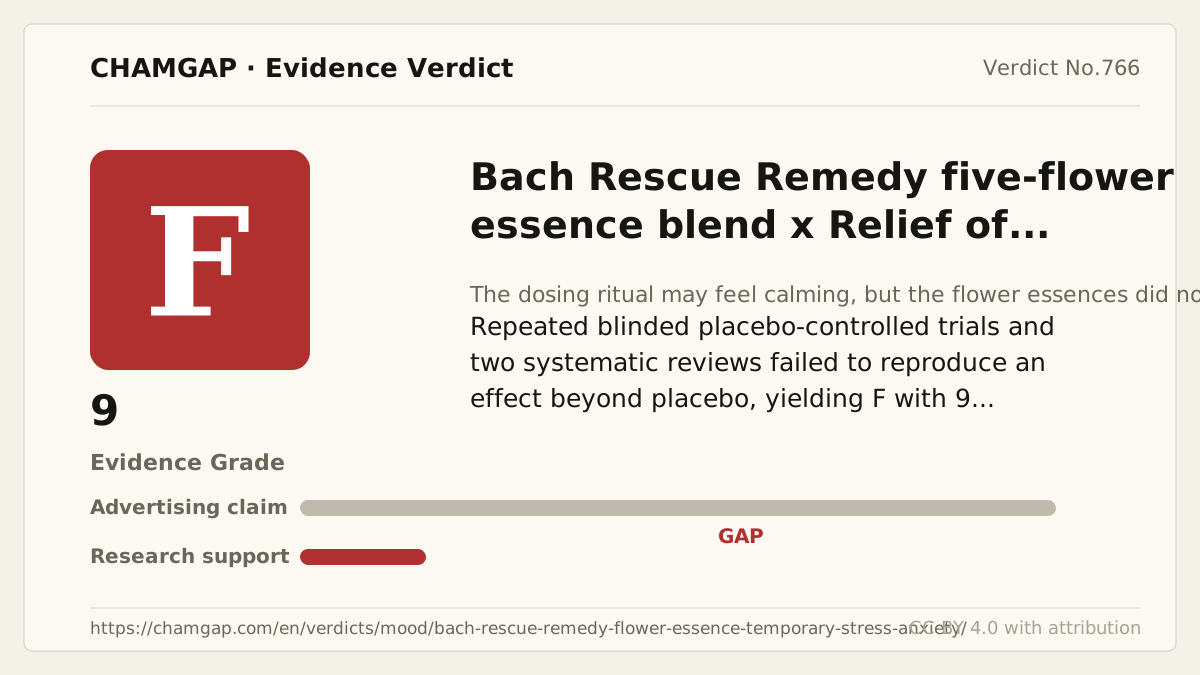
[Chamgap] Bach Rescue Remedy x relief of temporary stress and anxiety — Evidence Grade F·9. 4 cited sources checked. Source: https://chamgap.com/en/verdicts/mood/bach-rescue-remedy-flower-essence-temporary-stress-anxiety/ · CC BY 4.0CC BY 4.0 — free to use with attribution; do not distort grades, numbers, or verdict meaning.
What this document does and does not do
Chamgap is an information source. It reports what research has and has not confirmed; it does not tell readers what to take or buy. That decision belongs to readers and, when needed, medical or legal professionals. This verdict reflects literature available up to the search date and may change as new research appears. Nothing here is medical advice.