
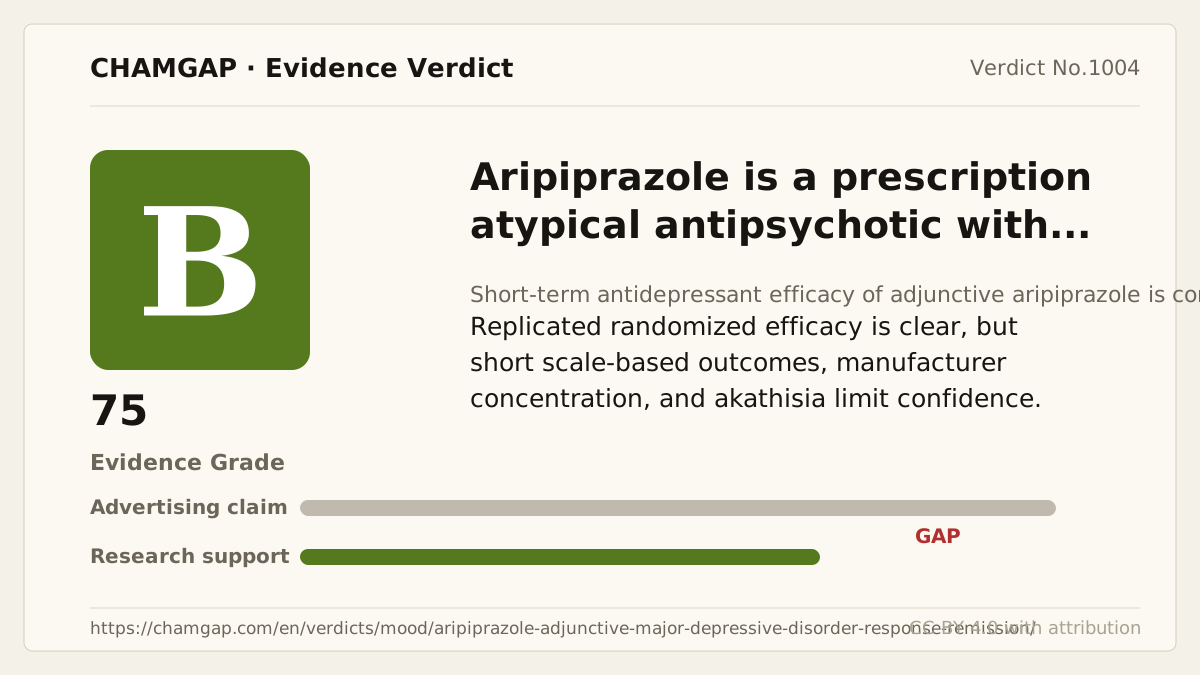
Aripiprazole is a prescription atypical antipsychotic with partial dopamine D2 receptor agonist properties.,
does it really help with The claim is improvement in depressive symptoms, response, and remission when added for adults with major depressive disorder inadequately responsive to antidepressants.?
research showsThree consecutive short placebo-controlled randomized trials consistently improved depression-rating scores, response, and remission. The trials lasted six weeks, all had manufacturer support, and the average effect was modest, supporting grade B.
ads claimFDA approval as adjunctive therapy establishes that trials exist; it does not guarantee a large effect or remission for every patient. Efficacy must be judged separately from akathisia, weight, and metabolic risk.
Useful facts when choosing a product
- Aripiprazole is an atypical antipsychotic requiring prescription and clinical monitoring.
- This verdict is limited to adjunctive use in adults with inadequate response to appropriate antidepressant therapy and does not assess antidepressant monotherapy.
- The pivotal randomized trials lasted about six weeks and do not directly establish long-term relapse prevention or sustained remission.
- Formulation, dose, concomitant antidepressant, and patient factors can alter benefits and adverse effects, so authorization cannot be equated with an individual clinical outcome.
Chamgap Semantic Classification Code
Candidate index · review held
M.aripiprazole-is-a-prescription-atypical-antipsychotic-with-partial-dopamine-d2-receptor-agonist-properties.UNK.the-claim-is-improvement-in-depressive-symptoms-response-and-remission-when-added-with-major-depressive-disorder-inadequately-responsive-to-antidepressants.improve.placeboMedicinal interventions > Aripiprazole is a prescription atypical antipsychotic with partial dopamine D2 receptor agonist properties. > Unknown > The claim is improvement in depressive symptoms, response, and remission when added with major depressive disorder inadequately responsive to antidepressants. > Improvement claim > Placebo
An automated migration candidate, not an issued permanent code; exact claim scope remains under review. This machine-generated migration candidate helps retrieval but is not a permanent assignment. The original verdict ID and URL remain authoritative.
What the research actually shows
Short-term adjunctive efficacy is consistent, but independent long-term pragmatic trials are needed for relapse prevention, functioning, quality of life, and outcomes after discontinuation.
Why this is classified as B (75)
Three six-week placebo-controlled randomized trials independently replicated benefits in MADRS scores, response, and remission, supported by a meta-analytic response OR of 2.07 and NNT of 7. This supports the upper end of psychiatric grade B with 75 points, while manufacturer funding and limited functional benefit preclude A.
Counterpoint. An NNT-scale benefit may be clinically useful in people who have not responded sufficiently to other treatment. This does not erase akathisia and metabolic burdens as separate safety concerns.
Rejudgment record. Cross-validation incorporated — Independent replication of MADRS, response, and remission benefits across three six-week placebo-controlled trials randomized after prospective antidepressant treatment, plus a meta-analytic response OR of 2.07 and NNT of 7, supports the upper end of the psychiatric prescription B range. All pivotal trials were funded by Bristol-Myers Squibb and Otsuka, and functional benefit remained limited, so A was not assigned.
Sub-claim grades by effect
This ingredient is marketed for several effects. A single overall grade blends strong and weak claims together, so each effect is graded separately here. The overall grade reflects the strongest disconfirming or core claim.
| Effect (sub-claim) | Grade | Basis |
|---|---|---|
| Improvement in depressive symptoms | B | MADRS scores fell consistently more in three six-week placebo-controlled trials, although mean differences were incremental. |
| Improved treatment response | B | Response benefit was replicated across trials and an independent meta-analysis, which estimated an NNT of 7 for aripiprazole response. |
| Improved remission rate | B | Higher remission rates than placebo recurred in all three pivotal trials, but each was a short trial with the same manufacturer sponsorship. |
Cross-check — AI research and Codex final gate
Evidence Table
| Study | Design | Sample | Funding | Endpoint | Result | Weight |
|---|---|---|---|---|---|---|
| Berman et al. first multicenter adjunctive randomized trial | Six-week double-blind trial randomizing adults with major depressive disorder inadequately responsive to prospective antidepressant therapy to adjunctive aripiprazole or placebo | 362 randomized participants | Funded by Bristol-Myers Squibb and Otsuka | Change in MADRS total score, response, and remission | Adjunctive aripiprazole significantly improved depressive symptoms, response, and remission versus placebo. | Direct randomized evidence, limited by industry support and short scale-based outcomes |
| Marcus et al. second multicenter adjunctive randomized trial | Six-week double-blind comparison of adjunctive aripiprazole versus placebo in major depressive disorder with inadequate antidepressant response | 381 randomized participants | Funded by Bristol-Myers Squibb and Otsuka | MADRS total score, response rate, and remission rate | MADRS change was -8.5 versus -5.7, response 32.4% versus 17.4%, remission 25.4% versus 15.2%, and akathisia 25.9% versus 4.2%. | Large RCT demonstrating replication and absolute effect size |
| Berman et al. third multicenter adjunctive randomized trial | Six-week double-blind trial randomizing inadequate responders after a prospective antidepressant phase to adjunctive aripiprazole or placebo | 349 randomized participants | Funded by Bristol-Myers Squibb and Otsuka | Change in MADRS total score, response, and remission | MADRS change was -10.1 versus -6.4 and remission 36.8% versus 18.9%, replicating benefit in a third trial. | Strengthens serial replication but shares the same sponsorship structure |
| Independent meta-analysis of adjunctive atypical antipsychotics | Systematic review and meta-analysis of placebo-controlled adjunctive atypical antipsychotic trials in major depressive disorder | 14 short-term trials including aripiprazole trials | Independent study; authors reported no relevant industry financial relationships | Remission, response, symptom scales, quality of life, and harms | For aripiprazole, the response odds ratio was 2.07 with NNT 7; symptom effects were small to moderate and quality-of-life or functional benefits were limited. | Independent synthesis that partly offsets sponsor concentration |
Receipt — 4 References
All 4 cited sources were verified for existence at the original page (as of 2026-07-21).
Final verification and publication gate: Codex · Evidence date: 2026-07-21 · Corrections: none
Cite this verdict
[Chamgap] Does adjunctive aripiprazole improve major depressive disorder with inadequate antidepressant response? — Evidence Grade B·75. 4 cited sources checked. Source: https://chamgap.com/en/verdicts/mood/aripiprazole-adjunctive-major-depressive-disorder-response-remission/ · CC BY 4.0CC BY 4.0 — free to use with attribution; do not distort grades, numbers, or verdict meaning.
What this document does and does not do
Chamgap is an information source. It reports what research has and has not confirmed; it does not tell readers what to take or buy. That decision belongs to readers and, when needed, medical or legal professionals. This verdict reflects literature available up to the search date and may change as new research appears. Nothing here is medical advice.