
Sugar-sweetened beverages,
does it really help with Higher incidence of liver cancer?
research showsThe grade is C with 56 points. WHI associated at least one daily serving with more liver cancer, and a 2026 pooled analysis found a per-serving association for hepatocellular carcinoma. Long follow-up was represented by one baseline food-frequency assessment, repeated diet data available in some cohorts were not used, and liver-disease confounding remained incomplete.
ads claimKorean soft and fruit drinks differ in sugar content and package size, so one bottle is not automatically the study's 355-mL serving. Nutrition labels and sugar-reduction policy address actual intake. Verdict 2081 is C with 56 points for all-cause mortality in NHS and HPFS. Watling 2026 also included NHS and HPFS, making it a different endpoint from the same data sources.
Useful facts when choosing a product
- Exposure combined regular soft drinks and fruit drinks, excluding fruit juice.
- One serving was standardized to about 355 mL.
- Neither key report randomized beverage intake.
- The first-two-year exclusion was sensitivity analysis.
- Artificially sweetened beverages were not associated with liver cancer.
Chamgap Semantic Classification Code
Candidate index · review held
F.sugar-sweetened-beverages.food.higher-incidence-of-liver-cancer.increase.UNKFoods and beverages > Sugar-sweetened beverages > Food consumption > Higher incidence of liver cancer > Increase claim > Unknown
An automated migration candidate, not an issued permanent code; exact claim scope remains under review. This machine-generated migration candidate helps retrieval but is not a permanent assignment. The original verdict ID and URL remain authoritative.
What the research actually shows
Zhao 2023 prospectively followed 98,786 postmenopausal US women; it was not randomized. The complete adjustment set was age, race/ethnicity, education, smoking, alcohol, BMI, physical activity, energy, NSAID use, cancer family history, oral contraceptive use, menopausal hormone therapy, and self-reported diabetes. Excluding the first two years was sensitivity analysis. Liver cancer was adjudicated from medical, pathology, and registry records. Soft drinks alone had HR 1.66 (0.97-2.85) and fruit drinks 1.71 (0.75-3.92). Artificially sweetened beverages were null: 11.8 versus 10.2 per 100,000 person-years, HR 1.17 (0.70-1.94). Funding listed WHI NHLBI/NIH/DHHS contracts HHSN268201600018C, HHSN268201600001C, HHSN268201600002C, HHSN268201600003C, and HHSN268201600004C; NIH/NCI R21 CA238651, R21 CA252962, R37 CA262299, U01 CA259208, and U01 CA272452; and American Cancer Society RSG-17-190-01-NEC and PASD-22-1003396-01-PASD. Watling 2026 pooled 11 prospective cohorts, 1,518,411 adults, median follow-up 17.8 years, and 2,811 liver cancers. The primary total-liver-cancer estimate per daily serving was null; HCC HR was 1.10 (1.03-1.18) and ICC HR 1.15 (1.00-1.32). Excluding SCCS yielded total-cancer HR 1.09 (1.03-1.15). Adjustment covered age, sex, race/ethnicity, BMI, activity, smoking, alcohol, aspirin/NSAIDs, diabetes, coffee, and energy when available. Funding listed CIHR Fellowship 187861, the NIH Intramural Research Program, Boston University Peter Paul Professorship, and SCCS NIH U01 CA202979.
Why this is classified as C (56)
Cancer signals recur, but one baseline dietary assessment despite repeated data in some cohorts and incomplete liver-disease confounding control are multiple avoidable weaknesses, supporting grade C.
Counterpoint. The 11-cohort primary total-liver-cancer result was null with I² 68.2%; positive findings were clearer for HCC and after excluding one cohort.
Rejudgment record. Cross-check applied — Definitions, all adjustment variables, mediator analyses, lag, absolute incidence, artificially sweetened beverages, cohort identity, and exact funding were checked in original reports.
| Endpoint | H | Hard endpoint - actual events such as death |
| Replication | R1 | Single confirmatory trial |
| Independence | I2 | Decisive evidence is publicly or non-profit funded |
| Effect size | E+ | Meets the clinically important threshold |
Stored derived and displayed grades match; this is not a current recalculation or validity check (C).
Sub-claim grades by effect
This ingredient is marketed for several effects. A single overall grade blends strong and weak claims together, so each effect is graded separately here. The overall grade reflects the strongest disconfirming or core claim.
| Effect (sub-claim) | Grade | Basis |
|---|---|---|
| Sugar-sweetened beverages increase incident liver cancer | C | An HCC signal exists, but multiple avoidable flaws and a null pooled primary total-cancer result remain. |
Cross-check — AI research and Codex final gate
Evidence Table
| Study | Design | Sample | Funding | Endpoint | Result | Weight |
|---|---|---|---|---|---|---|
| Zhao et al. 2023 | WHI prospective cohort | 98,786; 207 liver cancers | WHI NHLBI/NIH/DHHS contracts HHSN268201600018C, HHSN268201600001C, HHSN268201600002C, HHSN268201600003C, HHSN268201600004C; NIH/NCI R21 CA238651, R21 CA252962, R37 CA262299, U01 CA259208, U01 CA272452; ACS RSG-17-190-01-NEC and PASD-22-1003396-01-PASD | Adjudicated incident liver cancer | At least one daily vs no more than three monthly: HR 1.85 (1.16-2.96) | Pivotal evidence |
| Watling et al. 2026 | Pooled analysis of 11 prospective cohorts | 1,518,411; 2,811 liver cancers | CIHR Fellowship 187861; NIH Intramural Research Program; Boston University Peter Paul Professorship; SCCS NIH U01 CA202979 | Total liver cancer, HCC, and ICC | Primary total estimate null; HCC HR 1.10 (1.03-1.18) per daily serving | Supporting evidence |
Receipt — 3 References
All 3 cited sources were verified for existence at the original page (as of 2026-08-07).
Final verification and publication gate: Codex · Evidence date: 2026-08-07 · Corrections: none
Cite this verdict
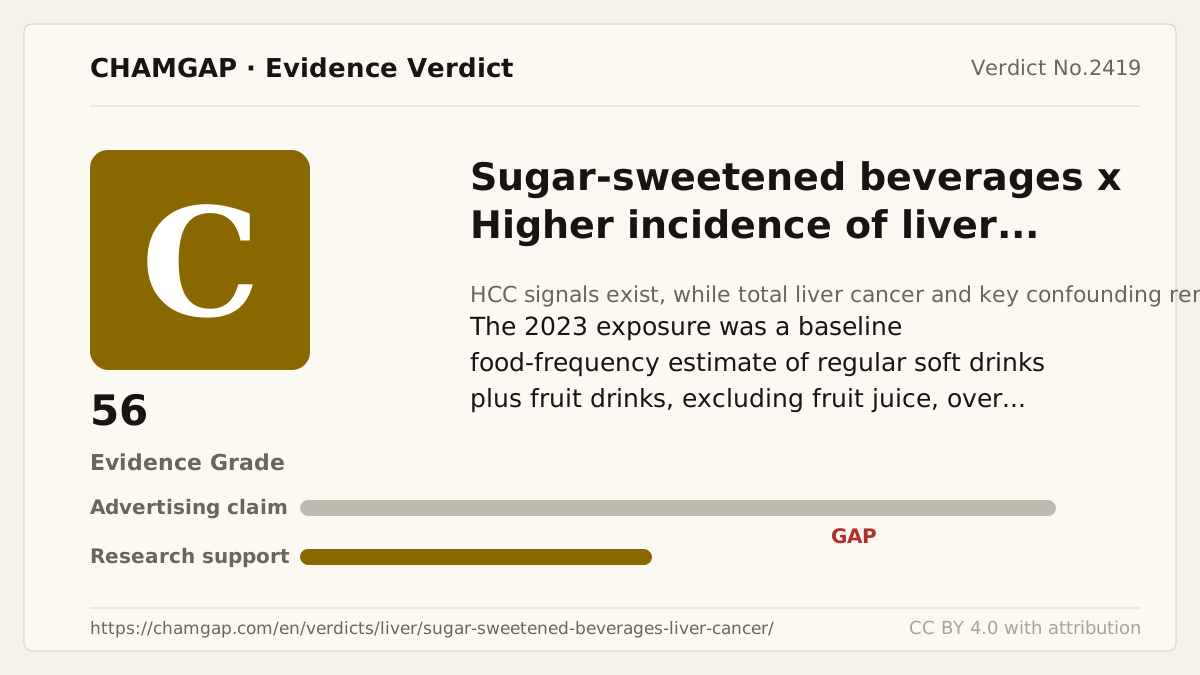
[Chamgap] Sugar-sweetened beverages × incident liver cancer — Evidence Grade C·56. 3 cited sources checked. Source: https://chamgap.com/en/verdicts/liver/sugar-sweetened-beverages-liver-cancer/ · CC BY 4.0CC BY 4.0 — free to use with attribution; do not distort grades, numbers, or verdict meaning.
What this document does and does not do
Chamgap is an information source. It reports what research has and has not confirmed; it does not tell readers what to take or buy. That decision belongs to readers and, when needed, medical or legal professionals. This verdict reflects literature available up to the search date and may change as new research appears. Nothing here is medical advice.