
Hepatitis B vaccine,
does it really help with Prevention of clinical and subclinical hepatitis B virus infection?
research showsHepatitis B vaccination is rated A because randomized trials by independent teams showed large reductions in actual clinical and subclinical infection. Szmuness 1980 randomized 1,083 participants and used a life-table analysis censoring dropouts; cumulative infection was 1.4% to 3.4% with vaccine versus 18% to 27% with placebo (P<0.0001). The fully independent Crosnier 1981 trial confirmed actual infection in 6 of 164 versus 19 of 154 participants (P<0.005).
ads claimPromotion can focus on antibody response, but this verdict rests on reduced clinical or subclinical HBV infection. Historical plasma-derived-vaccine figures should not be presented as the identical absolute effect for every modern product and population.
Useful facts when choosing a product
- The 1980 pivotal trial used a plasma-derived inactivated HBsAg vaccine; current products are predominantly recombinant HBsAg vaccines.
- The pivotal trial received support from Merck Sharp & Dohme and United States NIH grant HL-09011.
- This verdict concerns prevention of hepatitis B infection and does not borrow evidence from MMR, varicella, BCG, or other vaccines.
Chamgap Semantic Classification Code
Candidate index · review held
M.hepatitis-b-vaccine.UNK.clinical-and-subclinical-hepatitis-b-virus-infection.prevent.placeboMedicinal interventions > Hepatitis B vaccine > Unknown > clinical and subclinical hepatitis B virus infection > Occurrence-prevention claim > Placebo
An automated migration candidate, not an issued permanent code; exact claim scope remains under review. This machine-generated migration candidate helps retrieval but is not a permanent assignment. The original verdict ID and URL remain authoritative.
What the research actually shows
Szmuness 1980 randomized 1,083 participants and lost 167, or 15.42%, to follow-up; losses were balanced at 78 of 549 vaccine recipients and 89 of 534 placebo recipients. A life-table analysis censored dropouts and used a log-rank comparison. At 18 months there were 7 versus 45 clinical hepatitis cases, 11 versus 70 HBsAg-positive cases, and 14 versus 73 total HBV events excluding isolated anti-HBc. Depending on the definition, cumulative infection was 1.4% to 3.4% versus 18% to 27%, P<0.0001, with maximum efficacy of 92.3%. Crosnier 1981 enrolled 367 staff across 48 hemodialysis units; 318 completed, a loss of 49 or 13.35%, and actual infection was 6 of 164 (3.66%) versus 19 of 154 (12.34%), P<0.005. Its author team was wholly independent of Szmuness. The 1982 United States trial randomized 865 participants and found infection of 2.2% versus 9.9%, P<0.01, but overlapping authors with Szmuness 1980 mean it is not independent replication. Actual HBV infection was the primary efficacy endpoint in all three trials; antibody response was a separate immunogenicity result.
Why this is classified as A (86)
The large Szmuness 1980 effect used actual infection, and the fully independent Crosnier 1981 trial replicated it even if the trial with follow-up limitations is set aside. Large effect and independent replication are satisfied, but Szmuness had mixed Merck and NIH/NHLBI support and Crosnier's monetary funding source could not be confirmed, giving A with 86 points.
Counterpoint. Some immunocompromised people respond inadequately, and protection depends on timing and completion of vaccination. Individual schedules and post-exposure management require clinical advice.
Rejudgment record. Cross-check applied — Large randomized effects on actual HBV infection, replicated by a Crosnier author team fully independent of Szmuness, with mixed funding reflected
| Endpoint | H | Hard endpoint - actual events such as death |
| Replication | R2 | Independently replicated across trials |
| Independence | I1 | Mixed funding sources |
| Effect size | E+ | Meets the clinically important threshold |
Stored derived and displayed grades match; this is not a current recalculation or validity check (A).
Sub-claim grades by effect
This ingredient is marketed for several effects. A single overall grade blends strong and weak claims together, so each effect is graded separately here. The overall grade reflects the strongest disconfirming or core claim.
| Effect (sub-claim) | Grade | Basis |
|---|---|---|
| Prevention of clinical hepatitis B | A | Large placebo-controlled trials substantially reduced the infection outcome that included clinical hepatitis. |
| Prevention of subclinical HBV infection | A | The principal efficacy outcome including antigenemia and serologic infection succeeded. |
| Prevention of HBV infection in high-risk health care workers | A | The 865-person trial across 43 hemodialysis units found infection in 2.2% versus 9.9%. |
Cross-check — AI research and Codex final gate
Evidence Table
| Study | Design | Sample | Funding | Endpoint | Result | Weight |
|---|---|---|---|---|---|---|
| Szmuness W et al. 1980 | Randomized double-blind placebo-controlled trial | 1,083 randomized (549 vaccine and 534 placebo); 167 lost to follow-up (15.42%) | Merck Sharp & Dohme Research Laboratories and United States NIH NHLBI grant HL-09011 | Clinical or subclinical HBV infection | A dropout-censored life-table and log-rank analysis found 1.4% to 3.4% with vaccine versus 18% to 27% with placebo, P<0.0001; maximum efficacy was 92.3%. | Pivotal large actual-infection trial |
| Crosnier J et al. 1981 | Randomized double-blind placebo-controlled trial across 48 hemodialysis units | 367 enrolled; 318 completed, with 49 dropouts (13.35%) | Institut Pasteur vaccine used; monetary funding source not confirmed | Actual HBV infection | Infection occurred in 6 of 164 vaccine recipients (3.66%) versus 19 of 154 placebo recipients (12.34%), P<0.005. | Replication by an author team fully independent of Szmuness |
| Szmuness W et al. 1982 | Randomized double-blind placebo-controlled trial across 43 hemodialysis units | 865 randomized; number lost to follow-up not confirmed | Not identified in the abstract; Heptavax-B product trial | HBV infection with or without hepatitis | Infection occurred in 2.2% with vaccine versus 9.9% with placebo, P<0.01, replicating prevention. | Supportive replication with authors overlapping Szmuness 1980 |
Receipt — 3 References
All 3 cited sources were verified for existence at the original page (as of 2026-07-24).
Final verification and publication gate: Codex · Evidence date: 2026-07-24 · Corrections: none
Cite this verdict
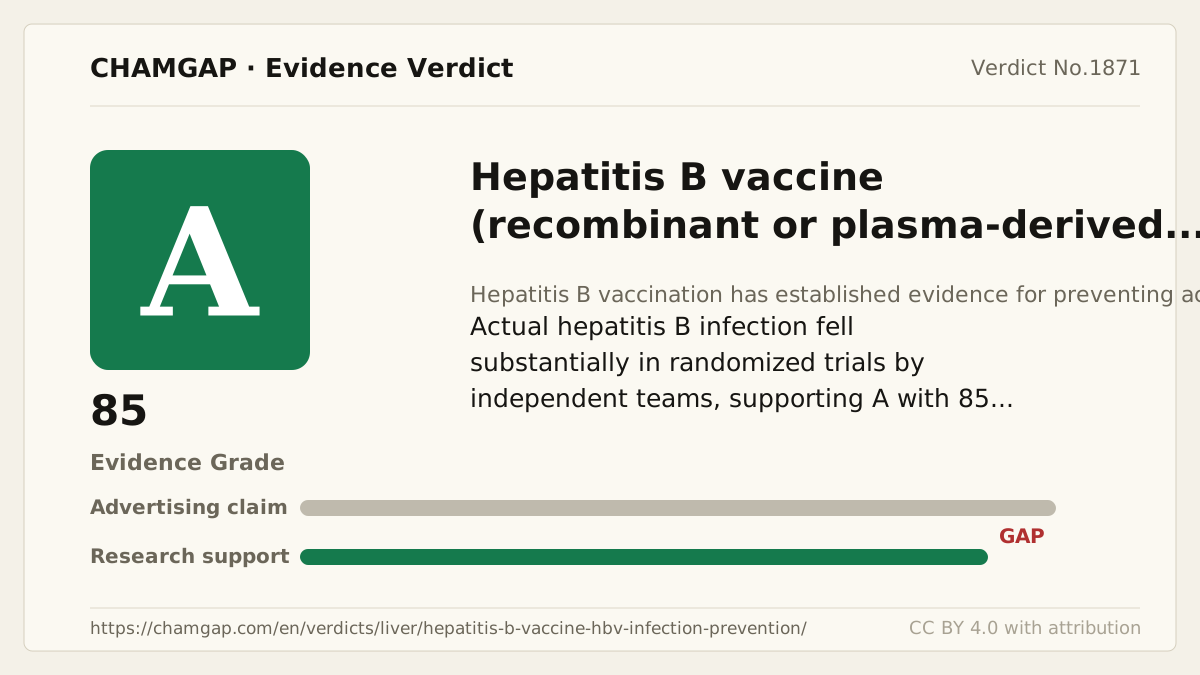
[Chamgap] Hepatitis B vaccine x prevention of hepatitis B infection — Evidence Grade A·86. 3 cited sources checked. Source: https://chamgap.com/en/verdicts/liver/hepatitis-b-vaccine-hbv-infection-prevention/ · CC BY 4.0CC BY 4.0 — free to use with attribution; do not distort grades, numbers, or verdict meaning.
What this document does and does not do
Chamgap is an information source. It reports what research has and has not confirmed; it does not tell readers what to take or buy. That decision belongs to readers and, when needed, medical or legal professionals. This verdict reflects literature available up to the search date and may change as new research appears. Nothing here is medical advice.