
Six-month AFP plus ultrasound surveillance,
does it really help with Reduced hepatocellular-carcinoma mortality?
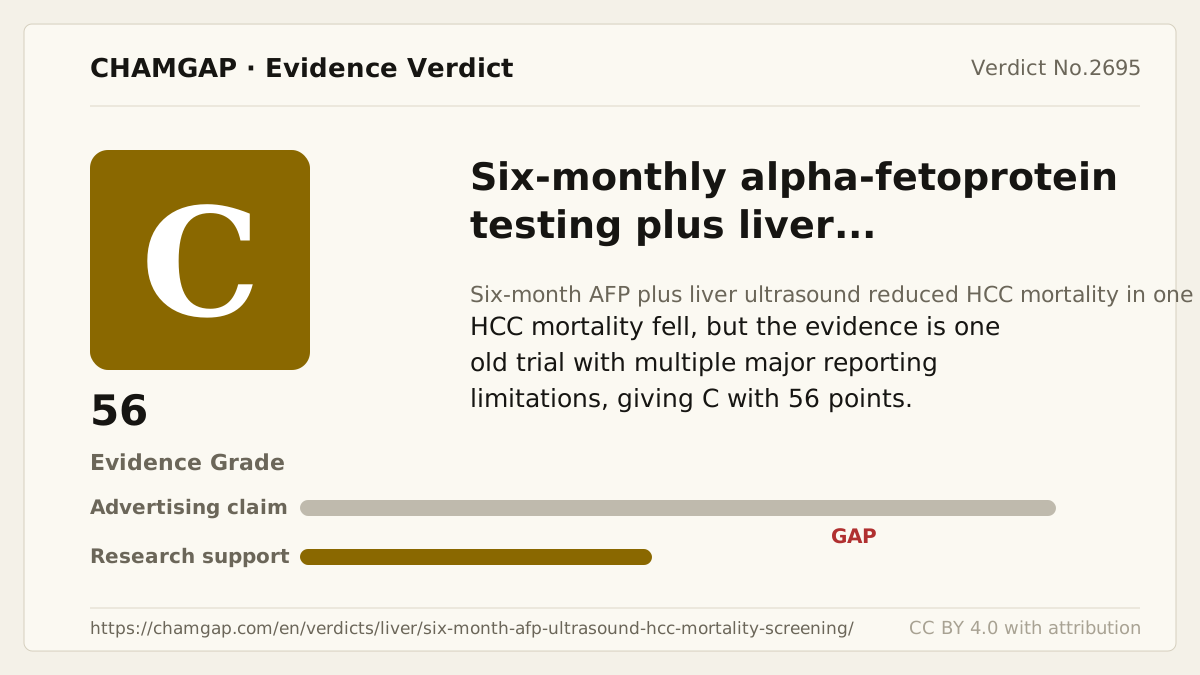
research showsThe grade is C with 56 points. In the Shanghai cluster-randomized trial, HCC deaths were 32/9,373 versus 54/9,443, mortality rate ratio 0.63 (95% CI 0.41 to 0.98). Weak allocation, masking, and follow-up reporting limit certainty.
ads claimScreening did not itself treat cancer. The result reflects a 1990s Shanghai program linking earlier detection to appropriate treatment such as resection.
Useful facts when choosing a product
- Participants were offered AFP testing and real-time liver ultrasonography every six months for five to ten rounds.
- Completion of offered screening was 58.2%.
- No trial registration exists because the study predates routine registration.
Chamgap Semantic Classification Code
Candidate index · review held
P.six-alpha-fetoprotein-testing-plus-liver-ultrasonography-surveillance-in-adults-at-high-risk-from-hepatitis-b-or-chronic-hepatitis.diagnostic.hepatocellular-carcinoma-mortality.reduce.UNKProcedures, devices and tests > Six- alpha-fetoprotein testing plus liver ultrasonography surveillance in adults at high risk from hepatitis B or chronic hepatitis > Diagnostic or screening > hepatocellular-carcinoma mortality > Reduction claim > Unknown
An automated migration candidate, not an issued permanent code; exact claim scope remains under review. This machine-generated migration candidate helps retrieval but is not a permanent assignment. The original verdict ID and URL remain authoritative.
What the research actually shows
More than 300 factories, enterprises, and schools were used as clusters. A total of 19,200 people were allocated, and the final report presented 18,816 after 384 intervention-side consent refusals. The paper only states simple cluster sampling and does not report sequence generation or concealment. Participants and clinicians were unmasked, and masking of cause-of-death assessment was not reported. The final report used intention-to-treat analysis but did not report the missing-data method or the number completing follow-up. HCC mortality was named as primary, but no prospective registry record exists because the trial predates routine registration. Allocation, adjudicator masking, and follow-up or missing-data reporting create at least two avoidable limitations. No funding statement for this trial was found. Funding independence was therefore not counted as a strength.
Why this is classified as C (56)
HCC mortality was significantly reduced, but the evidence is one cluster trial with unknown funding and multiple allocation, masking, and follow-up limitations, giving C with 56 points.
Counterpoint. Modern eligibility, imaging quality, and downstream treatment differ, requiring individualized hepatology assessment.
Rejudgment record. Cross-check applied — Cross-checked the 2004 article and systematic review for cluster allocation and final-analysis counts, HCC mortality, adherence, allocation, masking, follow-up reporting, and absence of a funding statement
| Endpoint | H | Hard endpoint - actual events such as death |
| Replication | R1 | Single confirmatory trial |
| Independence | I1 | Mixed funding sources |
| Effect size | E+ | Meets the clinically important threshold |
Stored derived and displayed grades match; this is not a current recalculation or validity check (C).
Sub-claim grades by effect
This ingredient is marketed for several effects. A single overall grade blends strong and weak claims together, so each effect is graded separately here. The overall grade reflects the strongest disconfirming or core claim.
| Effect (sub-claim) | Grade | Basis |
|---|---|---|
| Six-month AFP plus liver ultrasound surveillance reduces HCC mortality | C | The mortality rate ratio was 0.63 (0.41 to 0.98). |
Cross-check — AI research and Codex final gate
Evidence Table
| Study | Design | Sample | Funding | Endpoint | Result | Weight |
|---|---|---|---|---|---|---|
| Zhang BH, Yang BH, Tang ZY. 2004 | Cluster-randomized trial using more than 300 institutions as clusters | 19,200 allocated; 18,816 in the final report (9,373/9,443) | Funding could not be verified because the article contains no funding statement | Hepatocellular-carcinoma mortality | 32/9,373 versus 54/9,443; 83.2 versus 131.5 per 100,000 person-years; mortality rate ratio 0.63 (95% CI 0.41 to 0.98) | Pivotal single trial with major methods-reporting limitations |
Receipt — 1 References
All 1 cited sources were verified for existence at the original page (as of 2026-08-15).
Final verification and publication gate: Codex · Evidence date: 2026-08-15 · Corrections: none
Cite this verdict
[Chamgap] Six-month AFP plus ultrasound surveillance x HCC mortality — Evidence Grade C·56. 1 cited sources checked. Source: https://chamgap.com/en/verdicts/liver/six-month-afp-ultrasound-hcc-mortality-screening/ · CC BY 4.0CC BY 4.0 — free to use with attribution; do not distort grades, numbers, or verdict meaning.
What this document does and does not do
Chamgap is an information source. It reports what research has and has not confirmed; it does not tell readers what to take or buy. That decision belongs to readers and, when needed, medical or legal professionals. This verdict reflects literature available up to the search date and may change as new research appears. Nothing here is medical advice.