
Resistant starch,
does it really help with Reduction of intrahepatic triglyceride and liver fat in patients with MASLD/NAFLD?
research showsResistant starch is rated C for reducing intrahepatic triglyceride in patients with MASLD/NAFLD. In a four-month randomized controlled trial analyzing 196 participants, intrahepatic triglyceride content fell by an absolute 9.08 percentage points more than with control starch, and the difference remained 5.89 percentage points after adjustment for weight loss. Signals for liver enzymes, body weight, and microbiome mediation were also observed, but direct evidence is essentially limited to this single trial and to imaging and metabolic surrogate outcomes. Liver fibrosis, cirrhosis, liver-related events, and mortality were not assessed.
ads claimMarketing expands microbiome changes and a liver-fat signal into treatment of fatty liver, liver detoxification, or prevention of cirrhosis. Direct evidence is limited to four-month changes in intrahepatic triglyceride and selected metabolic markers.
Useful facts when choosing a product
- RS2 is a starch form that escapes small-intestinal digestion, reaches the colon, and is fermented by gut microbes; high-amylose maize starch and raw potato starch are common sources.
- The pivotal NAFLD trial used 40 g of resistant starch per day in two divided portions for four months and provided an isocaloric digestible starch to controls.
- The resistant-starch type and measured resistant-starch content vary with the source material and processing, so an equal weight of ordinary starch is not equivalent.
- As a fermentable carbohydrate, resistant starch can cause gas, bloating, abdominal discomfort, and bowel changes, while adverse-event reporting across trials has not always been complete.
Chamgap Semantic Classification Code
Candidate index · review held
S.resistant-starch.UNK.intrahepatic-triglyceride-and-liver-fat-with-masld-nafld.reduce.UNKSupplements and nutraceuticals > Resistant starch > Unknown > intrahepatic triglyceride and liver fat with MASLD/NAFLD > Reduction claim > Unknown
An automated migration candidate, not an issued permanent code; exact claim scope remains under review. This machine-generated migration candidate helps retrieval but is not a permanent assignment. The original verdict ID and URL remain authoritative.
What the research actually shows
Ni and colleagues randomized patients with NAFLD to resistant starch or an energy-matched control starch for four months. The analysis included 99 resistant-starch and 97 control participants, and resistant starch reduced intrahepatic triglyceride, body weight, and liver enzymes. Multi-omics analyses linked changes in Bacteroides stercoris and branched-chain amino acids with liver-fat and enzyme changes, while mouse-transfer experiments added mechanistic plausibility. The study nevertheless remains the central completed human liver-fat trial and did not test histologic fibrosis, cirrhosis progression, liver-related hospitalization, or mortality. A meta-analysis of RS2 metabolic effects addressed other populations and endpoints and was not treated as an independent replication of the liver-fat result.
Why this is classified as C (52)
A four-month randomized controlled trial analyzing 196 participants found a significant reduction in intrahepatic triglyceride even after adjustment for weight loss. The credible controlled design supports the score, but a single trial, imaging and metabolic surrogates, and no hard outcomes limit the verdict to C with 52 points.
Counterpoint. The observed effect is a liver-fat surrogate; changes in fibrosis, cirrhosis, liver-related events, and mortality remain untested.
Rejudgment record. New verdict — A four-month randomized controlled trial of about 200 participants found lower intrahepatic triglyceride after adjustment for weight loss, but no direct replication exists and only imaging and metabolic surrogates were assessed, so the rule ① ceiling of C was applied
Sub-claim grades by effect
This ingredient is marketed for several effects. A single overall grade blends strong and weak claims together, so each effect is graded separately here. The overall grade reflects the strongest disconfirming or core claim.
| Effect (sub-claim) | Grade | Basis |
|---|---|---|
| Reduction of intrahepatic triglyceride in MASLD/NAFLD | C | A four-month randomized trial found a significant reduction versus control starch, but it is a single imaging-surrogate trial. |
| Improvement in liver enzymes and body weight in MASLD/NAFLD | C | Both improved in the pivotal trial, but they were secondary metabolic surrogates without independent replication. |
| Reduction in liver fibrosis, cirrhosis, or liver-related mortality | ? | No completed direct human intervention evidence assessing these hard outcomes was identified. |
Cross-check — AI research and Codex final gate
Evidence Table
| Study | Design | Sample | Funding | Endpoint | Result | Weight |
|---|---|---|---|---|---|---|
| Ni Y et al. 2023 | Four-month randomized control-starch trial with multi-omics analyses | 196 analyzed patients with NAFLD; 99 resistant starch and 97 control | Chinese national and local public research grants and academic support | Imaging-based intrahepatic triglyceride content, weight, liver enzymes, microbiome, and metabolites | Resistant starch reduced intrahepatic triglyceride by an absolute 9.08 percentage points versus control, with a 5.89-point difference after weight-loss adjustment. | Pivotal direct positive randomized trial with surrogate outcomes |
| Snelson M et al. 2019 | Systematic review and meta-analysis of randomized RS2 trials | Up to 11 randomized trials by metabolic outcome in healthy, obese, metabolic-syndrome, and diabetic populations | Academic research with no specific commercial funding reported | Glucose, insulin resistance, lipids, body weight, and tolerability | RS2 metabolic effects varied by endpoint and population, and the included studies were not independent replications of liver fat in NAFLD. | Scope and safety context, not direct liver-fat evidence |
Receipt — 2 References
All 2 cited sources were verified for existence at the original page (as of 2026-07-23).
Final verification and publication gate: Codex · Evidence date: 2026-07-23 · Corrections: none
Cite this verdict
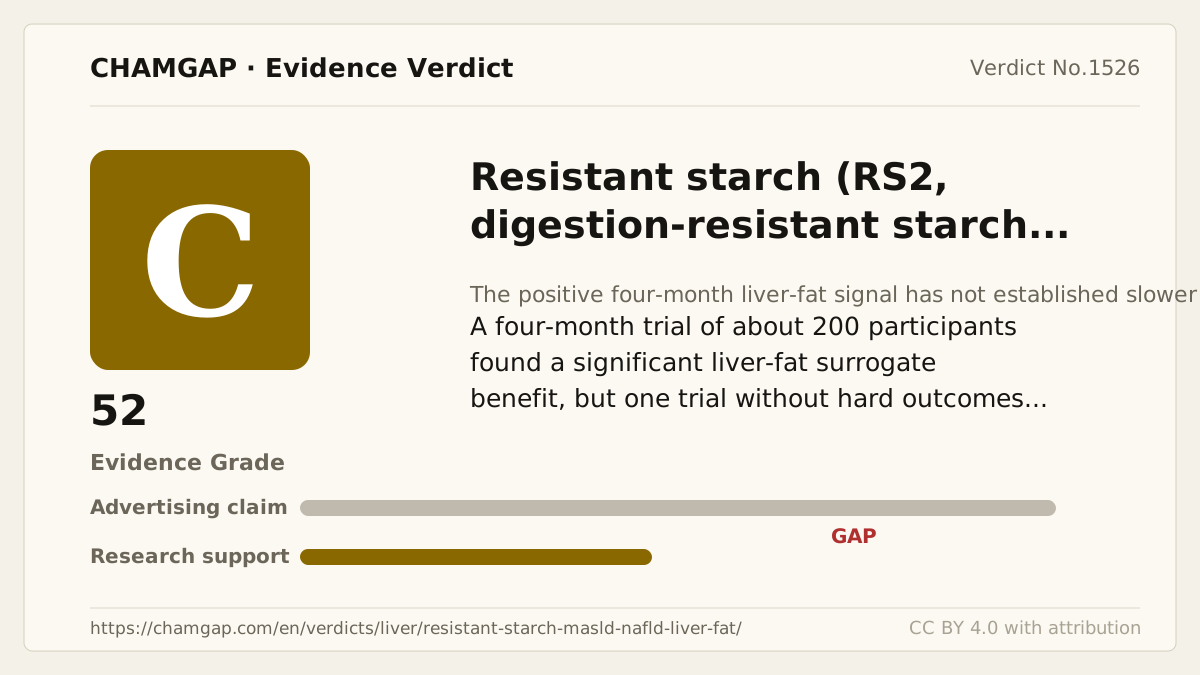
[Chamgap] Resistant starch x reduction of intrahepatic triglyceride and liver fat in MASLD/NAFLD — Evidence Grade C·52. 2 cited sources checked. Source: https://chamgap.com/en/verdicts/liver/resistant-starch-masld-nafld-liver-fat/ · CC BY 4.0CC BY 4.0 — free to use with attribution; do not distort grades, numbers, or verdict meaning.
What this document does and does not do
Chamgap is an information source. It reports what research has and has not confirmed; it does not tell readers what to take or buy. That decision belongs to readers and, when needed, medical or legal professionals. This verdict reflects literature available up to the search date and may change as new research appears. Nothing here is medical advice.