
Peginterferon alfa-2a,
does it really help with Sustained viral suppression and HBeAg seroconversion after a finite 48-week course in selected patients with chronic hepatitis B?
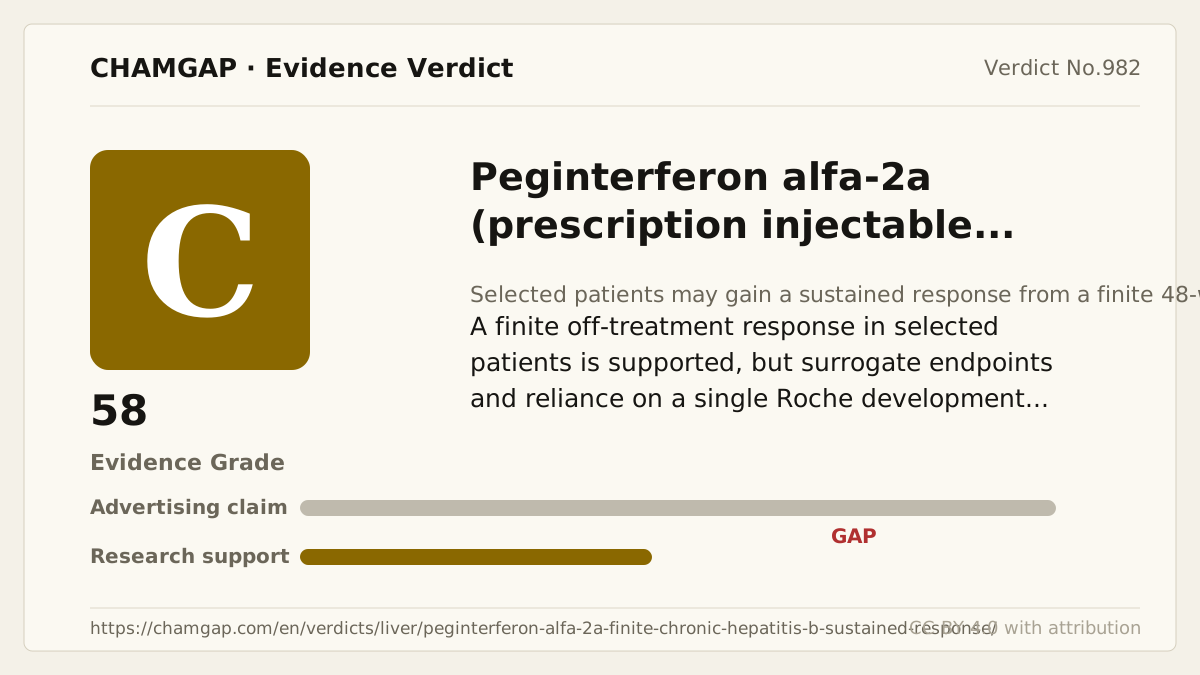
research showsThis claim is rated C. Peginterferon alfa-2a can induce off-treatment HBeAg seroconversion and viral suppression after a finite 48-week course in a subset of selected patients with chronic hepatitis B. In a randomized trial of 814 HBeAg-positive patients, HBeAg seroconversion was 32% versus 19% with lamivudine, and HBV DNA below 100,000 copies per milliliter was 32% versus 22%, 24 weeks after treatment. These are serologic and virologic surrogate endpoints, not direct outcomes such as cirrhosis, liver cancer, or death, and the evidence is centered on a single Roche development program. Boundary rule 1 therefore caps the grade at C. The finite-treatment option and evidence of off-treatment response in selected patients remain meaningful, but they do not establish improvement in hard clinical outcomes. Influenza-like symptoms, cytopenias, depression and other neuropsychiatric effects, thyroid or autoimmune exacerbation, and possible hepatic deterioration are major safety issues separate from efficacy.
ads claimMarketing may describe the regimen as a 48-week cure or viral eradication, while the evidence supports an off-treatment response in a selected minority. HBsAg loss is rarer, the treatment is unsuitable for many patients, and its toxicity means it is not inherently safer or more convenient than nucleos(t)ide analogues.
Useful facts when choosing a product
- Peginterferon alfa-2a is a specialist-prescribed subcutaneous biologic, and a representative adult chronic-hepatitis-B regimen is 180 micrograms once weekly for 48 weeks.
- Before treatment, clinicians assess liver-disease stage, HBV DNA, HBeAg, HBsAg, alanine aminotransferase, blood counts, thyroid and kidney function, mental health, autoimmune and cardiovascular conditions, and pregnancy potential, with repeated monitoring during treatment.
- Unlike long-term persistent suppression with TDF, TAF, or entecavir, peginterferon is a finite strategy for patients with a favorable chance of off-treatment response; a liver specialist must apply contraindications, response predictors, and futility stopping rules.
- Influenza-like symptoms, fatigue, injection reactions, neutropenia, thrombocytopenia, depression including suicidal thinking, thyroid or autoimmune exacerbation, and hepatic deterioration can occur and severe symptoms require immediate clinical attention.
Chamgap Semantic Classification Code
Candidate index · review held
M.peginterferon-alfa-2a.UNK.sustained-viral-suppression-and-hbeag-seroconversion-after-a-finite-course-in-selected-patients-with-chronic-hepatitis-b.assess.MULTIMedicinal interventions > Peginterferon alfa-2a > Unknown > Sustained viral suppression and HBeAg seroconversion after a finite course in selected patients with chronic hepatitis B > Association or change assessment > Multiple: primary unresolved
An automated migration candidate, not an issued permanent code; exact claim scope remains under review. This machine-generated migration candidate helps retrieval but is not a permanent assignment. The original verdict ID and URL remain authoritative.
What the research actually shows
Lau and colleagues assigned 814 HBeAg-positive patients with chronic hepatitis B to peginterferon alfa-2a alone, peginterferon plus lamivudine, or lamivudine alone for 48 weeks followed by 24 untreated weeks. Peginterferon monotherapy outperformed lamivudine for seroconversion and off-treatment viral suppression, but both key rates were 32%. A Brunetto follow-up analysis of the 537-participant HBeAg-negative parent trial found that on-treatment HBsAg decline predicted HBV DNA suppression six months after treatment and HBsAg clearance at three years, underscoring response-guided selection. The 2025 EASL guideline defines nucleos(t)ide analogues as long-term persistent suppression and PEG-IFN as a usually 48-week induction of off-treatment response. The TDF 652 grade B and TAF 902 and entecavir 810 grade C verdicts concern the long-term nucleos(t)ide-analogue axis, not this finite cure-oriented question.
Why this is classified as C (58)
An 814-participant randomized trial showed superior HBeAg seroconversion and off-treatment HBV DNA suppression after a 48-week course, supporting a finite response-induction strategy in selected patients. Both key outcomes are serologic or virologic surrogates, however, and the evidence is centered on a single Roche development program. Boundary rule 1 therefore yields C with 58 points. Safety requires strong caution independent of the efficacy grade.
Counterpoint. Candidates are not all people who carry hepatitis B but selected patients defined by disease phase and response predictors; unsupervised initiation or discontinuation can precipitate harm.
Rejudgment record. Cross-check revision — HBeAg and HBV DNA are surrogate endpoints and the evidence is centered on a single Roche development program, so boundary rule 1 caps the grade at C. This is equitable with TAF verdict 902 at C and entecavir verdict 810 at C; TDF verdict 652 is B because it has histologic evidence on fibrosis
Sub-claim grades by effect
This ingredient is marketed for several effects. A single overall grade blends strong and weak claims together, so each effect is graded separately here. The overall grade reflects the strongest disconfirming or core claim.
| Effect (sub-claim) | Grade | Basis |
|---|---|---|
| HBeAg seroconversion after a finite 48-week course | C | In an 814-participant trial, the rate was 32% at 24 weeks off treatment versus 19% with lamivudine, but most patients did not respond. |
| Sustained viral suppression after a finite 48-week course | C | Off-treatment HBV DNA suppression exceeded the comparator but was an approximately 32% virologic endpoint rather than a hard clinical outcome. |
Cross-check — AI research and Codex final gate
Evidence Table
| Study | Design | Sample | Funding | Endpoint | Result | Weight |
|---|---|---|---|---|---|---|
| Lau GKK et al. 2005 | Multinational randomized active-controlled trial | 814 patients with HBeAg-positive chronic hepatitis B | Registration trial sponsored by F. Hoffmann-La Roche | HBeAg seroconversion and HBV DNA suppression after 48 weeks of treatment and 24 weeks off treatment | Peginterferon monotherapy achieved 32% HBeAg seroconversion and 32% HBV DNA below 100,000 copies per milliliter versus 19% and 22% with lamivudine. | Key large direct randomized trial |
| Brunetto MR et al. 2009 | Post-treatment biomarker follow-up analysis of a large multinational randomized trial | Serum from 386 of 537 participants in the HBeAg-negative parent trial | Data from a Roche-sponsored parent trial | On-treatment HBsAg decline, HBV DNA suppression six months after treatment, and HBsAg clearance at three years | End-of-treatment HBsAg level and decline distinguished the likelihood of off-treatment suppression and later HBsAg clearance. | Supporting evidence for response selection and durability |
| European Association for the Study of the Liver. 2025 guideline | Evidence-based clinical practice guideline | Synthesis of chronic-HBV treatment evidence | European Association for the Study of the Liver guideline program | Long-term nucleos(t)ide-analogue suppression and finite PEG-IFN response-induction strategies | PEG-IFN was defined as a usually 48-week strategy intended to induce a durable off-treatment response in selected patients. | Current treatment context and patient-selection evidence |
Receipt — 3 References
All 3 cited sources were verified for existence at the original page (as of 2026-07-21).
Final verification and publication gate: Codex · Evidence date: 2026-07-21 · Corrections: none
Cite this verdict
[Chamgap] Peginterferon alfa-2a x sustained response after finite therapy for chronic hepatitis B — Evidence Grade C·58. 3 cited sources checked. Source: https://chamgap.com/en/verdicts/liver/peginterferon-alfa-2a-finite-chronic-hepatitis-b-sustained-response/ · CC BY 4.0CC BY 4.0 — free to use with attribution; do not distort grades, numbers, or verdict meaning.
What this document does and does not do
Chamgap is an information source. It reports what research has and has not confirmed; it does not tell readers what to take or buy. That decision belongs to readers and, when needed, medical or legal professionals. This verdict reflects literature available up to the search date and may change as new research appears. Nothing here is medical advice.